Artwork
Palazzo Maccarani Stati in Sant'Eustachio
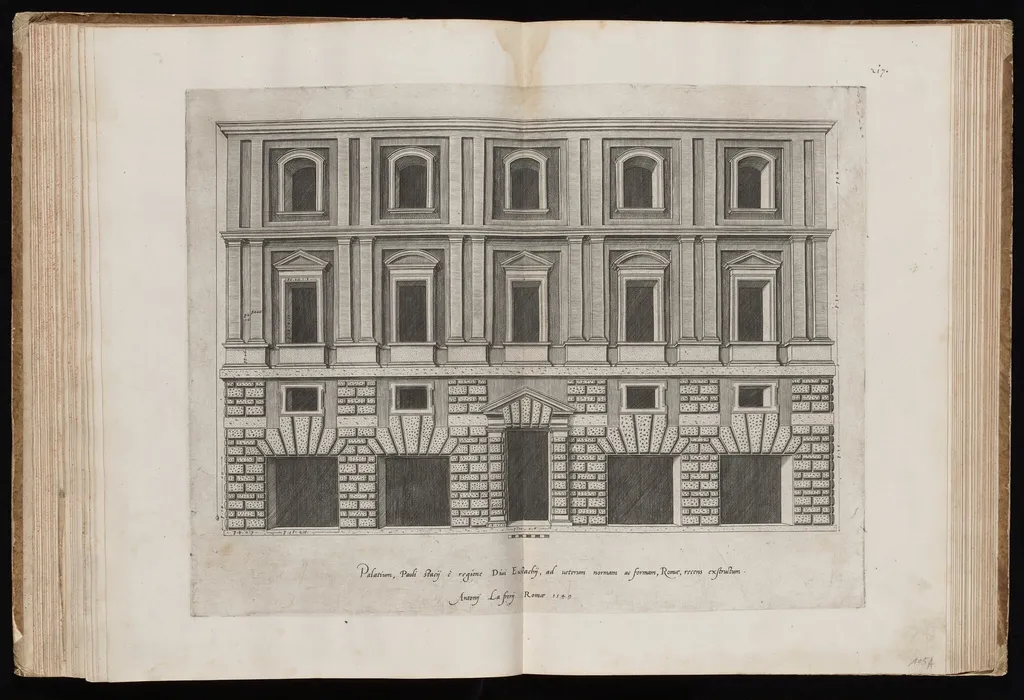
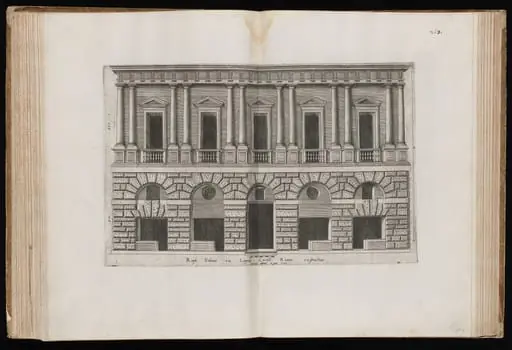
Palazzo Maccarani Stati in Sant'Eustachio is an ink print by the Renaissance artist Italian 16th Century. It dates from 1549 and is held in the collection of the National Gallery of Art. This 16th-century engraving depicts the Palazzo Maccarani Stati, a Roman building constructed in 1549.
About this work
This engraving shows a three-story palace with arched and triangular windows stacked in a neat pattern.
This engraving shows a three-story palace with arched and triangular windows stacked in a neat pattern. The front door sits below a balcony with a small roof.
Built in 1549, this is one of Giulio Romano’s rare surviving buildings. He worked mostly as a painter and designer, but this palace proves his skill in stone.
Check out the cross-hatching in the shadows—it gives depth without any color. Look up the technique next.
Overview
This 16th-century engraving depicts the Palazzo Maccarani Stati, a Roman building constructed in 1549. Located near the church of Sant'Eustachio, it is among the few surviving architectural works by Giulio Romano, who was primarily known for painting and decorative design. The print captures the palace’s three-story facade with precise linear detail, emphasizing its rhythmic window arrangement and subtle shadowing.
Subject & Meaning
The palace reflects the transition from High Renaissance to Mannerist architecture in Rome. Its facade, with alternating arched and triangular pediments over windows, demonstrates a deliberate play on classical forms. Though modest in scale, the building asserts civic presence through symmetry and refined proportion, signaling the patron’s status without overt grandeur.
Technique & Style
The engraving employs fine cross-hatching to model light and depth, a hallmark of printmaking in the period. Without color, the artist relies on line weight and density to suggest texture on stone surfaces and the recessed qualities of balconies and windows. The composition is orderly, with clear horizontal divisions and a centered entrance, reinforcing architectural clarity.
History & Provenance
Commissioned by the Maccarani Stati family, the palace was completed in 1549, near the end of Giulio Romano’s career. He had previously worked under Raphael and later at the Palazzo Te in Mantua. This building stands as one of his few executed urban palaces in Rome, making it a rare physical testament to his architectural vision beyond fresco and interior design.
Context
In mid-16th century Rome, aristocratic families commissioned palazzi to assert influence amid the city’s evolving urban fabric. Romano’s design, though restrained, aligned with contemporary trends favoring rhythmic fenestration and classical order. The building’s survival offers insight into how Mannerist principles were adapted to domestic architecture outside grand courtly settings.
Legacy
Though overshadowed by Romano’s larger projects, the Palazzo Maccarani Stati remains a documented example of his architectural hand. The engraving preserves its original appearance, aiding later scholars in understanding how his stylistic language translated into stone. It continues to be studied as a subtle yet significant intervention in Rome’s Renaissance streetscape.
Artist & collection

Artist
A 16th-century Italian sculptor left us small bronze works in dark brown and gold.