Artwork
Ornament Plate with Armor and Musical Instruments
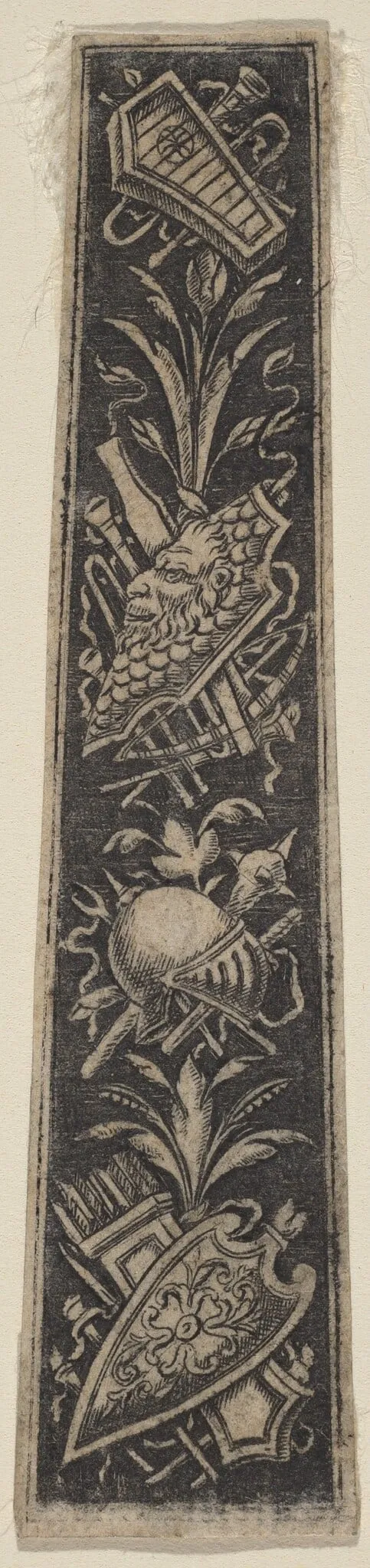
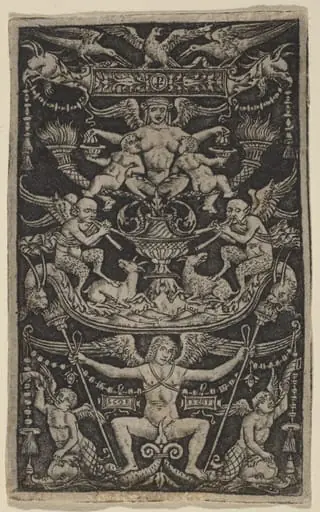
Ornament Plate with Armor and Musical Instruments is a print by the Romanticist artist Italian 18th Century. It dates from 1800 and is held in the collection of the National Gallery of Art. The work is a narrow, elongated plate rendered in the niello technique, presenting a darkened surface punctuated by stark black lines.
About this work
The technique used here is called *niello*, where metal is inlaid with black material to create deep, rich details.
This image shows a long, narrow design on a dark background. There’s a helmet with a plume, crossed swords, and a cluster of grapes. Below that, a lyre and a shield with a starburst shape sit among swirling vines and leaves. The whole thing looks carved or etched in deep black lines.
The mix of armor, grapes, and music hints at a story—maybe about war, peace, or art. The technique used here is called *niello*, where metal is inlaid with black material to create deep, rich details.
If you like this style, look up Italian 18th Century artists next.
Overview
The work is a narrow, elongated plate rendered in the niello technique, presenting a darkened surface punctuated by stark black lines. Central motifs include a plumed helmet, crossed swords, a cluster of grapes, a lyre, and a shield bearing a starburst, all intertwined with stylized vines and foliage. The composition balances martial and musical symbols within a decorative framework.
Subject & Meaning
The juxtaposition of armor elements with musical instruments and fruit suggests an allegorical pairing of war and peace, or perhaps the harmony between martial valor and the arts. The grapes may allude to abundance or celebration, while the lyre evokes poetic or lyrical themes, together creating a narrative of balanced virtues.
Technique & Style
Executed in niello, the artist incised the design into metal and filled the lines with a black sulphurous alloy, producing deep, glossy contrasts against the polished background. The stylized, almost linear treatment of figures and foliage reflects a decorative aesthetic common in ornamental metalwork of the period, emphasizing pattern over naturalistic detail.
Context
Such plates were typically produced for ornamental or ceremonial purposes in the 18th‑century Italian tradition of metal engraving. The combination of martial and musical iconography aligns with contemporary emblematic motifs used in courtly and aristocratic settings to convey status and cultured refinement.
Artist & collection

Artist
This Italian artist carved bronze figures in the 18th century, blending myth and motion in metal.

![Design for a Wall of a Music Room [recto], by Italian 18th Century](https://artifactworldgallery.com/img/italian-18th-century--design-for-a-wall-of-a-music-room-recto--1582534309a804bd-w320.webp)
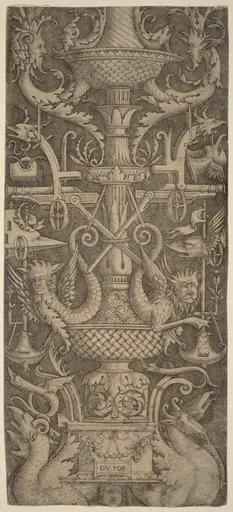 Ornament Panel with Dragons, Masks, and Instruments of War
 Sheath with Venus and Eros
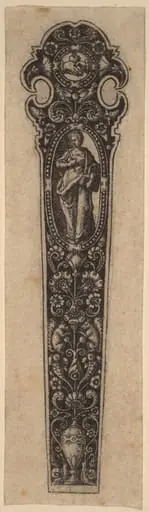 Ornament for Knife Handle
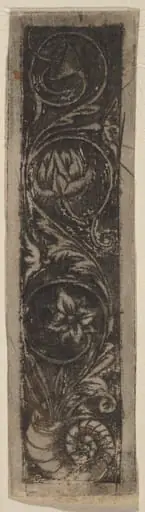 Oblong Ornament Panel
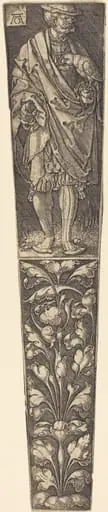 Dagger Sheath with Gentleman Holding a Parrot
 Dagger Sheath with Nude Woman
 Upright Arabesque with Masks, Cupids and Nereids
 Dagger Sheath with the Whore of Babylon
 Apollo and Daphne
 Panel of Ornament with a Satyress Feeding Two Children