Artwork
Sheath with Venus and Eros

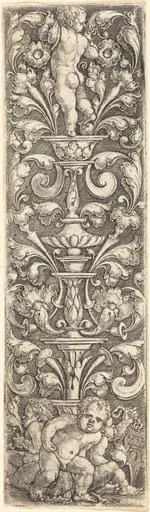
Sheath with Venus and Eros is an ink print by the Renaissance artist Master IB. It dates from 1516 and is held in the collection of the National Gallery of Art. This engraving, dated 1516, depicts a slender, vertical design likely intended as a decorative sheath for a blade.
About this work
Overview
This engraving, dated 1516, depicts a slender, vertical design likely intended as a decorative sheath for a blade. Executed by the artist known as Master IB, it combines mythological figures with intricate ornamental borders, suggesting its function as both artistic object and functional embellishment. The composition is tightly packed, emphasizing detail over spatial depth.
Subject & Meaning
Below, a frieze of miniature faces emerges from scrolling foliage, possibly representing attendants, spirits, or symbolic virtues.
At the upper register, Venus, nude and holding a mirror, is accompanied by Eros, winged and smaller in scale. Below, a frieze of miniature faces emerges from scrolling foliage, possibly representing attendants, spirits, or symbolic virtues. The pairing of Venus and Eros evokes themes of love and desire, common in Renaissance iconography, while the surrounding faces may allude to the pervasive influence of these forces.
Technique & Style
The image is rendered in fine-line engraving, with precise incisions carved into a metal plate to produce detailed tonal contrasts. The artist employs dense, repetitive patterns in the foliage and drapery, characteristic of Northern Renaissance printmaking. The scale of the figures diminishes toward the base, creating a sense of layered depth within a narrow format.
History & Provenance
The work is attributed to Master IB, an anonymous engraver active in the early 16th century, likely in southern Germany or the Low Countries. No definitive record of its original commission survives, but similar designs appear on weapon sheaths and luxury objects from the period, indicating its use among elite patrons who valued mythological ornamentation.
Context
During the early 1500s, mythological scenes were frequently adapted for decorative arts, reflecting humanist interests in classical antiquity. Engravings like this served as models for metalworkers and goldsmiths, bridging fine art and craft. The format suggests it was meant for replication, either as a print or as a template for metal inlay.
Legacy
Though Master IB’s identity remains obscure, this engraving exemplifies the transmission of classical themes through print culture. Its influence can be traced in later decorative arts, where mythological motifs became standard in European weapon and furniture ornamentation. The work endures as a testament to the integration of narrative and utility in Renaissance material culture.
Artist & collection


 Ornament Panel: Nereid and Two Children Playing Musical Instruments
 Ornamental Panel: Triton Ridden by a Child
 Ornament Panel: Two Sphinxes Supporting Shields
 Panel of Ornament with Candelabra Supported by Two Blindfolded Women
 Nereid Ridden by Two Children
 Ornament Panel: Triton Ridden by a Child
 Ornament Panel: Four Children with a Cat and a Dog
 High Ornament
 Ornament Panel: Four Children Playing
 Ornament Panel: Nereid Ridden by Two Children
 Ornament Panel: Triton and Two Infant Satyrs
 Ornament Panel: Two Sphinxes and Two Children Holding Palms