Artwork
Plate 3: Simeon
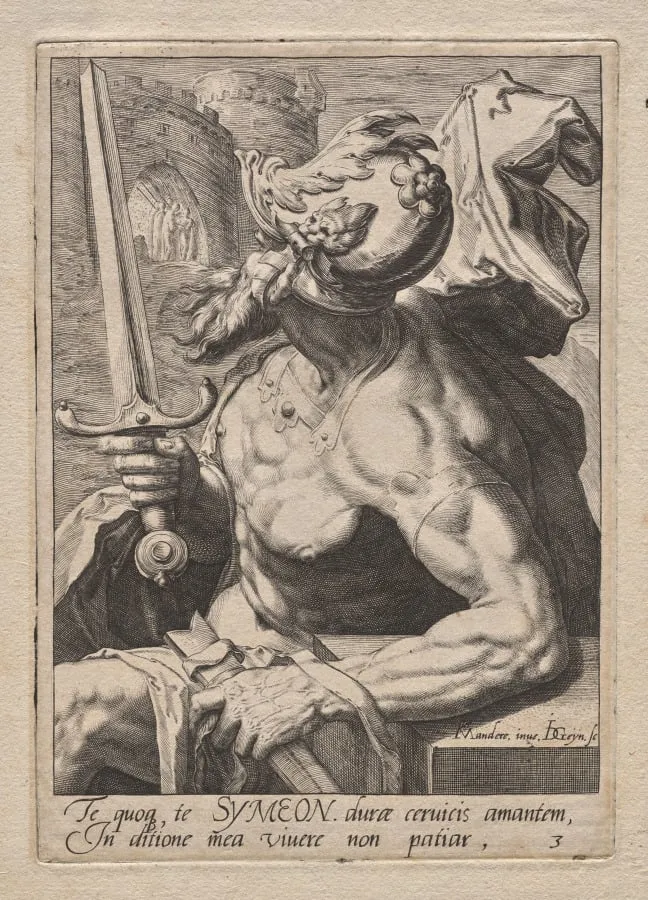
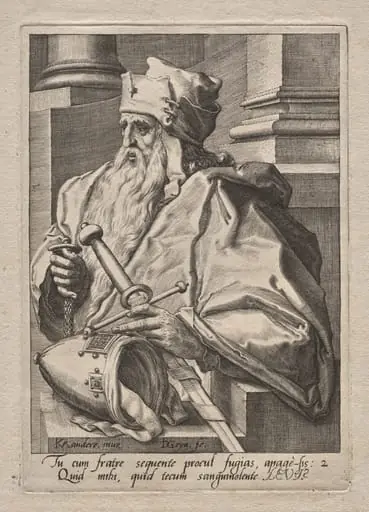
Plate 3: Simeon is a print by the Renaissance artist Jacob de Gheyn II. It dates from 1589 and is held in the collection of the Cleveland Museum of Art.
About this work
Overview
Created in the late 16th century in the Netherlands, the series draws from Old Testament accounts to present moral and historical archetypes.
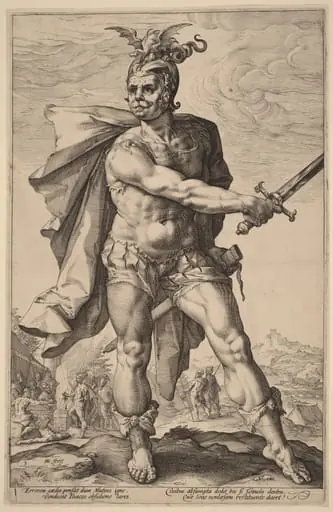
This print is the third in a series illustrating the twelve sons of Jacob, each represented with symbolic attire and objects reflecting their biblical narratives. Created in the late 16th century in the Netherlands, the series draws from Old Testament accounts to present moral and historical archetypes. Simeon is depicted in armor, clutching a sword, signaling his association with violence as recorded in Genesis.
Subject & Meaning
Simeon, the second son of Jacob and Leah, is linked in scripture to the massacre of the men of Shechem, an act of retribution for the violation of his sister Dinah. The armor and sword in this image allude to his role as an avenger, distinguishing him from his brothers. The depiction aligns with the biblical blessing in Genesis 49, where Jacob foretells Simeon’s tribe will be scattered due to their anger.
Technique & Style
Executed as a detailed engraving, the print employs fine linear precision to render the texture of armor, fabric, and facial expression. The composition is frontal and static, emphasizing symbolic clarity over dynamic movement. Background elements are minimal, focusing attention on the figure and his attributes, consistent with Northern Renaissance traditions of didactic imagery.
History & Provenance
The series was produced in the Netherlands during a period of religious upheaval and resistance to Spanish rule. Biblical figures like Simeon were invoked as models of righteous fury and endurance. While the exact publisher is unconfirmed, similar prints from this era circulated widely among Protestant audiences seeking moral instruction through visual narrative.
Context
Late 16th-century Dutch printmakers frequently turned to biblical themes to navigate political and religious tensions. The twelve sons of Jacob offered a framework to explore themes of justice, retribution, and divine judgment. These prints served both devotional and educational purposes, reinforcing communal identity through familiar scriptural stories.
Legacy
The series contributed to a broader European tradition of biblical iconography in print form, influencing later depictions of Old Testament figures. Though not widely exhibited today, these works remain valuable for understanding how religious narratives were visualized and disseminated during the Reformation era in the Low Countries.
Artist & collection

Artist
Jacob de Gheyn II was a Dutch painter and engraver, whose work shows the transition from Northern Mannerism to Dutch realism over the course of his career.

![The Farnese Hercules, three-quarter view turned to left [plate 3], by François Perrier](https://artifactworldgallery.com/img/francois-perrier--the-farnese-hercules-three-quarter-view-turned-to-left-plate--b0564bebaad016fa-w320.webp)