Artwork
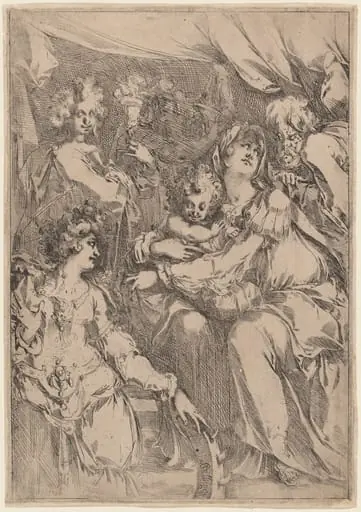
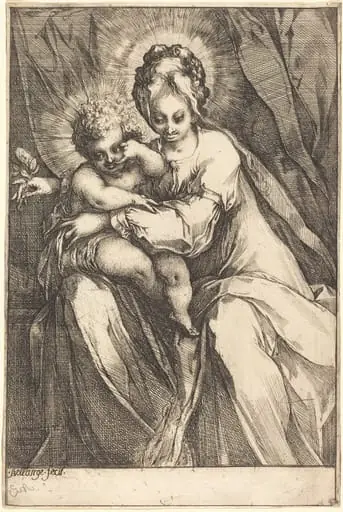
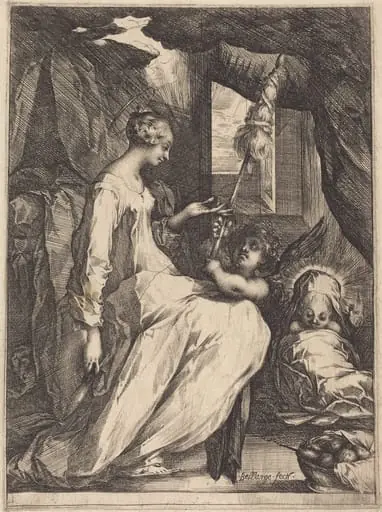
The Virgin and Child with Distaff and an Angel
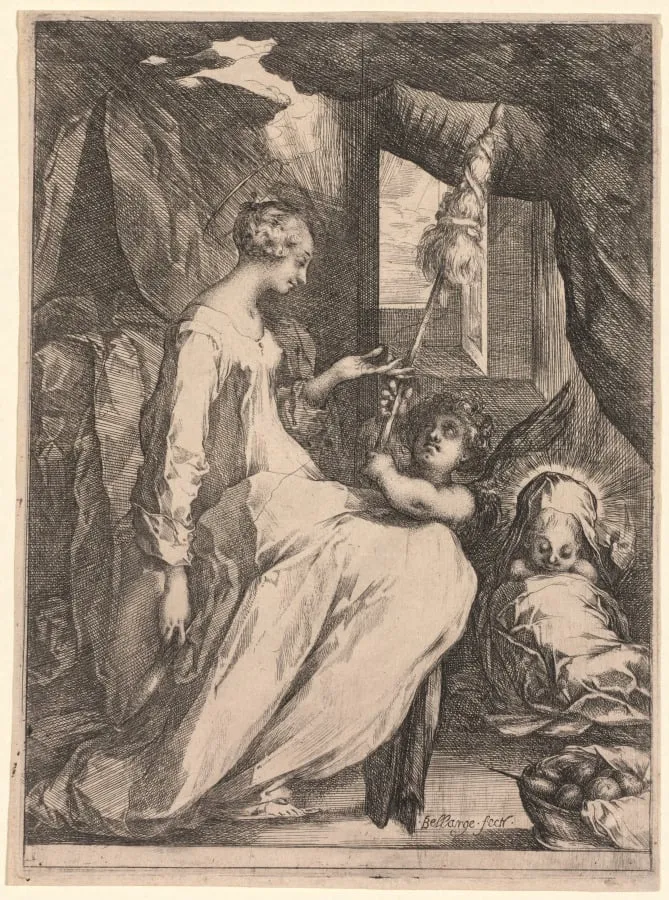
The Virgin and Child with Distaff and an Angel is a print by the Baroque artist Jacques Bellange. It dates from 1612 and is held in the collection of the Cleveland Museum of Art.
About this work
Overview
His limited output belies the intensity of his vision, combining technical precision with an uncanny emotional depth.
Jacques Bellange created fewer than fifty etchings during a brief five-year span between 1611 and 1616, yet his work left a lasting imprint on early 17th-century printmaking. His limited output belies the intensity of his vision, combining technical precision with an uncanny emotional depth. These prints, though few in number, stand as singular expressions of a highly personal aesthetic that diverged sharply from conventional religious imagery of the period.
Subject & Meaning
The scene depicts the Virgin Mary spinning wool with a distaff while the Christ Child sleeps in her lap, an angel offering the spindle. This references the medieval legend of Mary’s childhood at the Temple of Jerusalem, where she wove sacred vestments. The quiet domesticity is unsettled by the angel’s enigmatic expression and the elongated, almost otherworldly forms, transforming a pious narrative into a meditation on sacred solitude and hidden mystery.
Technique & Style
Bellange employed fine, controlled etching lines to model figures with a sculptural weight, set against deep, shadowed backgrounds that heighten their luminosity. His figures are stretched and sinuous, their gestures subtly distorted to evoke inner tension. The contrast between the soft glow of skin and the near-black voids recalls Caravaggio’s chiaroscuro, yet Bellange’s mood is more introspective, less theatrical, leaning into the psychological ambiguity characteristic of Mannerism.
History & Provenance
Bellange served as court artist to the Dukes of Lorraine, where his prints circulated among elite collectors. Though his etchings were not widely reproduced, they were admired for their originality. The work now held by The Cleveland Museum of Art entered its collection through documented 20th-century acquisitions, preserving its rare status as one of fewer than fifty surviving impressions from Bellange’s brief but influential career.
Context
Emerging in the early 1600s, Bellange’s style aligned with Mannerism’s broader European trend of elongating forms and amplifying emotional intensity. While contemporaries like Caravaggio pursued dramatic realism, Bellange favored dreamlike stillness and symbolic distortion. His prints reflect the spiritual tensions of post-Reformation France, where religious imagery was reimagined through personal, often cryptic visions rather than doctrinal clarity.
Legacy
Bellange’s etchings were largely overlooked after his death until the 19th century, when collectors and scholars recognized their unique fusion of technical finesse and psychological strangeness. Today, his work is studied as a bridge between late Renaissance symbolism and the introspective turn of Baroque art. His ability to infuse sacred subjects with quiet unease continues to distinguish him among his peers.
Artist & collection
Artist
Jacques Bellange (c. 1575–1616) was an artist and printmaker from the Duchy of Lorraine (then independent but now part of France) whose etchings and some drawings are his only securely identified works today. They are…