Artwork
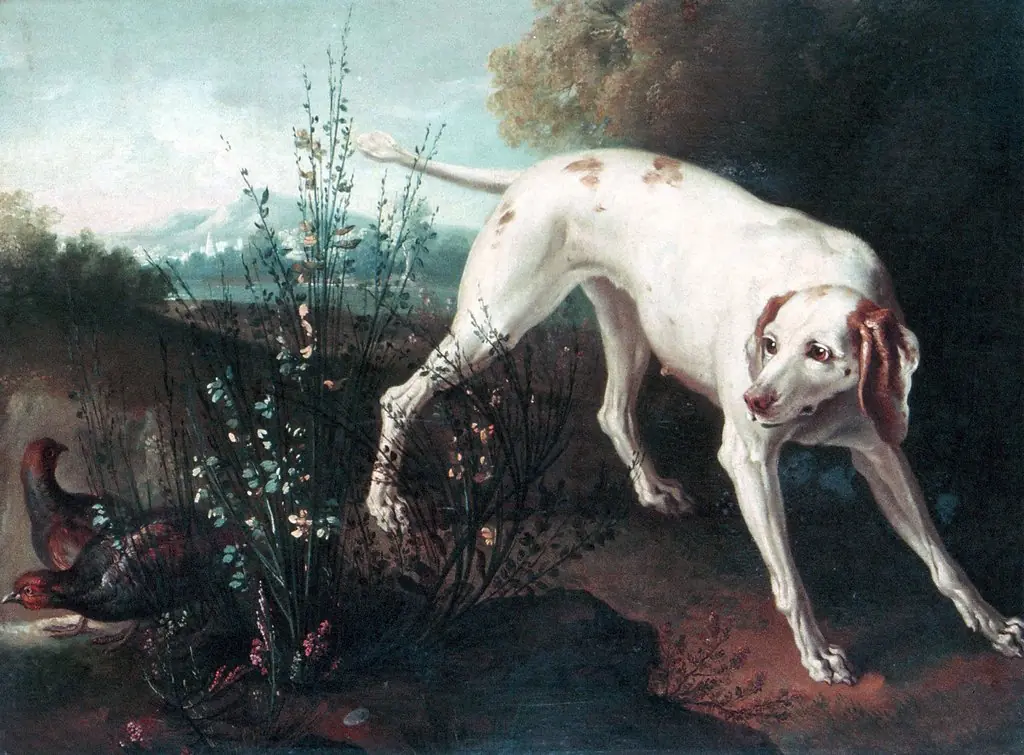
Dog Pointing a Partridge
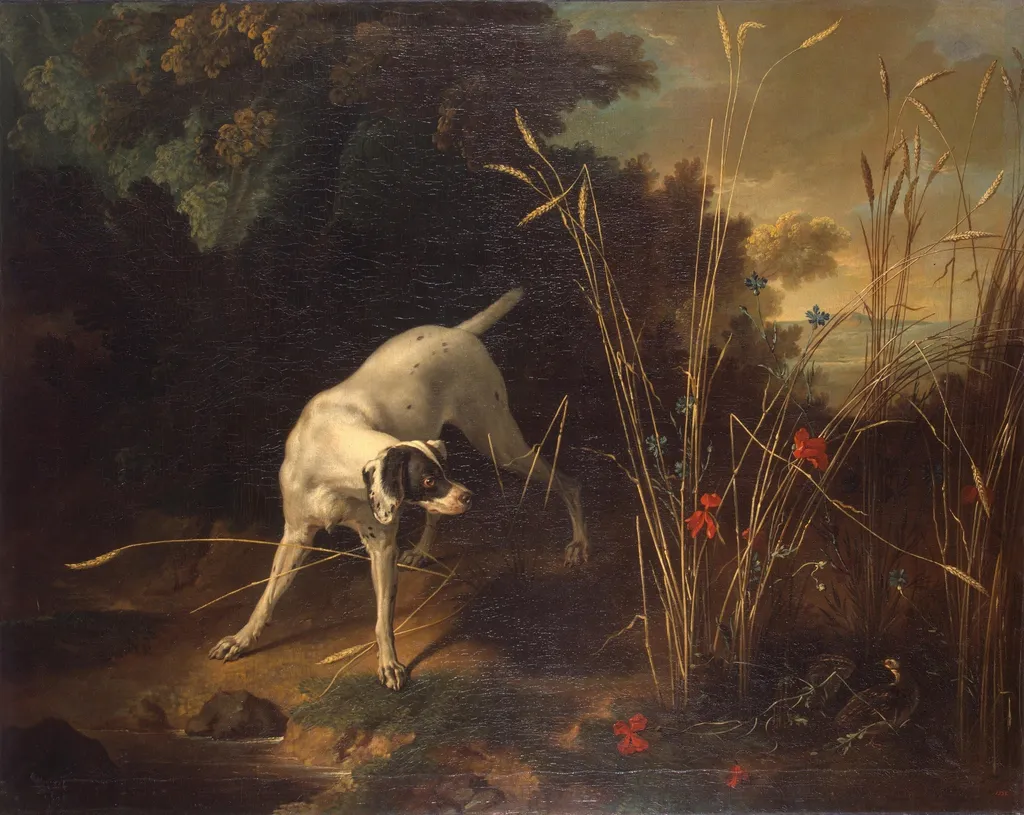
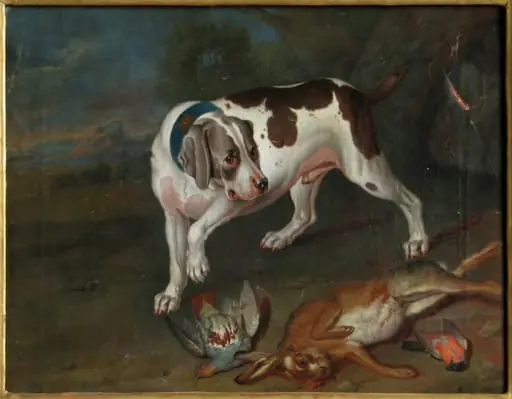
Dog Pointing a Partridge is an oil painting by the Rococo painting artist Jean-Baptiste Oudry. It dates from 1725 and is held in the collection of the Hermitage Museum.
About this work
Overview
Oudry situates the animal on a dirt path, grounding the figure with naturalistic details such as red flowers and tall grasses emerging from the foreground soil.
Painted in 1725, Dog Pointing a Partridge is a characteristic example of Jean-Baptiste Oudry's mastery in animal portraiture and hunting scenes. The composition centers on a white pointer with distinct black markings on its ears and back, captured in a moment of intense stillness as it points toward an unseen partridge off the right edge of the canvas. Oudry situates the animal on a dirt path, grounding the figure with naturalistic details such as red flowers and tall grasses emerging from the foreground soil. The background recedes into a dark, atmospheric landscape of trees and bushes, a technique that isolates the subject and heightens the dramatic tension of the hunt. This work exemplifies the French Rococo interest in the natural world and the specific genre of the 'dog portrait,' which Oudry elevated through his precise observation of anatomy and fur texture. Created during the height of his career under the patronage of the French court, the painting reflects the artist's dual role as a chronicler of royal hunts and a skilled painter of domesticated animals. The work demonstrates Oudry's ability to blend scientific accuracy with a sense of narrative immediacy, securing his reputation as the leading animalier of 18th-century France.
Subject & Meaning
The composition centers on the dog’s poised stance, a classic signal of pointing toward game in the tradition of French hunting imagery. By fixing the animal’s gaze on an off‑canvas target, Oudry conveys anticipation and the collaborative relationship between hunter and hound, emphasizing the ritual of the chase rather than the capture itself.
Technique & Style
Oudry employs chiaroscuro, contrasting illuminated foreground elements with a deep, muted background to model form and create spatial depth. The brushwork renders the dog’s fur and the delicate petals with fine detail, while broader strokes suggest foliage and distant vegetation. The palette balances warm earth tones with the vivid red of the flowers, reinforcing the scene’s naturalistic yet theatrical quality.
History & Provenance
Executed in 1725, the painting entered the Russian imperial collection in the 18th century and has remained in the State Hermitage Museum since. Documentation traces its acquisition to the period when the Hermitage was expanding its holdings of European decorative arts and genre scenes, reflecting the museum’s early interest in French animal painting.
Context
Oudry, a leading animal painter of the French Rococo, often produced works for aristocratic patrons who prized depictions of leisure pursuits such as hunting. This piece aligns with his broader oeuvre of meticulously observed fauna, combining scientific accuracy with a decorative sensibility that appealed to the tastes of the French court and its European admirers.
Own this work as a print
Artist & collection

Artist
Jean-Baptiste Oudry was a French Rococo painter, engraver, and tapestry designer. He is particularly well known for his naturalistic pictures of animals and his hunt pieces depicting game. His son, Jacques-Charles Oudry, was also a painter.