Artwork
Chieftain Wushe Surrendering the City: from Battle Scenes of the Quelling of the Rebellions in the Western Regions, with imperial Poems
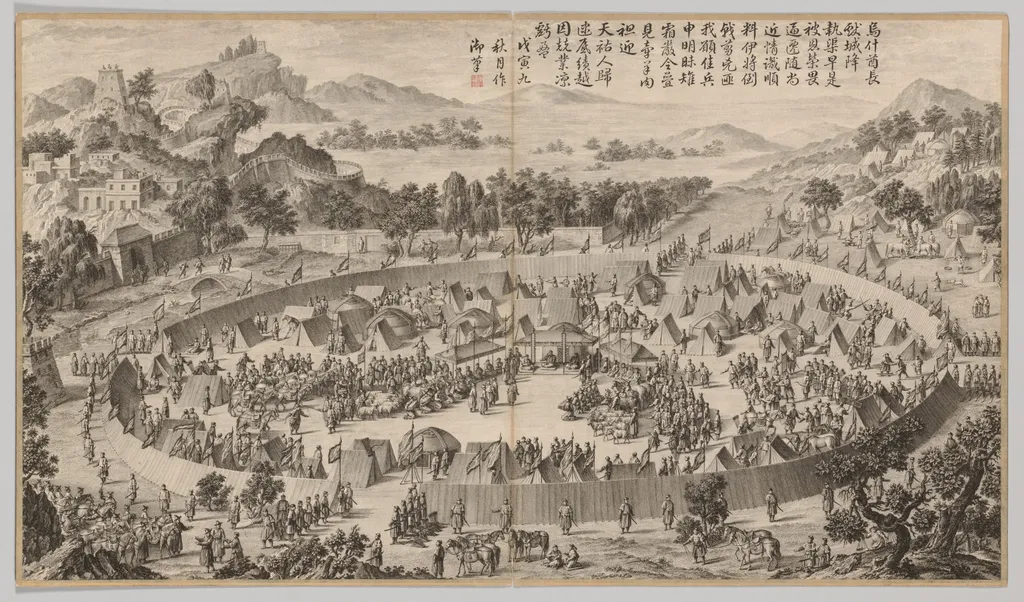
Chieftain Wushe Surrendering the City: from Battle Scenes of the Quelling of the Rebellions in the Western Regions, with imperial Poems is a print by the Romanticist artist Jean Damascene Sallusti. It dates from 1770 and is held in the collection of the Cleveland Museum of Art.
About this work
This etching shows a man kneeling in front of a fortress, handing over a city’s keys.
It’s part of a set made for Emperor Qianlong to celebrate his army’s victories in Central Asia. The emperor even wrote poems to go with each picture, bragging about his generals.
If you like this bold style, check out Jean Damascene Sallusti (Italian, died 1781).
Overview
A series of copperplate engravings commissioned by Emperor Qianlong to document military campaigns in the Western Regions, now part of Xinjiang. Each print was paired with an imperial poem composed by the emperor himself, blending visual narrative with literary praise. The works were produced under imperial supervision, intended as official records of Qing expansion and authority.
Subject & Meaning
The scene depicts Chieftain Wushe kneeling before a fortified gate, offering the keys to his city as a gesture of submission. This act symbolizes the pacification of local resistance and the extension of Qing sovereignty. The imagery emphasizes surrender and imperial dominance, reinforcing the legitimacy of military intervention as a means of political consolidation.
Technique & Style
Executed in fine-line copperplate etching, the composition employs clear contours and controlled shading to distinguish figures from architecture.
Executed in fine-line copperplate etching, the composition employs clear contours and controlled shading to distinguish figures from architecture. The perspective is frontal and hierarchical, with the chieftain rendered smaller than the fortress and imperial attendants. The style reflects European engraving techniques adapted to Chinese imperial aesthetics, prioritizing clarity over emotional expression.
History & Provenance
Created between 1767 and 1770, the series was produced in Beijing by Jesuit artists working at the Qing court, including Jean-Damascène Sallusti. The prints were distributed within the imperial palace and used to reinforce state ideology. Original sets were stored in the Forbidden City, with later copies circulating among officials as symbols of imperial achievement.
Context
The campaigns depicted occurred during the 1750s–60s, as the Qing sought to secure control over the Tarim Basin against Dzungar and Uyghur resistance. These conflicts were part of a broader effort to stabilize the empire’s northwestern frontier. The prints served not only as historical records but also as propaganda, aligning military success with the Mandate of Heaven.
Legacy
The series remains one of the most comprehensive visual chronicles of Qing military campaigns. While later scholars have critiqued its propagandistic tone, the prints are valued for their detailed depiction of uniforms, weaponry, and architecture of the period. They continue to inform historical studies of Qing imperial ideology and cross-cultural artistic exchange in the 18th century.
Artist & collection
Artist
Jean-Damascène Sallusti, also Giovanni Damasceno (simplified Chinese: 安德义; traditional Chinese: 安德義; pinyin: Ān Déyì; d.

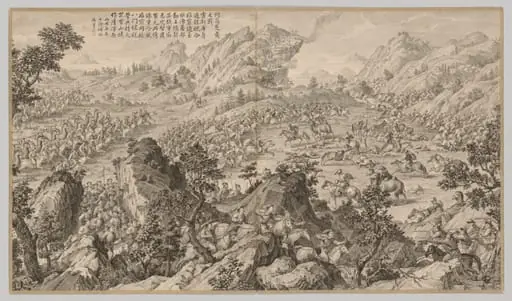 Battle at A'erchu'er: from Battle Scenes of the Quelling of Rebellions in the Western Regions, with Imperial Poems
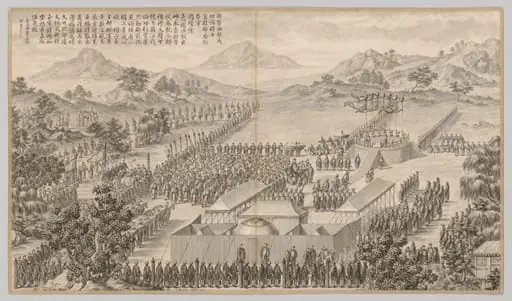 Rewards to Generals and Officers in Quelling the Uigurs: from Battle Scenes of the Quelling of Rebellions in the Western Regions, with Imperial Poems
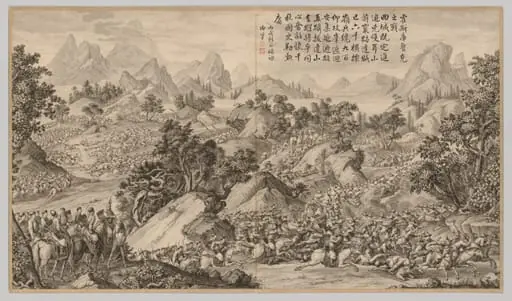 Battle at Heshi Kuluke: from Battle Scenes of the Quelling of Rebellions in the Western Regions, with Imperial Poems
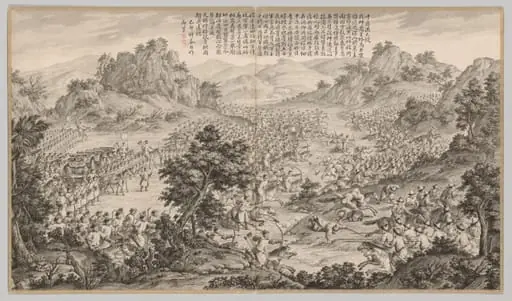 Great Victory at Hu'erman: from Battle Scenes of the Quelling of Rebellions in the Western Regions, with Imperial Poems
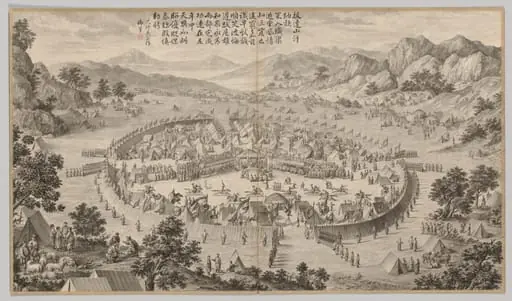 Khan of Bada Shan Presenting Tribute: from Battle Scenes of the Quelling of Rebellions in the Western Regions, with Imperial Poems
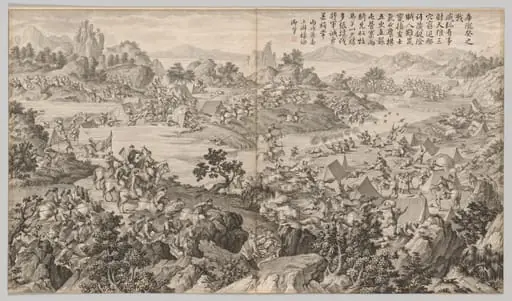 Battle of Kulongkui: from Battle Scenes of the Quelling of Rebellions in the Western Regions, with Imperial Poems
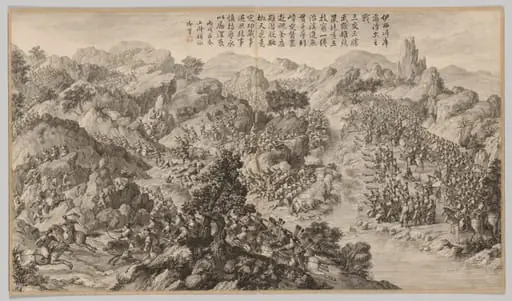 Battle at Yixi'er Ku'ernao'er: from Battle Scenes of the Quelling of Rebellions in the Western Regions, with Imperial Poems
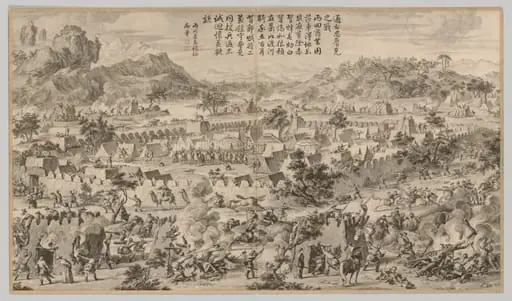 Battle at Tunggushi Luke: from Battle Scenes of the Quelling of the Rebellions in the Western Regions, with Imperial Poems
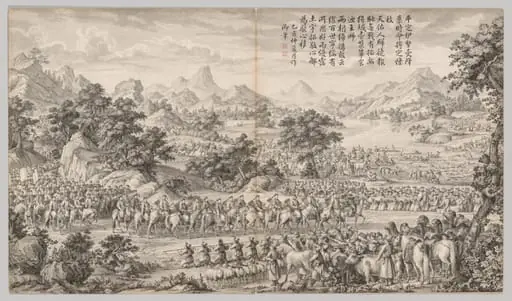 Receiving Surrender from the Eli: from Battle Scenes of the Quelling of Rebellions in the Western Regions, with Imperial Poems
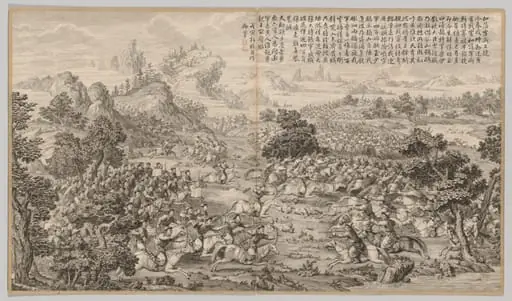 Victory at Heluo Heshi: from Battle Scenes of the Quelling of Rebellions in the Western Regions, with Imperial Poems
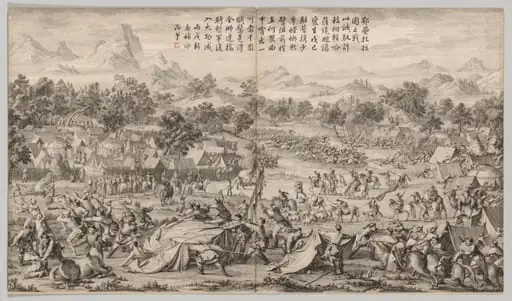 The Battle at Elei Zhalatu: from Battle Scenes of the Quelling of Rebellions in the Western Regions, with Imperial Poems
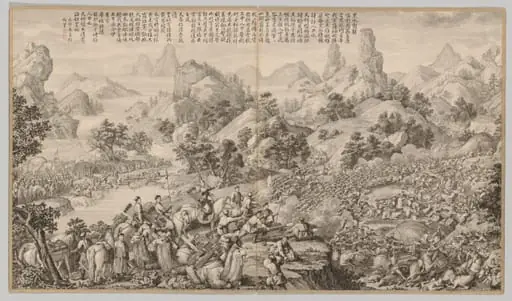 Breaking Through the Siege at Hesui: from Battle Scenes of the Quelling of Rebellions in the Western Regions, with imperial Poems
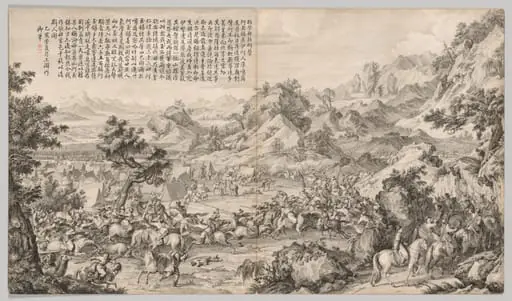 Attacking the Camp at Gatan Ola: from Battle Scenes of the Quelling of Rebellions in the Western Region, with Imperial Poems