Artwork
At Bawburgh
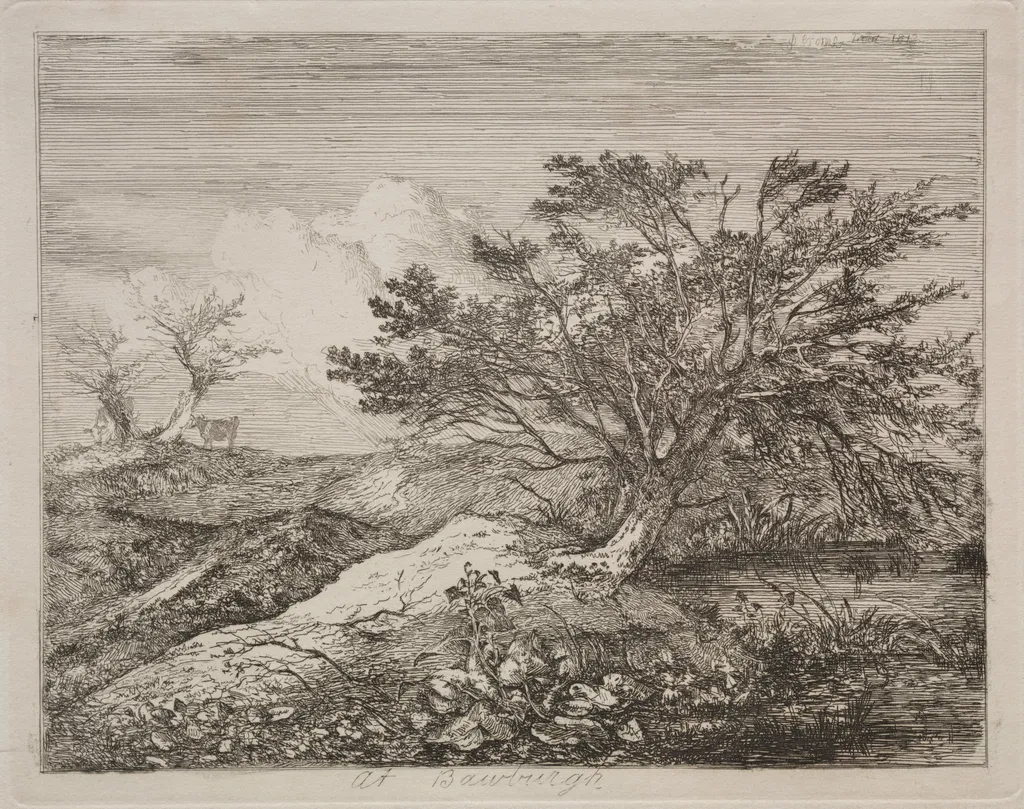
At Bawburgh is a print by the Romanticist artist John Crome. It dates from 1813 and is held in the collection of the Cleveland Museum of Art.
About this work
Overview
Created in 1813, At Bawburgh is a monochrome drawing by John Crome, currently in the collection of The Cleveland Museum of Art. Executed in ink and wash, the work captures a quiet rural scene in Norfolk, England, with minimal color and a focus on tonal contrast. Its restrained palette and delicate linework reflect Crome’s interest in natural atmosphere over narrative detail.
Subject & Meaning
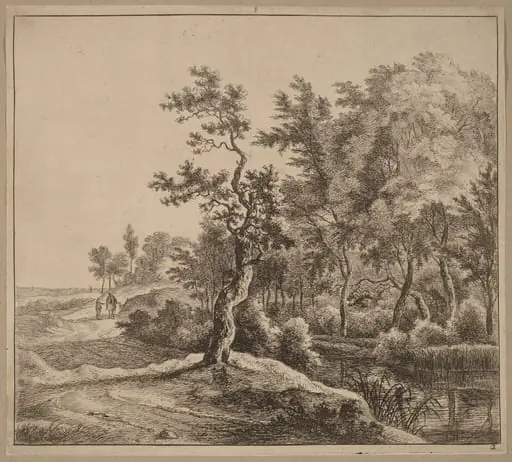
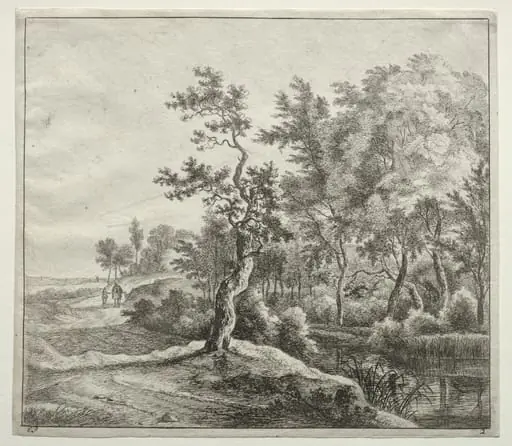
The drawing depicts a mist-laden landscape featuring two bare, gnarled trees on a gentle slope, their twisted branches silhouetted against a soft, textured sky.
The drawing depicts a mist-laden landscape featuring two bare, gnarled trees on a gentle slope, their twisted branches silhouetted against a soft, textured sky. A narrow stream meanders through the foreground, while scattered rocks and low vegetation suggest undisturbed wilderness. The stillness and solitude of the scene evoke a contemplative mood, aligning with Romantic-era sensibilities toward nature’s quiet power.
Technique & Style
Crome employed ink wash and fine linear strokes to build depth without color, using gradations of gray to suggest mist and shadow. The trees are rendered with angular, almost skeletal contours, contrasting with the fluid, wavy lines of the sky. Textural details in the ground—tiny bushes, pebbles—are suggested with minimal marks, emphasizing economy and atmospheric effect over precision.
History & Provenance
The drawing was made during Crome’s active period in Norfolk, where he frequently sketched local landscapes. It entered The Cleveland Museum of Art’s collection through established acquisition channels, likely as part of a broader effort to acquire British Romantic-era works. Its provenance remains unbroken since its creation, with no documented alterations or restorations.
Context
Produced during the height of British Romanticism, At Bawburgh reflects a cultural shift toward valuing nature as a source of emotional and spiritual resonance. Unlike grand landscapes of the period, Crome’s work favors intimate, unidealized views—emphasizing quiet observation over dramatic spectacle, a hallmark of the Norwich School he helped found.
Legacy
At Bawburgh exemplifies Crome’s influence on later British landscape artists who prioritized direct observation and tonal harmony. While not widely exhibited, the work remains a key example of early 19th-century English drawing, illustrating how modest, monochromatic studies could convey profound atmospheric presence without embellishment.
Own this work as a print
Artist & collection
Artist
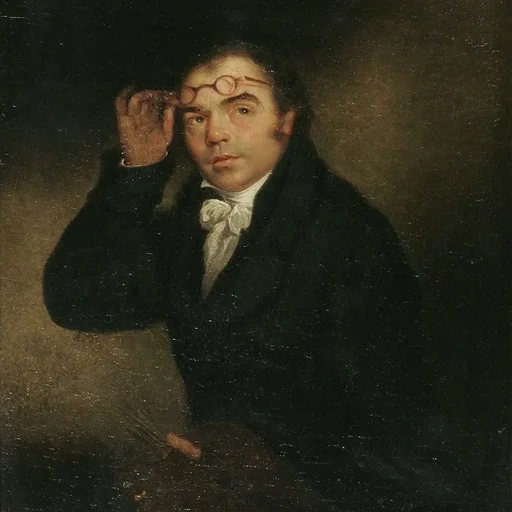
John Crome, once known as Old Crome to distinguish him from his artist son John Berney Crome, was an English landscape painter of the Romantic era, one of the principal artists and founding members of the Norwich School of painters.

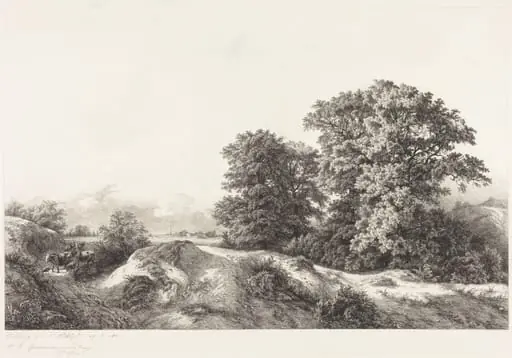 Oaks in the Vaux de Cernay
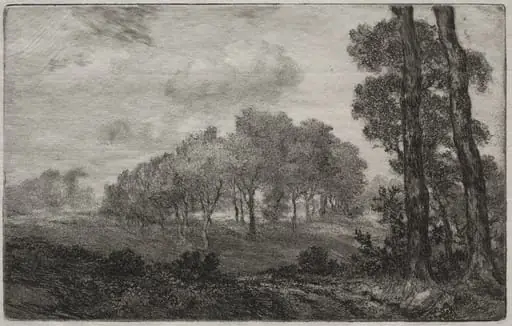 Landscape, after Français
 Landscape with a Winding Road
 The Serpentine Road
 Valley View, Man with a Donkey and a Dog
 The Thicket
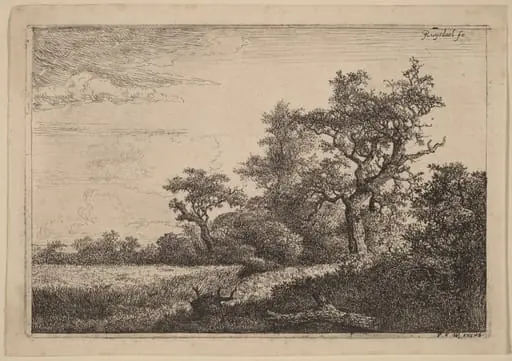 Grain Field at the Edge of a Wood (Corn Field)
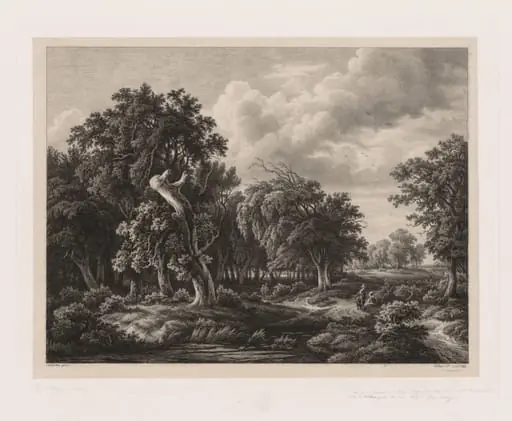 Groups of Various Plants Drawn After Nature: No. 7
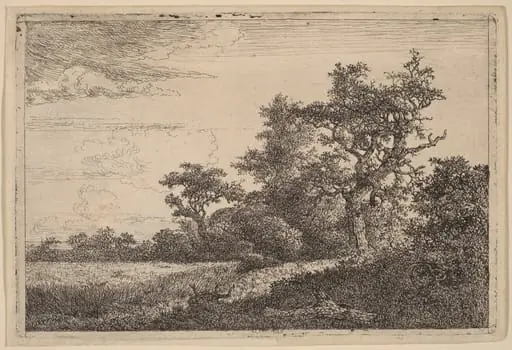 Grain Field at the Edge of a Wood (Corn Field)
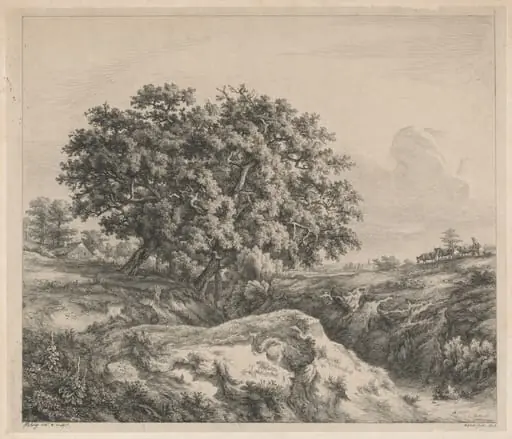 Le chêne au ravin (Oak Tree by a Ravine)