Artwork
Net Fishing at Night on the Sumida River
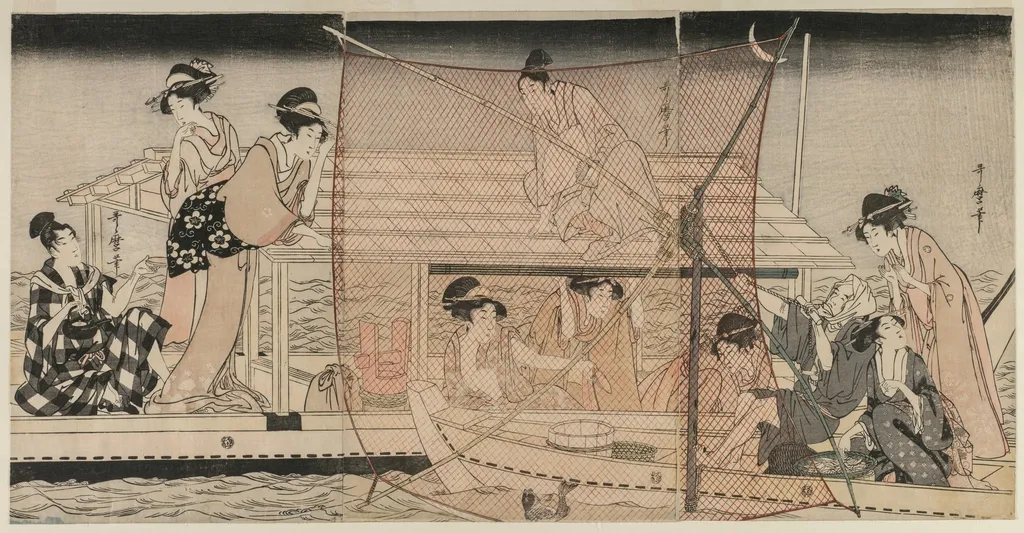
Net Fishing at Night on the Sumida River is a print by the Romanticist artist Kitagawa Utamaro. It dates from 1800 and is held in the collection of the Cleveland Museum of Art.
About this work
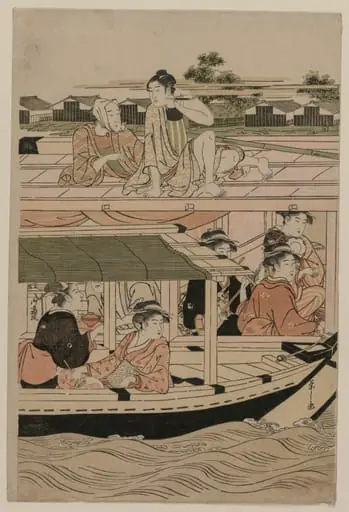
On the right, another man leans on the roof, watching the fisherman.
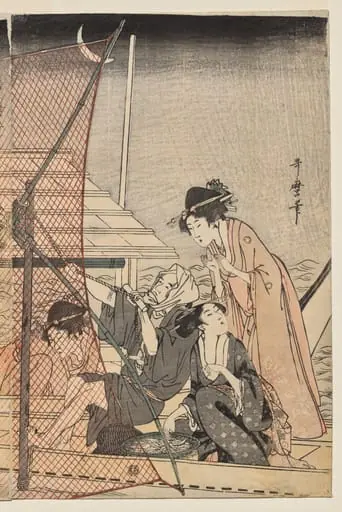
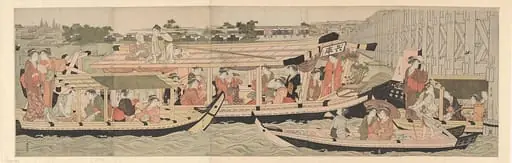
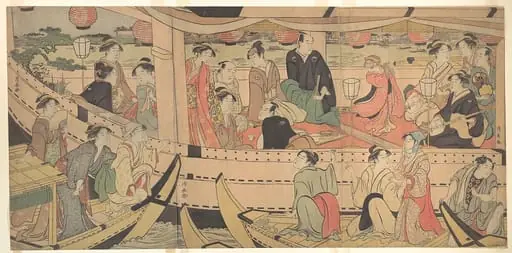
This print shows three scenes side by side. On the left, a party boat glows with lanterns. A man pours sake into small lacquer dishes for two women. In the middle, a fisherman struggles with a large net. His boat crosses paths with the party boat. On the right, another man leans on the roof, watching the fisherman.
Utamaro often captured everyday moments like this. He focused on small gestures and expressions. The night scene feels alive with flickering light and movement. You can almost hear the water and laughter.
Look up Kitagawa Utamaro (Japanese, c. 1754–1806).
Overview
Kitagawa Utamaro’s triptych, *Net Fishing at Night on the Sumida River*, presents three consecutive vignettes set on the Sumida River during an evening gathering. The left panel shows a pleasure boat illuminated by lanterns where a young man in a checked kimono serves sake to two women. The central image captures a fisherman wrestling with a large net as his boat passes the party vessel, and the right panel depicts a man perched on the roof, observing the struggle.
Subject & Meaning
The work juxtaposes leisurely socializing with the labor of river fishing, highlighting the coexistence of pleasure and work in Edo’s riverine life. The gestures—pouring sake, the fisherman’s strained grip, a woman’s open robe to feel the night air—convey a moment of shared space, suggesting a fleeting encounter between two distinct worlds.
Technique & Style
Executed as a three‑panel woodblock print, Utamō’s composition relies on delicate line work and subtle color gradations to render lantern light and water reflections. The artist’s focus on minute expressions and everyday actions typifies his interest in capturing transient, intimate scenes within the ukiyo‑e tradition.
History & Provenance
Created in the late 18th century, the print belongs to a series of multi‑panel works that explored nocturnal river activities in Edo. It was produced by a major publishing house of the period and circulated among urban audiences who recognized the Sumida River’s social significance.
Context
During Utamō’s career, river outings and nighttime entertainment were popular subjects in ukiyo‑e, reflecting the bustling urban culture of Edo. The Sumida River, a frequent backdrop for leisure and commerce, provided a setting where the boundaries between pleasure boats and working vessels often overlapped.
Legacy
The triptych exemplifies Utamō’s skill in rendering everyday moments with psychological depth, influencing later ukiyo‑e artists who pursued similar studies of ordinary life. Its balanced narrative across three panels continues to be cited as a model of compositional storytelling in Japanese printmaking.
Artist & collection


 Untitled
 Untitled
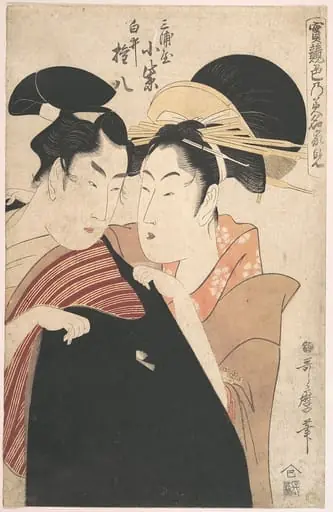 実競色乃美名家見 三浦屋小紫 白井権八|The Lovers Miura-ya Komurasaki and Shirai Gonpachi.
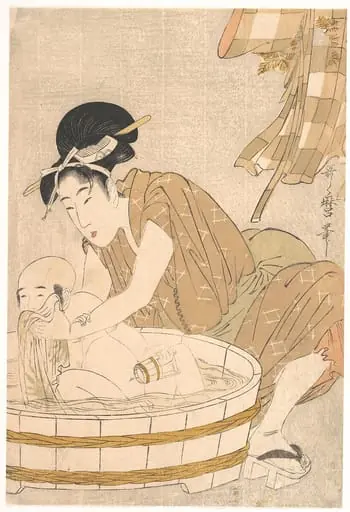 行水|Bathtime (Gyōzui)
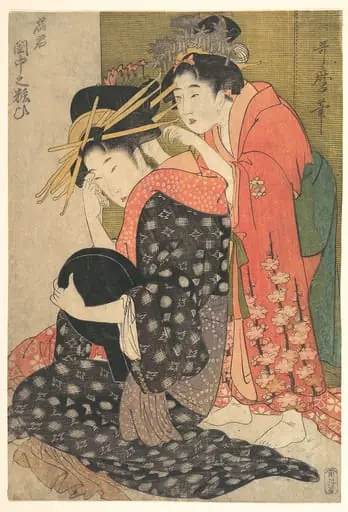 名君 閨中の粧ひ|The Oiran Yoso-oi Seated at Her Toilet
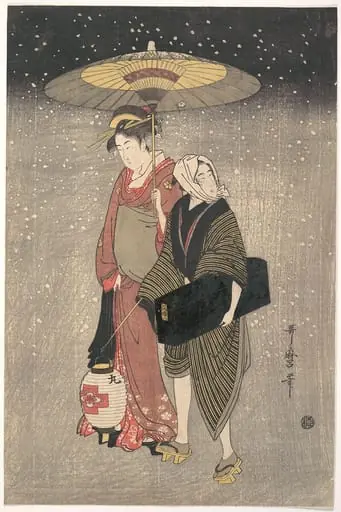 Untitled
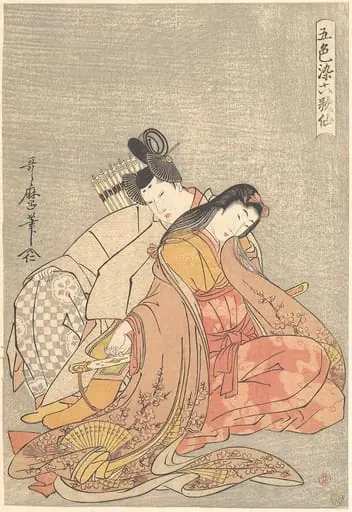 『五色染六歌仙』 在原業平と小野小町|“The Poet Ariwara no Narihira (825–880) and Ono no Komachi,” from the series Five Colors of Love for the Six Poetic Immortals (Goshiki-zome rokkasen)
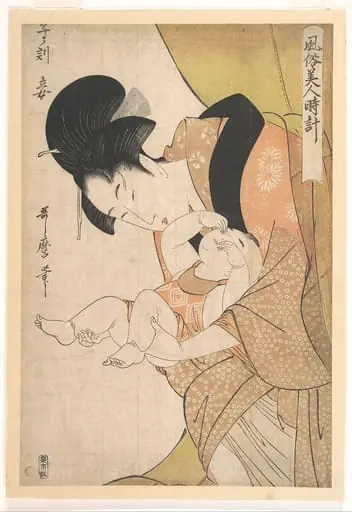 風俗美人時計 子ノ刻 妾|Midnight: Mother and Sleepy Child