Artwork
K. baierische Infanterie (Bavarian Infantrymen)
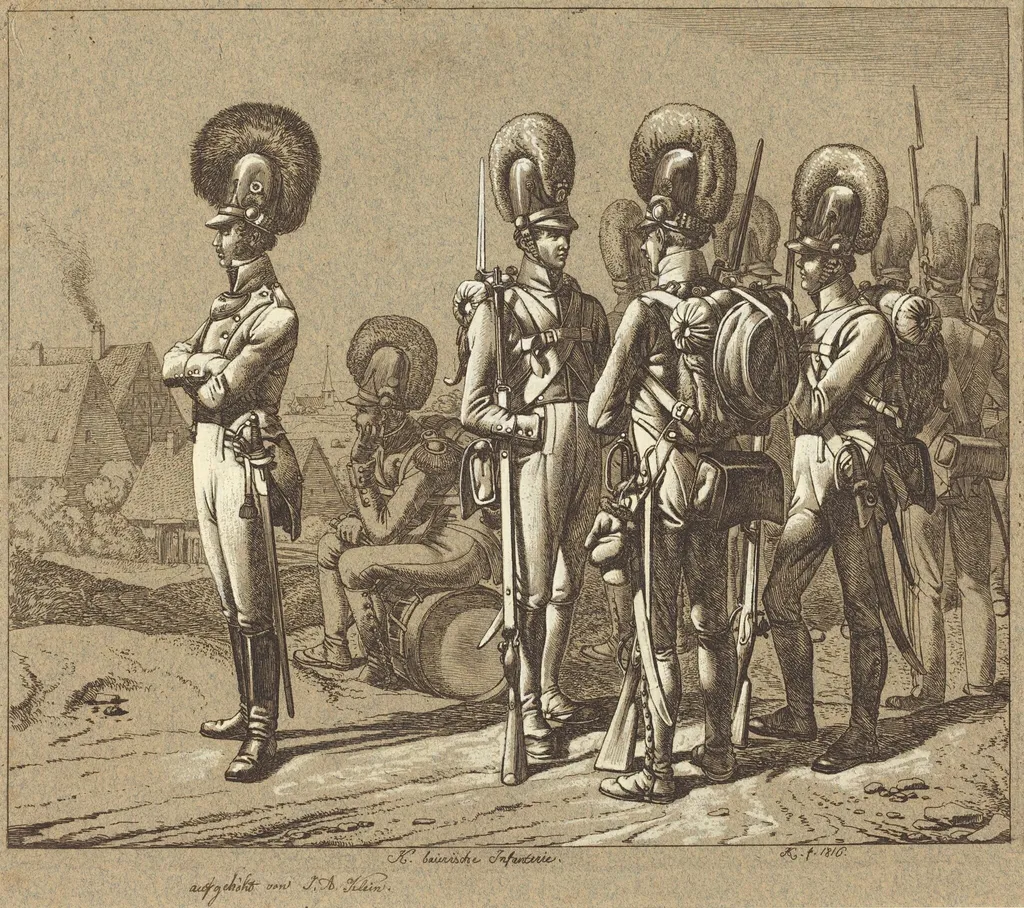
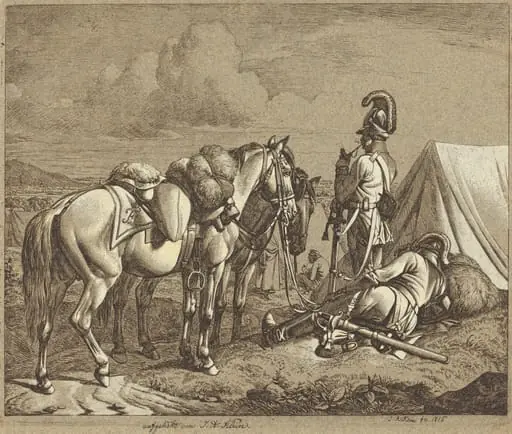
K. baierische Infanterie (Bavarian Infantrymen) is an ink print by the Romanticist artist Johann Adam Klein. It dates from 1816 and is held in the collection of the National Gallery of Art.
About this work
Overview
The composition presents six figures in orderly formation, their uniforms and equipment rendered with precision.
Created in 1816 by Johann Adam Klein, this etching depicts a group of Bavarian infantry soldiers rendered in dark lines with selective white heightening on a grey-green paper. The composition presents six figures in orderly formation, their uniforms and equipment rendered with precision. The subtle contrast between the inked contours and applied white pigment enhances the three-dimensionality of the forms, reflecting a documentary intent rather than dramatic flourish.
Subject & Meaning
The six soldiers represent a standard infantry unit of the Kingdom of Bavaria, identifiable by their tall hats with plumes, white coats, and armed with rifles and swords. One figure kneels, holding a drum, suggesting a regimental musician. The inclusion of a distant building with steps implies a military post or barracks, grounding the scene in a functional, everyday context. The label 'K. baierische Infanterie' confirms the unit’s identity, emphasizing institutional rather than individual identity.
Technique & Style
Klein employed etching as the primary technique, using fine lines to define uniforms and weaponry. White pigment was carefully applied to highlight edges and surfaces, adding luminosity against the muted paper tone. The method avoids heavy shading, favoring clarity and detail. Drypoint may have contributed to subtle texture in fabric and ground, while the restrained use of tone reflects a topographical approach, prioritizing accuracy over emotional intensity.
History & Provenance
Produced shortly after the Napoleonic Wars, the print likely served as part of a series documenting regional military forces within the newly reorganized German states. Klein, known for his topographical and military subjects, created this work during a period of heightened interest in national and regional identity. Its survival in institutional collections suggests early acquisition by cultural or military archives, though its specific early ownership remains undocumented.
Context
In early 19th-century Germany, detailed visual records of military units were commissioned to affirm state authority and regional pride. Bavaria, as a sovereign kingdom within the German Confederation, maintained distinct uniforms and traditions. Klein’s print aligns with a broader trend of ethnographic and military documentation, where art functioned as a form of visual cataloging rather than artistic expression for its own sake.
Legacy
The print contributes to a corpus of early 19th-century German military imagery that preserved the appearance of regional forces during a transitional period. While not widely exhibited today, it remains a reference for historians studying uniform evolution and the role of print culture in shaping perceptions of military identity. Its technical restraint and factual orientation distinguish it from more romanticized depictions of soldiers of the era.
Artist & collection


 Military Costumes: Grenadier of the Royal Guard
 Carabinier Mounting a Horse
 Blue Hussars
 A Party of Life Guards
 A Party of Life Guards
 Infanterie legère française, Carabinier
 Carabinier
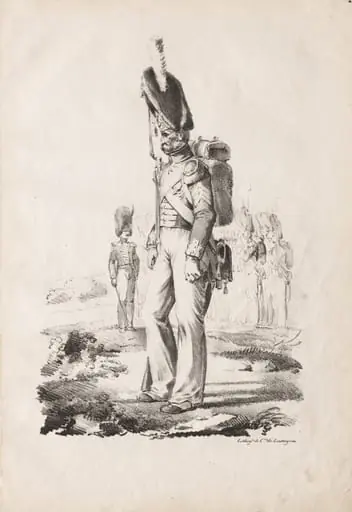 Military Costumes: Infantry Sargent
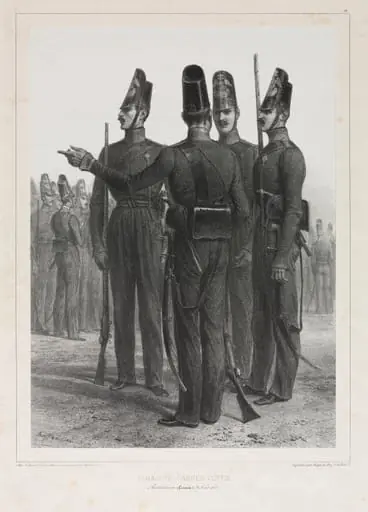 Arnoutes Gardes-Côtes
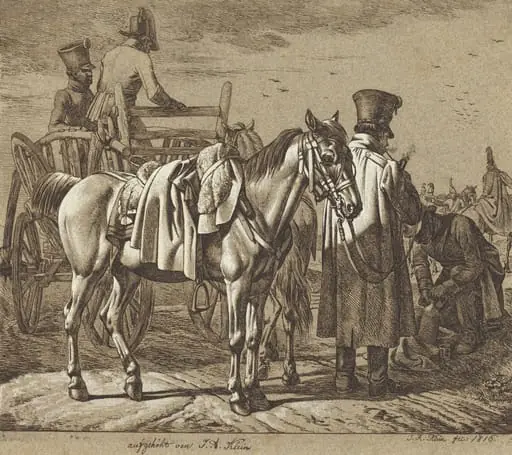 Horse with Soldiers Smoking Pipe/Military Scene
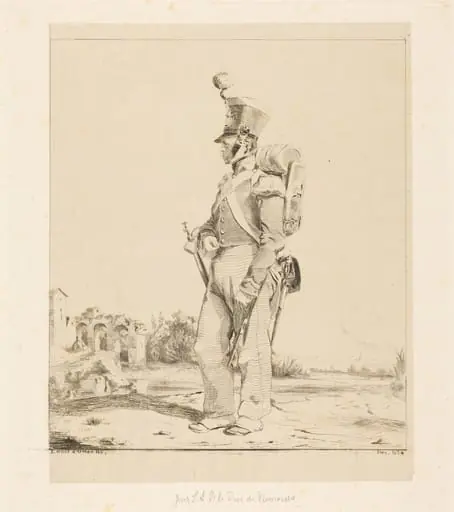 Infantryman
 Austrian Dragoons