Artwork
The Georgenberg in the Tyrol
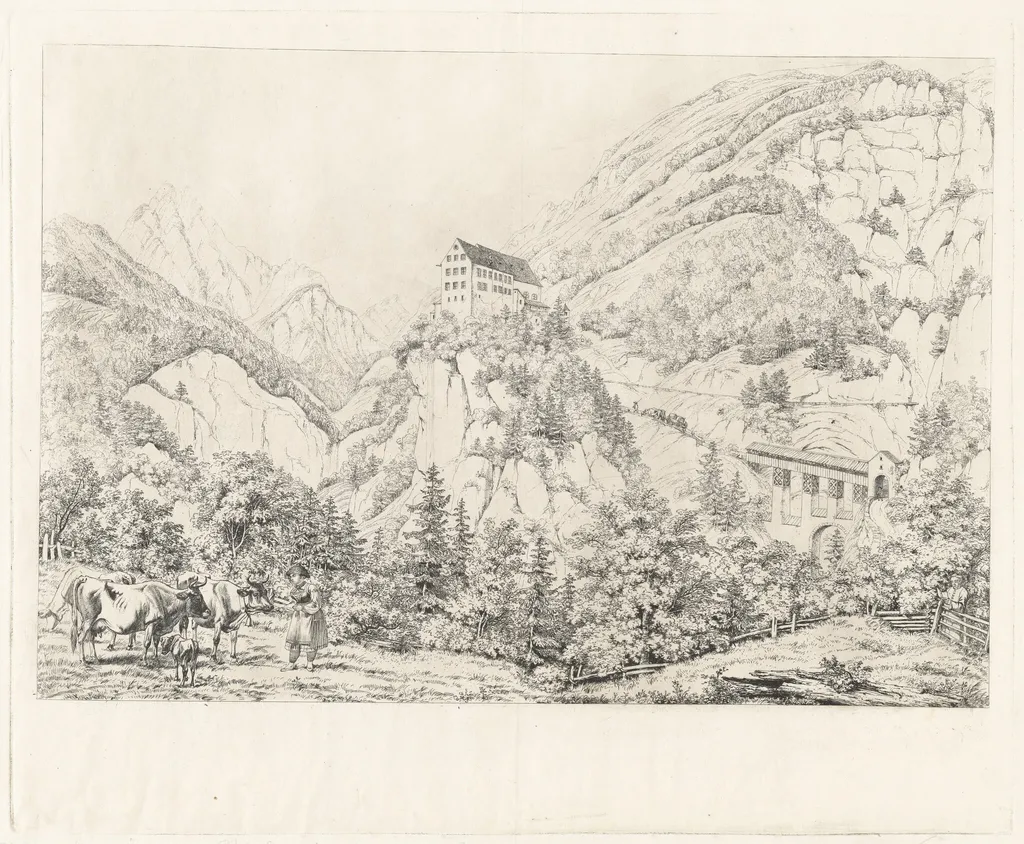
The Georgenberg in the Tyrol is an ink print by the Romanticist artist Johann Adam Klein. It dates from 1818 and is held in the collection of the National Gallery of Art.
About this work
Overview
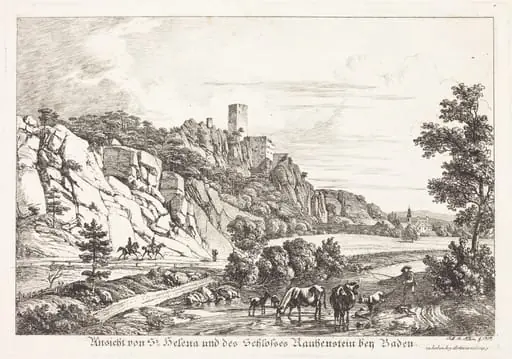
Created in 1818 by Johann Adam Klein, this etching depicts a rugged mountain in the Tyrol region, crowned by a fortified castle. Rendered in monochrome on laid paper, the composition balances natural terrain with human structures. The quiet atmosphere is reinforced by the stillness of figures and animals, suggesting a moment suspended in time rather than a narrative event.
Subject & Meaning
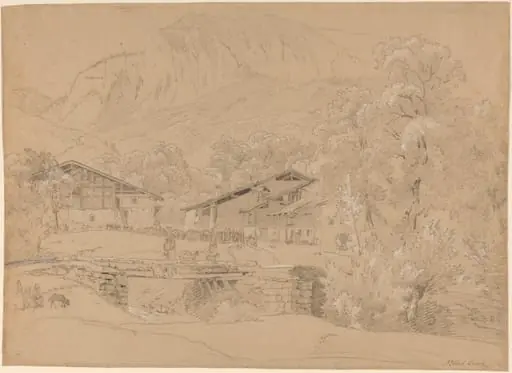
The scene centers on a lone woman in traditional dress, standing near three grazing cows, her presence subtly anchoring the landscape. The castle, perched precariously on the cliff, implies historical continuity, while the bridge and stream suggest passage and connection. The absence of movement or drama conveys a sense of enduring rural life, rooted in the land rather than defined by action.
Technique & Style
The paper’s laid texture subtly interacts with the ink, adding warmth to the otherwise precise lines, characteristic of early 19th-century topographical prints.
Klein employed fine, controlled etching lines to model form and texture, giving depth to the rocky outcrop, foliage, and wooden fence. The use of hatching and cross-hatching creates subtle tonal variations, enhancing the three-dimensionality of the terrain. The paper’s laid texture subtly interacts with the ink, adding warmth to the otherwise precise lines, characteristic of early 19th-century topographical prints.
History & Provenance
The print was made during Klein’s period of travel and documentation in the Tyrol, part of a broader effort to record regional landscapes in the wake of Napoleonic upheavals. It was likely produced for private collectors or as part of a series, though its early ownership records remain unclear. No known exhibition history exists prior to the 20th century.
Context
In early 19th-century Europe, topographical prints like this served both documentary and aesthetic purposes. Artists such as Klein responded to growing interest in regional identity and natural scenery, often commissioned by travelers or local patrons. This work reflects a shift from idealized landscapes toward observed, specific locales, aligning with Romantic-era sensibilities without overt emotional dramatization.
Legacy
Klein’s etching contributes to a body of work that preserved the visual character of Alpine regions before widespread industrialization. While not widely reproduced, it remains a representative example of German-speaking printmakers’ attention to detail and quiet observation. Its preservation in institutional collections underscores its value as a historical record of place and practice.
Artist & collection