Artwork
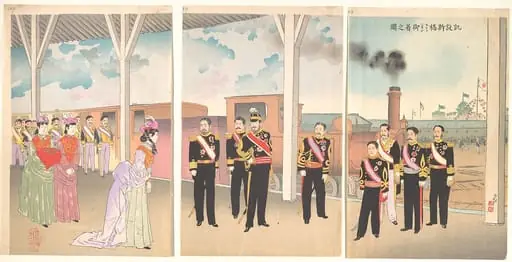
参謀本部行啓之図|Illustration of the Empress Visiting the General Staff Headquarters [to present a tray of bandages] (Sanbō honbu gyōkei no zu)
![参謀本部行啓之図|Illustration of the Empress Visiting the General Staff Headquarters [to present a tray of bandages] (Sanbō honbu gyōkei no zu), by Kobayashi Kiyochika, ink, 1895](https://artifactworldgallery.com/img/kobayashi-kiyochika--illustration-of-the-empress-visiting-the-general-staff-headq--f80f7b0e9726abbf-w1024.webp)
参謀本部行啓之図|Illustration of the Empress Visiting the General Staff Headquarters [to present a tray of bandages] (Sanbō honbu gyōkei no zu) is an ink print by the Impressionist artist Kobayashi Kiyochika. It dates from 1895 and is held in the collection of the Metropolitan Museum of Art.
About this work
Overview
Each of the three panels captures a distinct moment of the event, rendered in ink and color on paper.
Created in 1895 by Kobayashi Kiyochika, this triptych woodblock print depicts a ceremonial visit by the Empress to the Imperial Japanese General Staff Headquarters. Each of the three panels captures a distinct moment of the event, rendered in ink and color on paper. The composition follows traditional ukiyo-e formatting, with clear divisions between scenes and a restrained palette dominated by reds and golds, emphasizing ritual formality over naturalism.
Subject & Meaning
The print records a symbolic act of imperial support for the military during the First Sino-Japanese War. The Empress is shown presenting a tray of bandages, a gesture meant to convey compassion and national unity. The presence of high-ranking officers and court attendants underscores the event’s political significance. The scene blends ceremonial protocol with moral messaging, reinforcing the Empress’s role as a moral anchor for the armed forces.
Technique & Style
Kiyochika employs flat areas of color and simplified forms, characteristic of late 19th-century ukiyo-e adapting to modern subjects. Linework is precise but uncluttered, with minimal shading. The use of bold reds in curtains and garments creates visual continuity across panels, while the lack of perspective and depth gives the work a stylized, almost theatrical quality. This approach prioritizes symbolic clarity over realism.
History & Provenance
Commissioned to commemorate the Empress’s visit to the General Staff in 1895, the print was produced during a period of rising nationalism and military expansion. It entered The Metropolitan Museum of Art’s collection through established channels of early 20th-century Japanese art acquisition. Its survival in good condition reflects its status as a documented historical artifact rather than a mass-market print.
Context
Produced during the First Sino-Japanese War, the print aligns with state-sponsored imagery promoting imperial authority and military morale. Kiyochika, once known for landscapes of Meiji-era Tokyo, shifted toward official subjects as Japan modernized its visual culture. This work reflects the state’s use of traditional print media to legitimize new political structures and reinforce the Emperor’s symbolic centrality.
Legacy
The triptych stands as a rare example of Kiyochika’s engagement with state ceremonial themes, distinguishing it from his earlier, more personal works. It remains a key reference for understanding how ukiyo-e evolved under Meiji-era nationalism. While not widely reproduced, it is studied for its visual diplomacy and as evidence of the intersection between art, monarchy, and militarism in modern Japan.
Artist & collection

Artist
Kiyochika grew up in Tokyo when the city was turning from samurai streets into a modern capital.

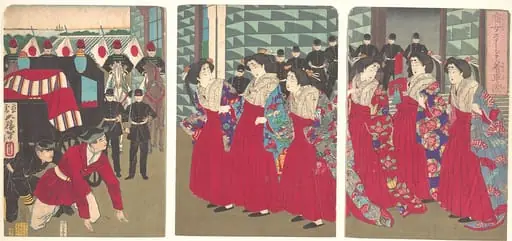 官女ステーション着車図|Illustration of Ladies-in-waiting boarding at a station (Kanjo sutēshon chakusha zu)
![野戦病院行幸之図|Illustration of the Empress Visiting a Field Hospital [in Hiroshima] (Yasen byōin gyōkō no zu), by Kobayashi Kiyochika](https://artifactworldgallery.com/img/kobayashi-kiyochika--illustration-of-the-empress-visiting-a-field-hospital-in-hir--34d3a02653578c64-w320.webp) 野戦病院行幸之図|Illustration of the Empress Visiting a Field Hospital [in Hiroshima] (Yasen byōin gyōkō no zu)
野戦病院行幸之図|Illustration of the Empress Visiting a Field Hospital [in Hiroshima] (Yasen byōin gyōkō no zu)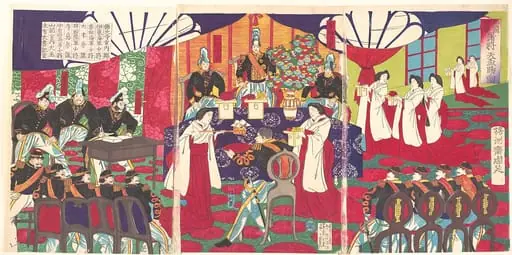 西国諸将鎮静天杯賜ル之図|Illustration of the Commanders who Pacified Western Japan, Receiving the Emperor's Gift Cups (Saigoku chinsei shoshō tenpai o tamawaru no zu)
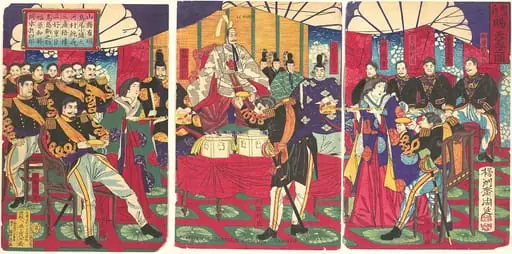 勲功之将天杯賜之図|Illustration of the Honored Commanders, Receiving the Emperor's Gift Cup (Kunkō no shō tenpai o tamau no zu)
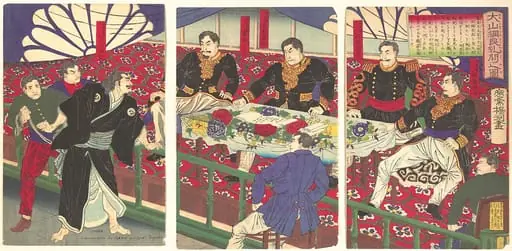 大山綱良糾問の図|Illustration of the Inquisition of Ōyama Tsunayoshi (Ōyama Tsunayoshi kyūmon no zu)
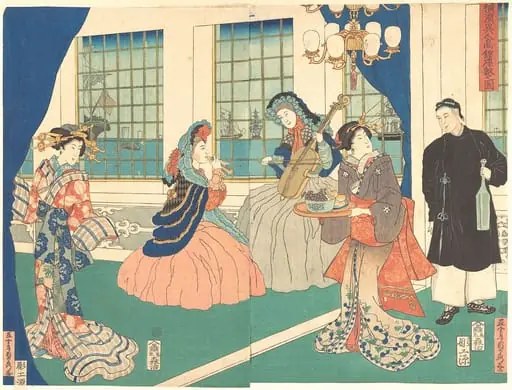 『横浜異 人商館座敷之図』|Drawing Room of a Foreign Business Establishment in Yokohama