Artwork
The Trimurti cave at Elephanta Caves, Bombay
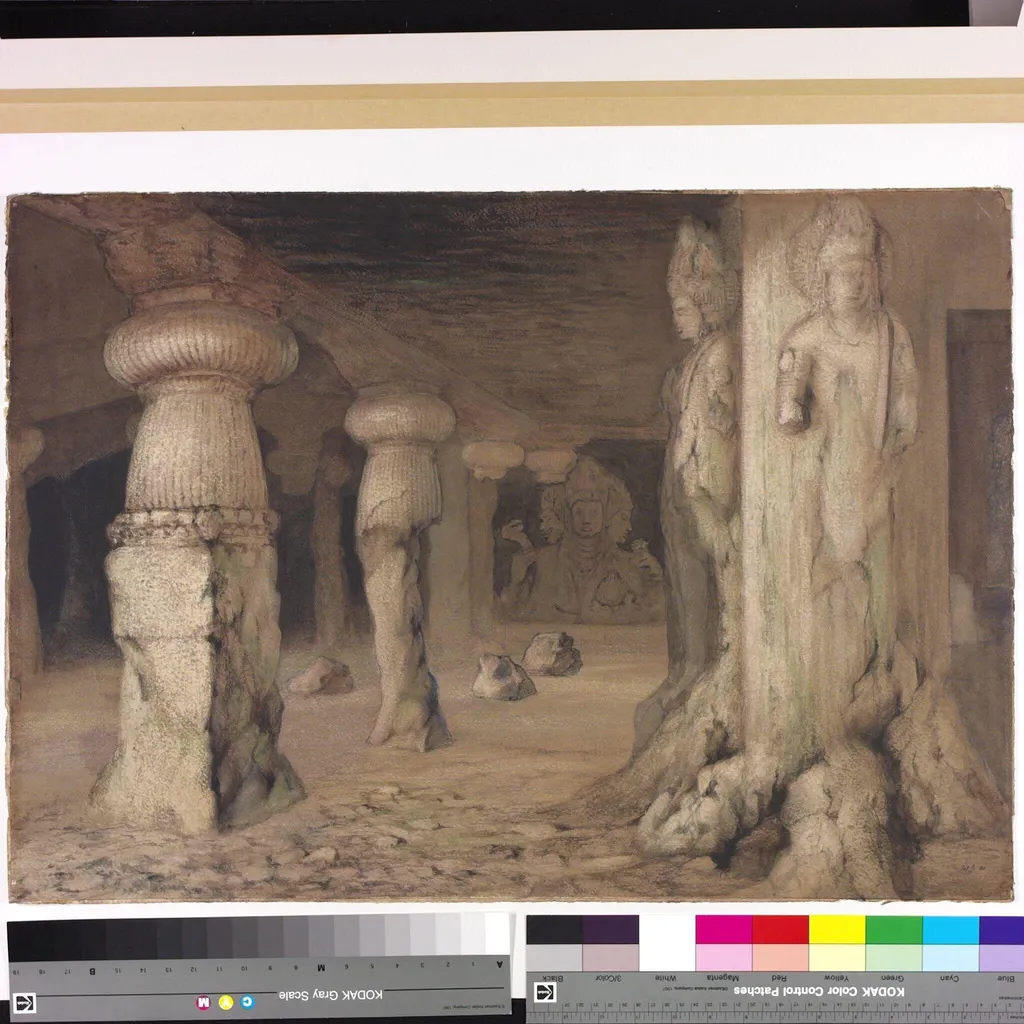
The Trimurti cave at Elephanta Caves, Bombay is a paint painting by the Impressionist artist George Landseer. It dates from 1860 and is held in the collection of the Victoria and Albert Museum.
About this work
Overview
These works capture the monumental stone reliefs within the cave, rendered with attention to architectural form and atmospheric lighting.
George Landseer, a 19th-century English artist, produced a series of 31 sketches documenting the Trimurti cave at Elephanta during his travels in northern India. These works capture the monumental stone reliefs within the cave, rendered with attention to architectural form and atmospheric lighting. The sketches were later donated by his widow and remain a visual record of the site as observed by a Western artist in the mid-1800s.
Subject & Meaning
The sketches focus on the central triadic sculpture of Shiva as creator, preserver, and destroyer — a representation of Hindu cosmology carved into the cave’s rock face. Landseer’s compositions emphasize the scale and solemnity of the figures, framed by the cavern’s natural darkness. His approach treats the reliefs as both religious artifacts and sculptural forms, without overt interpretive commentary.
Technique & Style
Landseer employed chiaroscuro to convey the cave’s dim interior, using strong contrasts between shadow and light to suggest depth and volume. His linework balances precise detail in the carvings with looser, suggestive strokes in the surrounding rock, blending observational realism with a soft, atmospheric quality. The technique reflects his training in portraiture and landscape, adapted to an unfamiliar architectural context.
History & Provenance
Landseer traveled to India in the 1850s as part of a broader wave of British artists documenting colonial territories. He returned to England in 1870, bringing with him the sketch collection, which remained in private hands until his widow’s donation. The works were not exhibited publicly during his lifetime but are now held as historical records of 19th-century artistic engagement with Indian heritage.
Context
During Landseer’s visit, the Elephanta Caves were largely neglected by local authorities and rarely visited by Western travelers. His sketches emerged amid growing European interest in South Asian antiquities, often framed by colonial curiosity rather than scholarly study. The drawings offer a rare visual account of the site before modern conservation efforts.
Legacy
Landseer’s sketches serve as a primary visual archive of the Trimurti cave’s condition in the mid-19th century. While not widely known in art history, they provide insight into how British artists interpreted non-Western sacred spaces. The collection remains a resource for scholars studying early documentation of Indian heritage and cross-cultural artistic exchange.
Artist & collection
Artist
George Landseer (1829–1878 London) was a British painter. He was the nephew of Sir Edwin Henry Landseer and his father Thomas Landseer was also an artist. He studied at the Royal Academy Schools in 1846 and exhibited at…

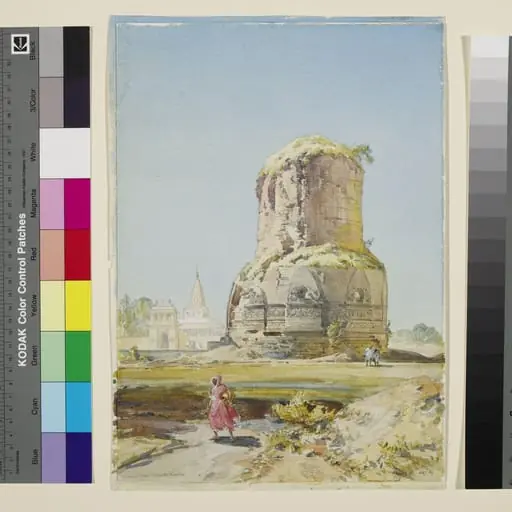 Buddhist stupa at Sarnath, Benaras
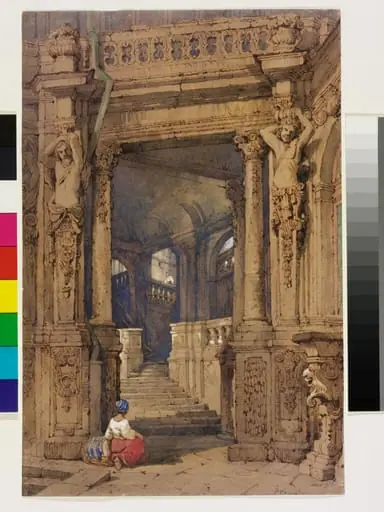 Entrance to the Zwinger, Dresden
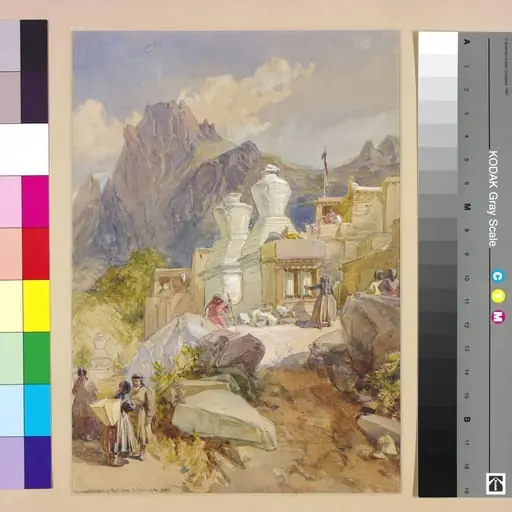 Praying cylinders in the village of Kulsi on the Indus
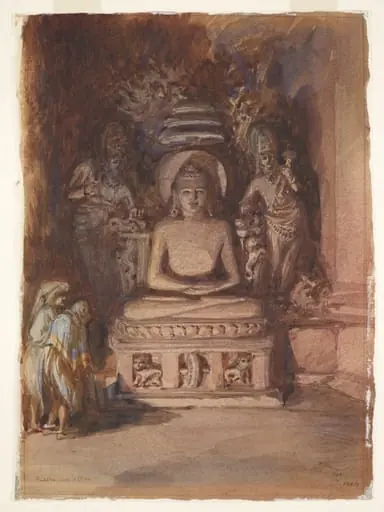 Buddha, Caves of Ellora
 Portrait of a Lady with her little Daughter
 The Nishat Bagh
 Sculpture at Temple
 Rameshwar cave, Ellora
 Sculpture Court including the Discobolus at Crystal Palace
 'Stele with Buddhist triad', China, 581-618 or later, 'Bodhisattva', Japan, 'Bowl', (origins unknown), 'Figure of Avalokiteshvara', Japanese, after statue in Horyuji Temple, early 20th century, 'Bodhisattva Avalokiteshvara (Kannon)', Japan, late 8th century, from the Charles Lang Freer Collection