Artwork
Jesus Christ before Pontias Pilate
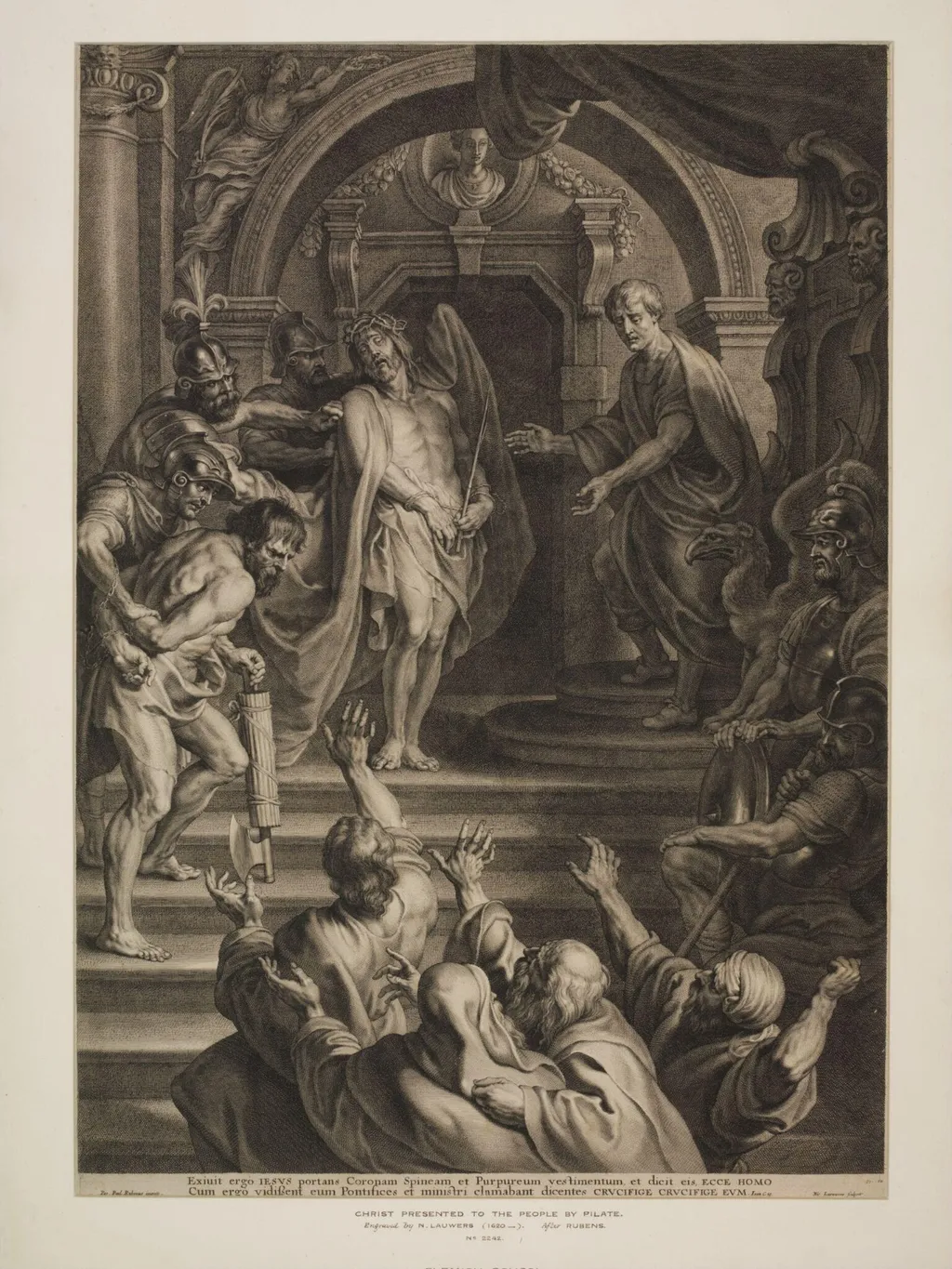
Jesus Christ before Pontias Pilate is a print by Nicolaes Lauwers. It dates from 1650 and is held in the collection of the Victoria and Albert Museum.
About this work
Overview
Created in 1650 by Nicolaes Lauwers, this print depicts the biblical moment of Christ’s trial before Pontius Pilate.
Created in 1650 by Nicolaes Lauwers, this print depicts the biblical moment of Christ’s trial before Pontius Pilate. It is a reproductive engraving based on a composition by Peter Paul Rubens, reflecting the widespread practice of disseminating major artistic designs through printmaking in the 17th century. The work is signed 'Laeuwers,' a variant spelling of the artist’s name, and was produced on paper using etching and engraving techniques common in Flemish print workshops.
Subject & Meaning
The scene captures Jesus, dressed plainly, standing before Pilate, who is depicted in richer attire, emphasizing their contrasting social and spiritual roles. Around them, a crowd of figures gestures in agitation or supplication, heightening the emotional weight of the moment. The composition underscores the tension between divine passivity and human authority, a theme central to Christian iconography of the Passion, inviting contemplation on justice, power, and sacrifice.
Technique & Style
Lauwers employed fine linear engraving to render the figures and architectural details with precision. Strong contrasts in light and shadow, derived from Rubens’s original, define the forms and create a sense of depth. The background archway, rendered with intricate detailing, frames the central figures, while the crowd’s varied postures add narrative complexity. The print’s clarity and controlled line work reflect the technical discipline of Flemish reproductive engraving at mid-century.
History & Provenance
The print was made during a period when Rubens’s designs were widely circulated through prints, ensuring his influence extended beyond painting. Lauwers, active in Antwerp, specialized in translating major compositions into engraved form for collectors and religious institutions. While specific early ownership records are sparse, such prints were commonly bound in devotional albums or used as teaching aids in clerical settings across Europe.
Context
In mid-17th-century Flanders, religious imagery remained central to both private devotion and public identity, despite the Protestant Reformation’s impact. Printmakers like Lauwers played a key role in sustaining Catholic visual culture by reproducing works by leading artists such as Rubens. The trial of Christ was a popular subject, resonating with contemporary theological debates about authority, guilt, and redemption.
Legacy
Lauwers’s print contributed to the enduring visual vocabulary of Christ’s trial in European art. Though not an original composition, its precise execution helped standardize Rubens’s interpretation for generations of viewers. Such reproductive prints ensured that major Baroque narratives reached audiences beyond elite collectors, embedding them in broader cultural consciousness through accessible, widely distributed formats.
Artist & collection