Artwork
Farm (Une ferme)
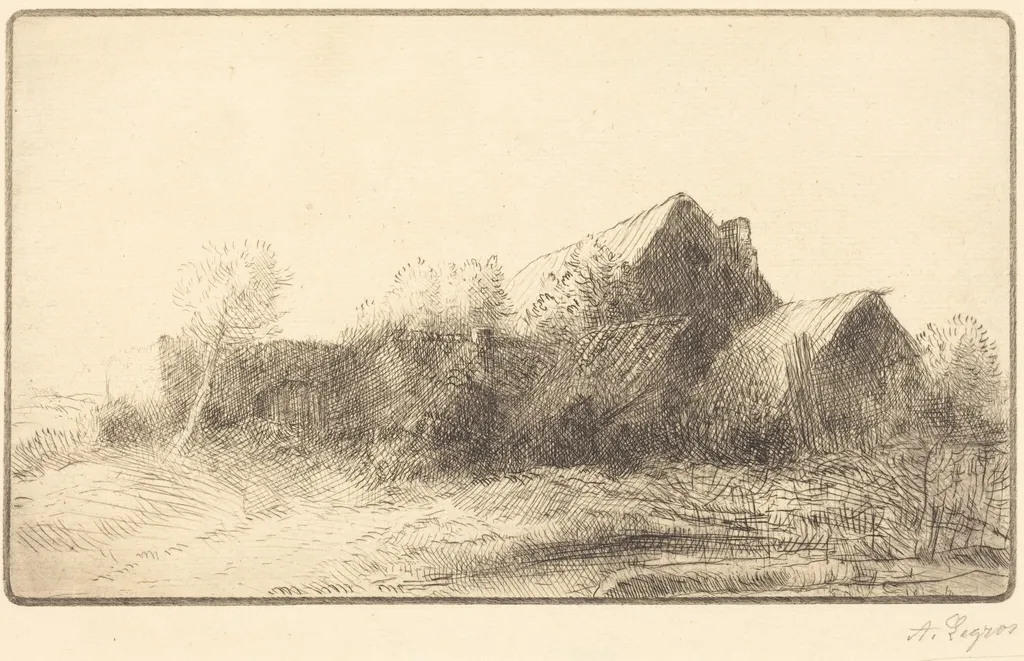
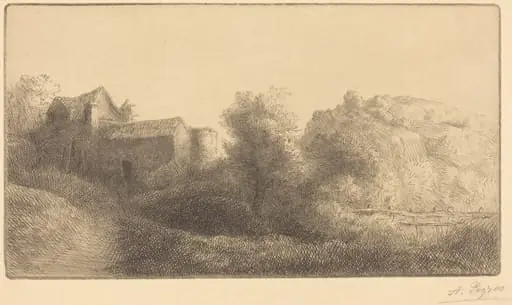
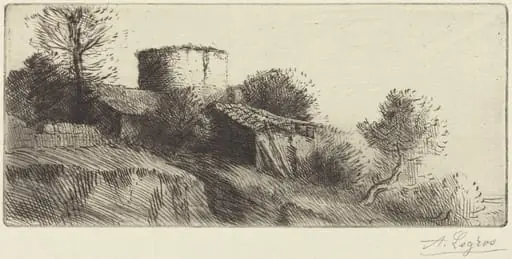
Farm (Une ferme) is an ink print by the Romanticist artist Alphonse Legros. It dates from 1874 and is held in the collection of the National Gallery of Art.
About this work
Overview
Created in 1874, *Farm (Une ferme)* is an etching and drypoint by Alphonse Legros, a French artist who moved to London in 1863 and became a British citizen. The work belongs to a period when Legros was deeply engaged in printmaking, helping to reinvigorate the medium in Britain. His technical mastery and interest in rural subjects shaped much of his graphic output during this time.
Subject & Meaning
The composition conveys a sense of place rooted in labor and isolation, reflecting Legros’s interest in the dignity of rural life without overt sentimentality.
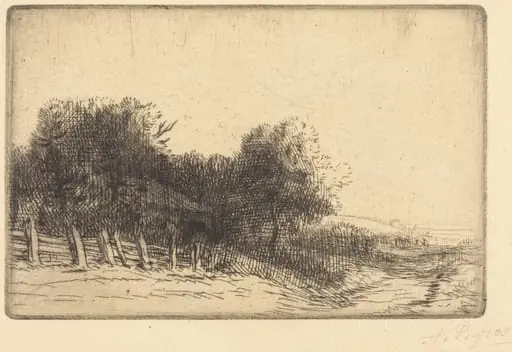
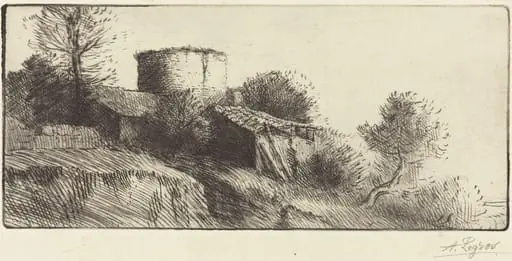
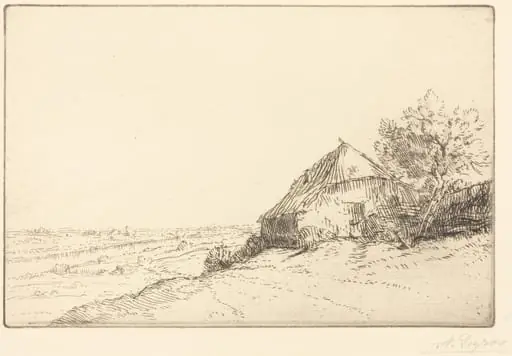
The scene depicts a cluster of modest dwellings nestled in a valley, surrounded by rugged mountains and sparse vegetation. There is no human presence, yet the arrangement of structures and the texture of the land suggest quiet, enduring habitation. The composition conveys a sense of place rooted in labor and isolation, reflecting Legros’s interest in the dignity of rural life without overt sentimentality.
Technique & Style
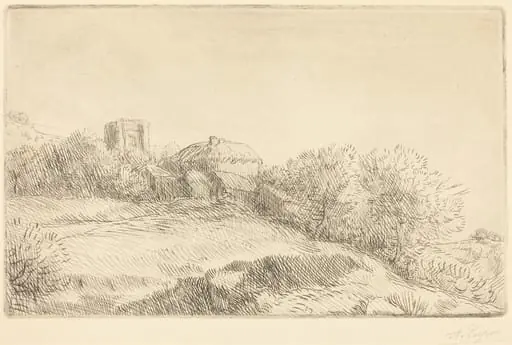
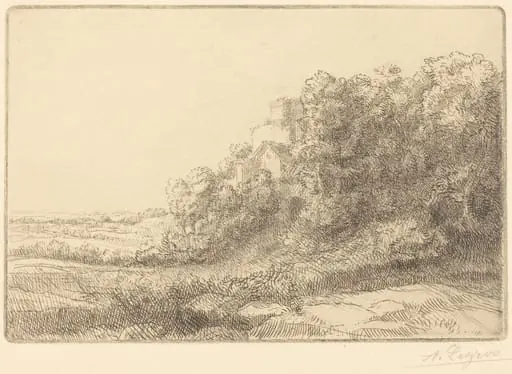
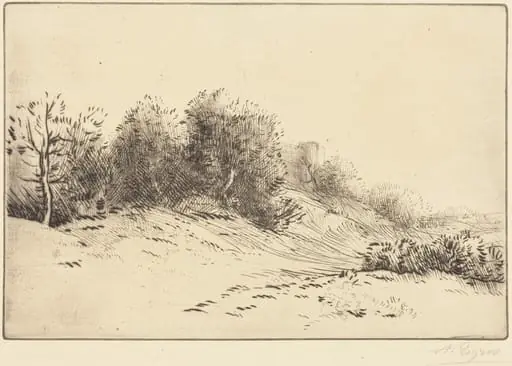
Legros employed etching and drypoint to create a dense, tactile surface. Drypoint’s burr holds ink to produce rich, velvety blacks, especially in the shadowed slopes and rooflines, while etched lines define the contours of buildings and terrain. The sketchlike quality arises from spontaneous, angular strokes that mimic the roughness of the landscape, emphasizing texture over precision.
History & Provenance
The print was made during Legros’s early years in London, a time when he was establishing himself in British artistic circles. Though specific early ownership records are sparse, it was likely circulated among print collectors and students at the Slade School, where Legros taught. Its survival reflects its status as a working example of his evolving printmaking practice.
Context
In the 1870s, British printmaking was undergoing a revival, with artists turning away from commercial reproduction toward expressive, hand-made etchings. Legros, influenced by French Realism and Dutch landscape traditions, contributed to this movement by emphasizing direct observation and material honesty. *Farm* aligns with this shift, valuing the rawness of the natural world over idealized composition.
Legacy
Legros’s prints, including *Farm*, influenced a generation of British etchers who sought to elevate printmaking as a fine art. His use of drypoint to capture texture and atmosphere became a model for later artists. Though less widely known today, his work remains a touchstone in the history of 19th-century graphic art for its technical rigor and quiet emotional resonance.
Artist & collection

Artist
Alphonse Legros (French pronunciation: ; 8 May 1837 – 8 December 1911) was a French, later British, painter, etcher, sculptor, and medallist.