Artwork
Landscape with Boat, 1st plate (Le paysage au bateau)
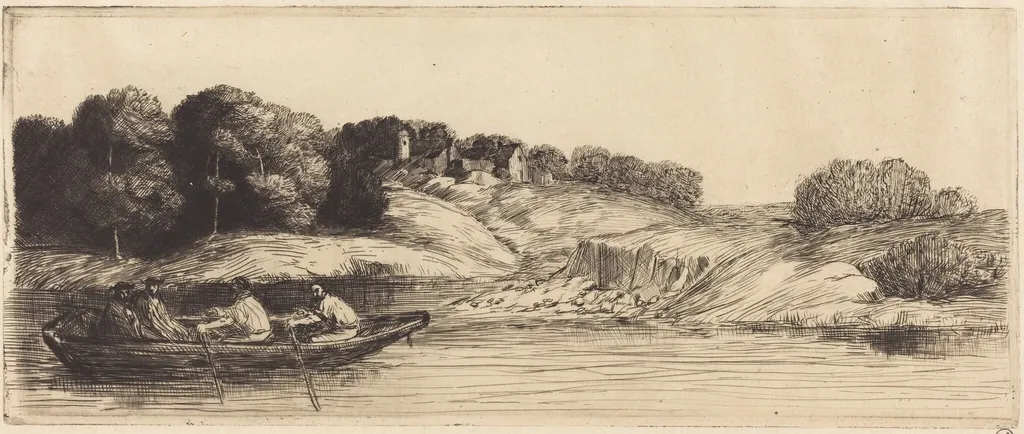
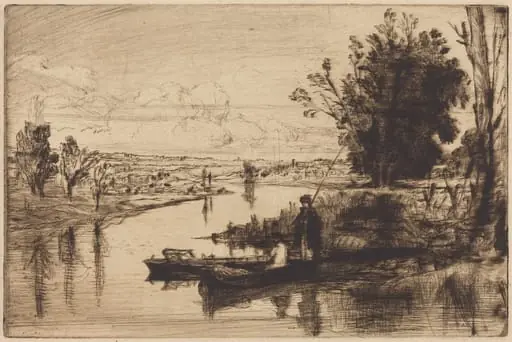
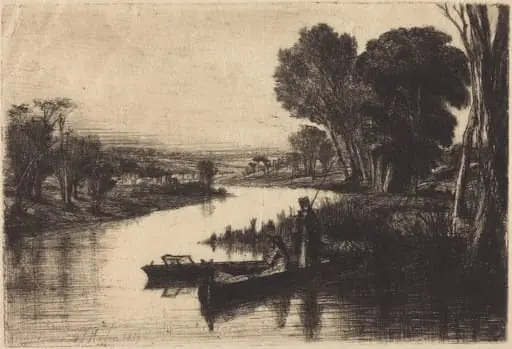
Landscape with Boat, 1st plate (Le paysage au bateau) is an ink print by the Romanticist artist Alphonse Legros. It dates from 1874 and is held in the collection of the National Gallery of Art.
About this work
Overview
Executed in etching and drypoint, the work reflects his deep engagement with printmaking during a period when he helped reinvigorate the medium in Britain.
Created in 1874, *Landscape with Boat, 1st plate* is an intaglio print by Alphonse Legros, a French artist who moved to London in 1863. Executed in etching and drypoint, the work reflects his deep engagement with printmaking during a period when he helped reinvigorate the medium in Britain. Unlike his sculptural or painted works, this piece emphasizes quiet observation over dramatic expression, capturing a moment in a rural landscape with restrained precision.
Subject & Meaning
The scene presents a tranquil waterside setting: a small boat floats near the foreground, carrying indistinct figures, while gently rolling hills and scattered trees recede into the distance. Distant buildings suggest human habitation without disrupting the quietude. The composition avoids narrative specificity, instead inviting contemplation of stillness and solitude. Legros treats the landscape not as a backdrop but as a subject worthy of quiet reverence, aligned with his broader interest in everyday rural life.
Technique & Style
Legros employed etching for fine linear detail and drypoint for rich, velvety blacks, layering both to build subtle tonal gradations. The water’s surface is suggested through delicate, meandering lines, while the hills and foliage are rendered with textured, cross-hatched marks. The boat’s form is simplified yet distinct, anchored by dense shadow. His technique avoids theatrical contrast, favoring a muted palette and soft transitions that enhance the scene’s calm, introspective mood.
History & Provenance
The print was made during Legros’s early years in London, shortly after his appointment as professor of drawing at the Slade School. It belongs to a series of landscapes he produced between 1870 and 1880, reflecting his shift from figural subjects to natural scenes. While the print’s early ownership is undocumented, it was later included in institutional collections, notably the British Museum, which acquired examples of his prints as part of its broader effort to preserve 19th-century British printmaking.
Context
In the 1870s, British printmaking was undergoing a revival, with artists like Legros championing etching as a serious artistic medium rather than a reproductive tool. His work aligned with the broader European interest in naturalism and the quietude of rural life, contrasting with the grandeur of academic painting. Legros’s prints, including this one, contributed to a growing appreciation for the expressive potential of intaglio techniques among British artists and collectors.
Legacy
Legros’s *Landscape with Boat* exemplifies his influence on the British etching revival, demonstrating how technical mastery could serve quiet, observational art. Though less celebrated than his portraits or sculptures, this print helped establish a model for landscape etching that emphasized atmosphere over spectacle. His students and contemporaries adopted his restrained approach, embedding his methods into the pedagogy of the Slade and shaping a generation of printmakers focused on subtlety and craft.
Artist & collection

Artist
Alphonse Legros (French pronunciation: ; 8 May 1837 – 8 December 1911) was a French, later British, painter, etcher, sculptor, and medallist.