Artwork
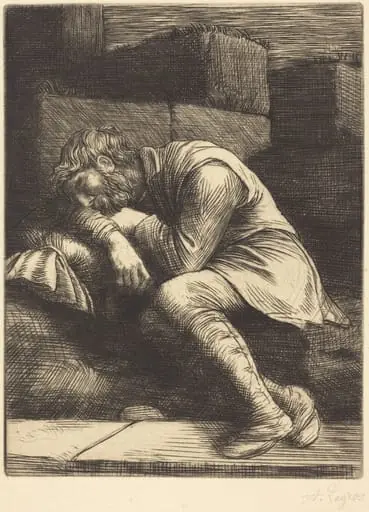
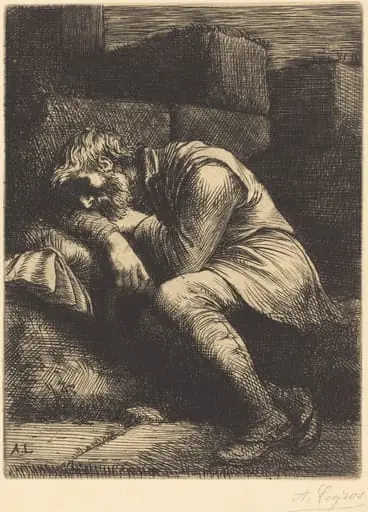
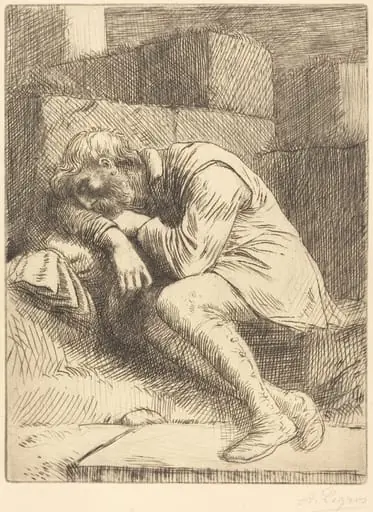
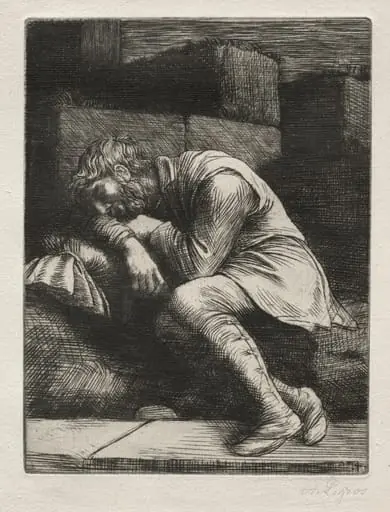
Sleeping Beggar (Mendiant endormi)
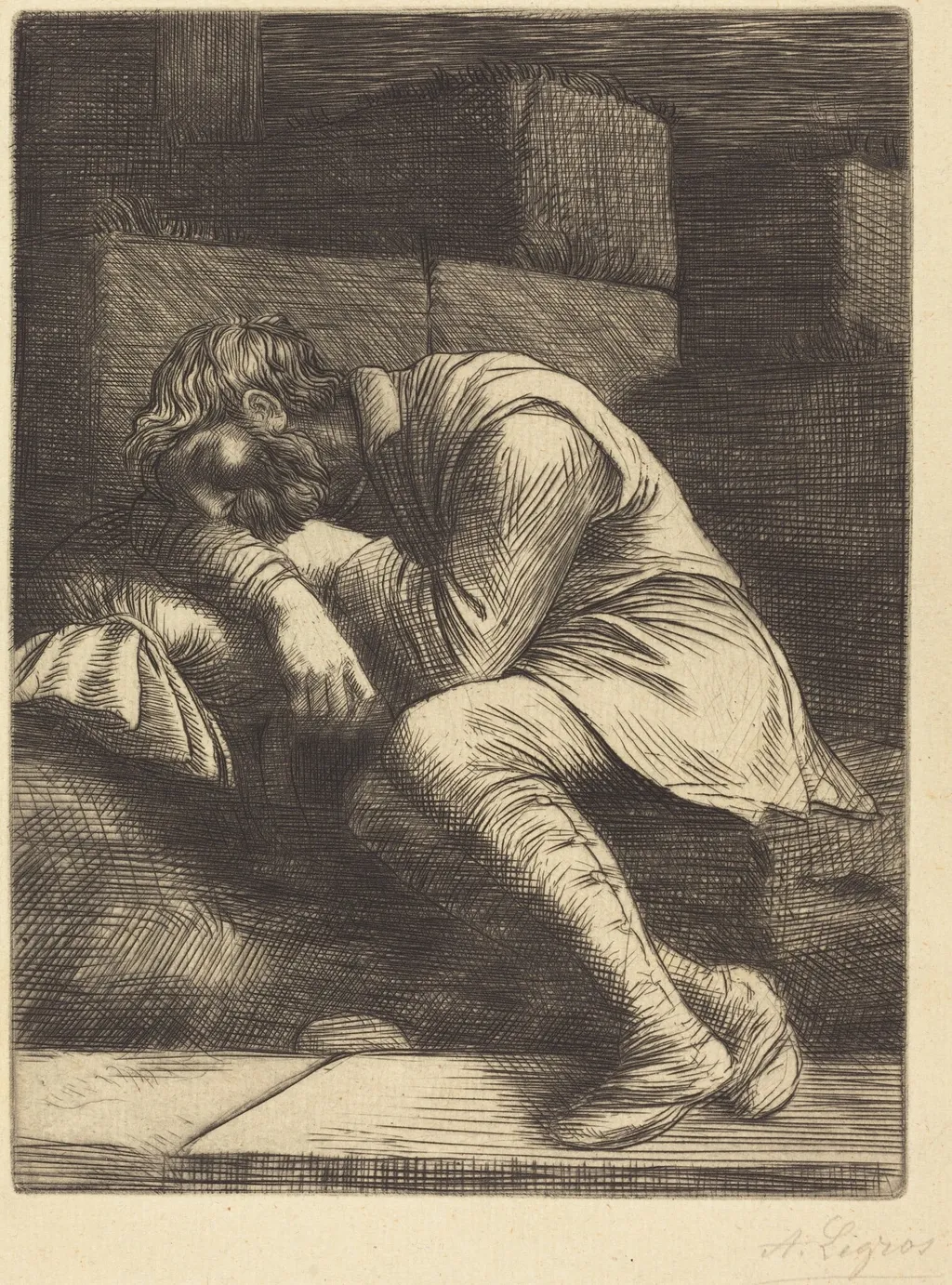
Sleeping Beggar (Mendiant endormi) is an ink print by the Romanticist artist Alphonse Legros. It dates from 1874 and is held in the collection of the National Gallery of Art.
About this work
Overview
Created in 1874 by Alphonse Legros, *Sleeping Beggar (Mendiant endormi)* is an etching and drypoint print that captures a moment of quiet vulnerability. Legros, originally French but based in Britain since 1863, was instrumental in revitalizing printmaking there. This work exemplifies his commitment to the expressive potential of intaglio techniques, blending observation with emotional restraint.
Subject & Meaning
The absence of narrative detail or judgment invites contemplation rather than pity, emphasizing dignity in stillness.
The print portrays a woman, exhausted and asleep on the ground, her body curled in a natural yet strained posture. Her loose garments and exposed skin suggest poverty and exposure to the elements. The absence of narrative detail or judgment invites contemplation rather than pity, emphasizing dignity in stillness. The scene’s intimacy transforms a moment of hardship into a quiet meditation on human resilience.
Technique & Style
Legros employed drypoint to carve fine, richly textured lines directly into the metal plate, capturing the folds of fabric and subtle shadows on the figure’s skin with remarkable precision. Etching provided broader tonal areas, while the soft burr of drypoint added depth and warmth. The dark, heavily worked background enhances the figure’s solitude, using contrast to isolate her within a confined, private space.
History & Provenance
Executed during Legros’s early years in London, the print emerged from a period when he was actively teaching and promoting etching as a serious artistic medium. Though not widely exhibited at the time, it reflects his engagement with social realism and his alignment with European traditions of depicting the marginalized. Its survival in institutional collections underscores its significance in the revival of British printmaking.
Context
In the 1870s, British art saw renewed interest in printmaking as an autonomous form, distinct from reproductive engraving. Legros, influenced by French Realism and the Barbizon school, brought a focus on everyday life and unidealized figures. *Sleeping Beggar* aligns with this shift, rejecting romanticism in favor of direct observation, mirroring broader cultural movements toward social awareness in the visual arts.
Legacy
The print remains a quiet but enduring example of Legros’s influence on British print culture. His technical rigor and empathetic subject matter inspired a generation of artists to treat etching as a vehicle for personal expression. While not widely reproduced, *Sleeping Beggar* continues to be studied for its mastery of tone, composition, and its unembellished portrayal of human fragility.
Artist & collection

Artist
Alphonse Legros (French pronunciation: ; 8 May 1837 – 8 December 1911) was a French, later British, painter, etcher, sculptor, and medallist.