Artwork
Sleeping Beggar (Mendiant endormi)
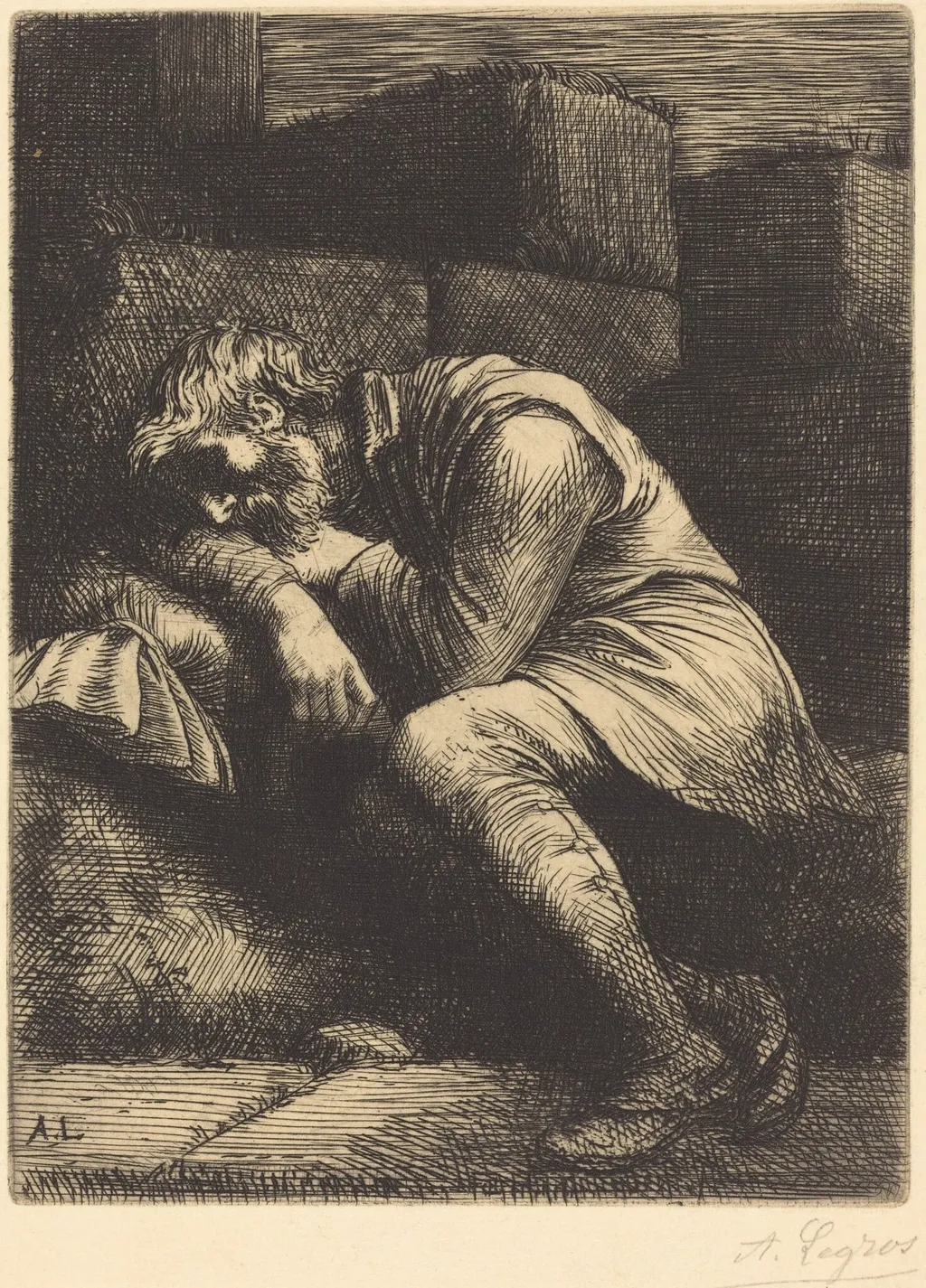
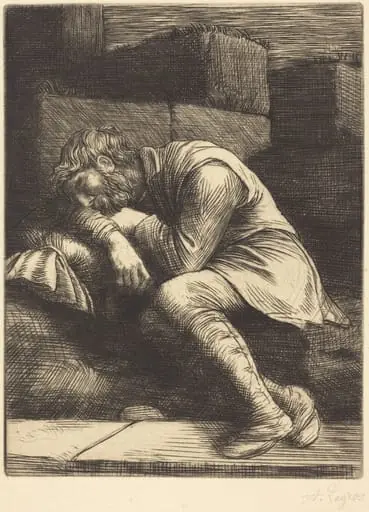
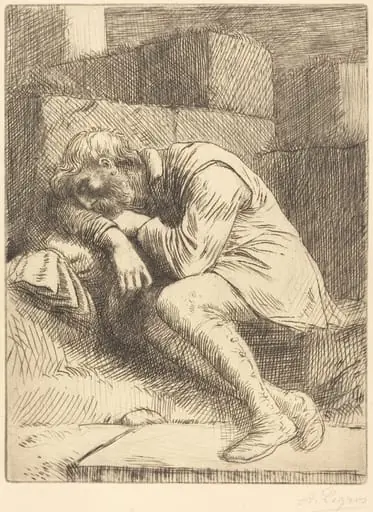
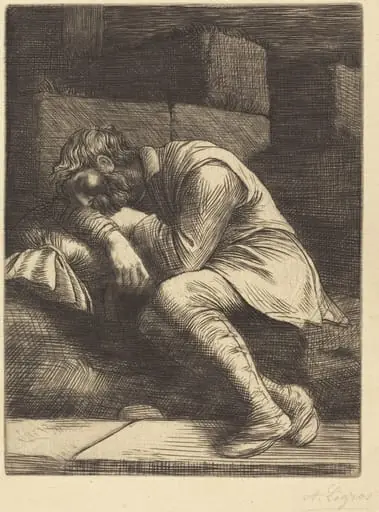
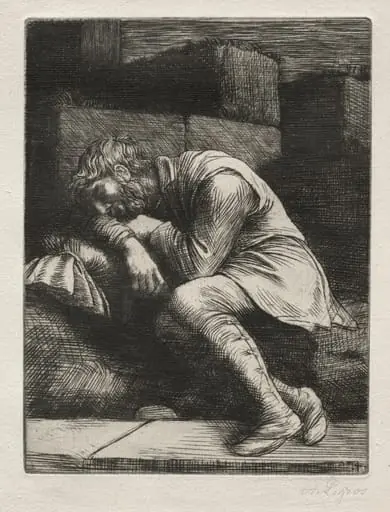
Sleeping Beggar (Mendiant endormi) is an ink print by the Romanticist artist Alphonse Legros. It dates from 1874 and is held in the collection of the National Gallery of Art.
About this work
Overview
Created in 1874 by Alphonse Legros, *Sleeping Beggar (Mendiant endormi)* is an etching and drypoint print depicting a destitute man at rest.
Created in 1874 by Alphonse Legros, *Sleeping Beggar (Mendiant endormi)* is an etching and drypoint print depicting a destitute man at rest. Legros, originally French but based in London since 1863, was instrumental in revitalizing printmaking in Britain. This work exemplifies his commitment to the expressive potential of graphic media, capturing quiet human vulnerability through meticulous line work and tonal variation.
Subject & Meaning
The figure is a homeless man, curled on the ground with his head resting on a folded bundle of cloth. His posture suggests profound fatigue, not mere repose. The absence of narrative context or symbolic embellishment directs attention to the raw physicality of poverty. The relaxed face contrasts with the ragged clothing, emphasizing dignity amid hardship without melodrama.
Technique & Style
Legros employed etching for fine, controlled lines and drypoint for richer, grainy textures, enhancing the tactile quality of fabric and skin. Deep shadows enclose the figure, isolating it in a dim, undefined space. The contrast between the soft contours of the body and the harsh, scratchy background creates a sense of weight and solitude, characteristic of Legros’s tonal approach to printmaking.
History & Provenance
Produced during Legros’s tenure at the Slade School of Fine Art, the print reflects his influence on British artistic practice. Though not widely exhibited at the time, it circulated among collectors and students, contributing to the revival of etching as a serious medium. Its survival in institutional collections underscores its role in late 19th-century print culture.
Context
While often associated with Realism, Legros’s work engages with the social concerns of his era without overt political messaging. The sleeping beggar aligns with broader European interest in marginalized figures, yet avoids romanticization. Unlike Romantic depictions of the sublime, this image grounds suffering in quiet, unadorned observation, reflecting a shift toward modern social awareness in art.
Legacy
Legros’s *Sleeping Beggar* remains a quiet landmark in British printmaking, illustrating how technical precision could convey emotional depth without spectacle. It influenced subsequent generations of printmakers who valued directness and material honesty. The work endures not as a commentary on poverty, but as a testament to the artist’s ability to render humanity with restraint and clarity.
Artist & collection

Artist
Alphonse Legros (French pronunciation: ; 8 May 1837 – 8 December 1911) was a French, later British, painter, etcher, sculptor, and medallist.