Artwork
Women of Brussels (Femmes de Bruges)
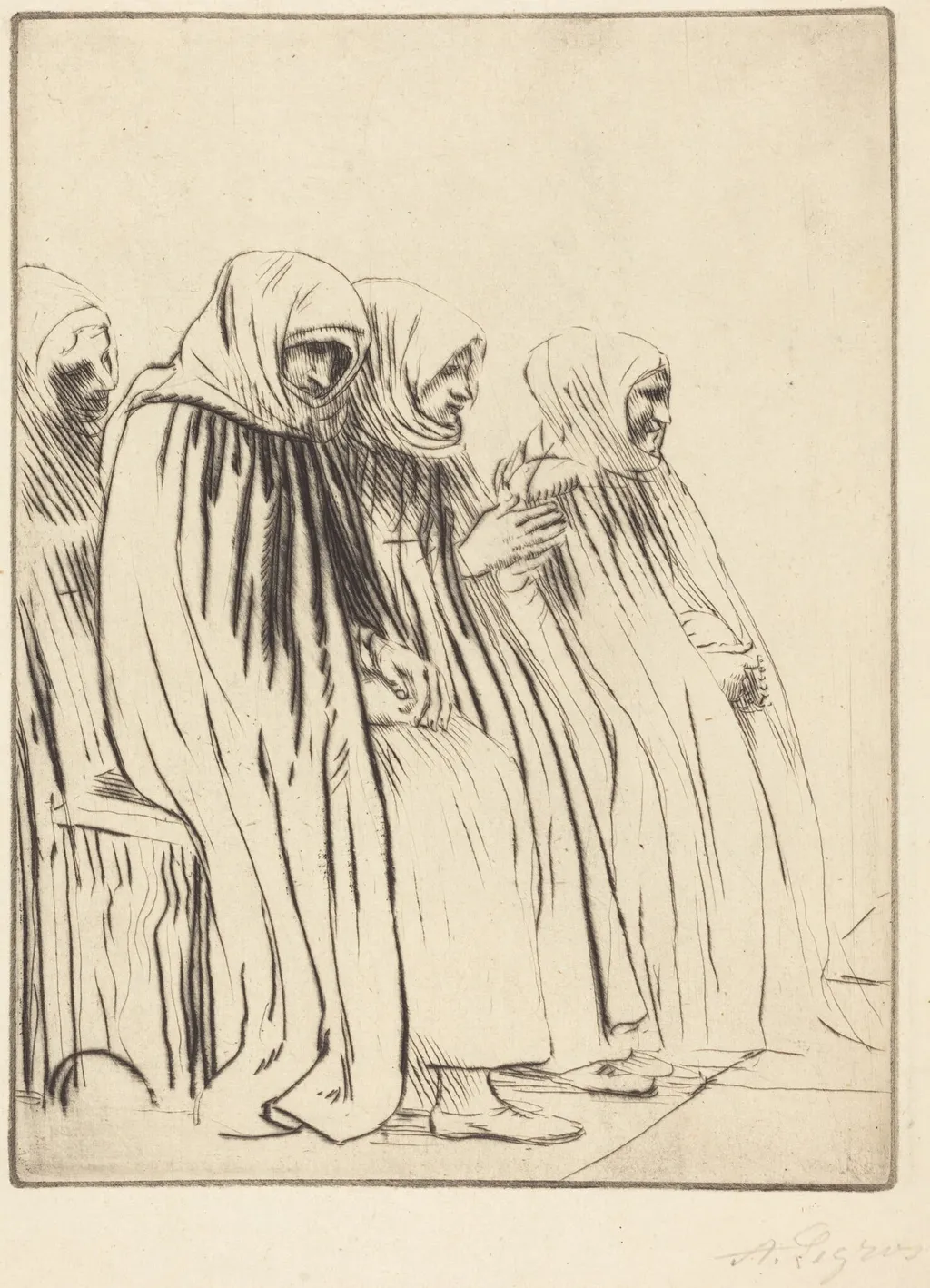
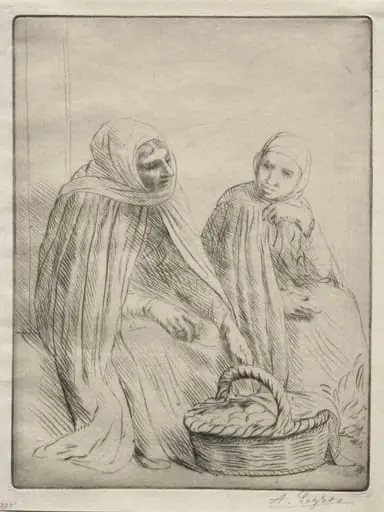
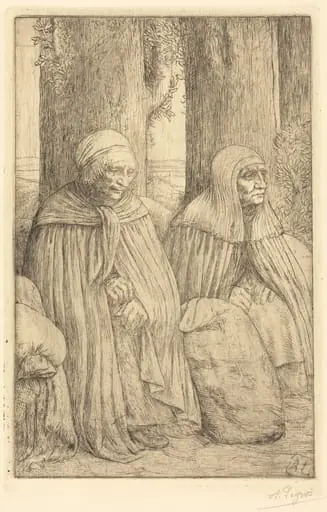
Women of Brussels (Femmes de Bruges) is an ink print by the Romanticist artist Alphonse Legros. It dates from 1874 and is held in the collection of the National Gallery of Art.
About this work
Overview
This work exemplifies his commitment to printmaking as a serious artistic medium, emphasizing expressive line and tonal depth over polished finish.
Created in 1874 by Alphonse Legros, *Women of Brussels (Femmes de Bruges)* is an intaglio print combining etching and drypoint. Legros, a French artist who moved to London in 1863, became a central figure in the British etching revival. This work exemplifies his commitment to printmaking as a serious artistic medium, emphasizing expressive line and tonal depth over polished finish. The image captures a quiet moment in urban life with minimal detail and maximum emotional resonance.
Subject & Meaning
The print portrays three women walking together in a city, their forms defined by flowing drapery and synchronized movement. Their faces are left indistinct, shifting focus from individual identity to collective presence. The absence of a detailed background isolates their motion, suggesting anonymity and routine. The work reflects Legros’s interest in ordinary life, portraying women not as symbols but as quiet participants in the rhythm of urban existence.
Technique & Style
Legros employed drypoint to scratch directly into a metal plate, creating rich, fuzzy lines that hold ink unevenly, and etching to define broader forms. The resulting texture is coarse and immediate, with scratchy strokes suggesting fabric, shadow, and motion. The lack of fine detail and the grainy tonal range give the image a sense of spontaneity. This method prioritizes expressive gesture over precision, aligning with the aesthetic values of the etching revival movement.
History & Provenance
Made during Legros’s time in London, the print emerged from a period when he was actively teaching and promoting printmaking at the Slade School of Art. While specific early ownership records are sparse, the work is part of a broader body of prints Legros produced between 1865 and 1880, many of which were circulated among collectors and institutions interested in the revival of etching as fine art. Its subject matter reflects his continued engagement with European urban scenes.
Context
In the 1870s, European artists were reevaluating printmaking as a vehicle for personal expression, moving away from reproductive techniques. Legros, influenced by Dutch and French precedents, helped shift perception by treating etching as a direct, intimate medium. *Women of Brussels* aligns with contemporaneous interest in everyday life, paralleling the realism of Courbet and the observational focus of Japanese prints, which were gaining attention in Britain at the time.
Legacy
Legros’s prints, including this one, influenced a generation of British artists who embraced etching for its tactile qualities and emotional directness. His teaching at the Slade institutionalized these methods, ensuring their survival beyond his own output. *Women of Brussels* remains a representative example of how intaglio techniques could convey atmosphere and movement without reliance on detail, shaping the trajectory of modern printmaking in the late 19th century.
Artist & collection

Artist
Alphonse Legros (French pronunciation: ; 8 May 1837 – 8 December 1911) was a French, later British, painter, etcher, sculptor, and medallist.