Artwork
Self-Portrait and Other Heads
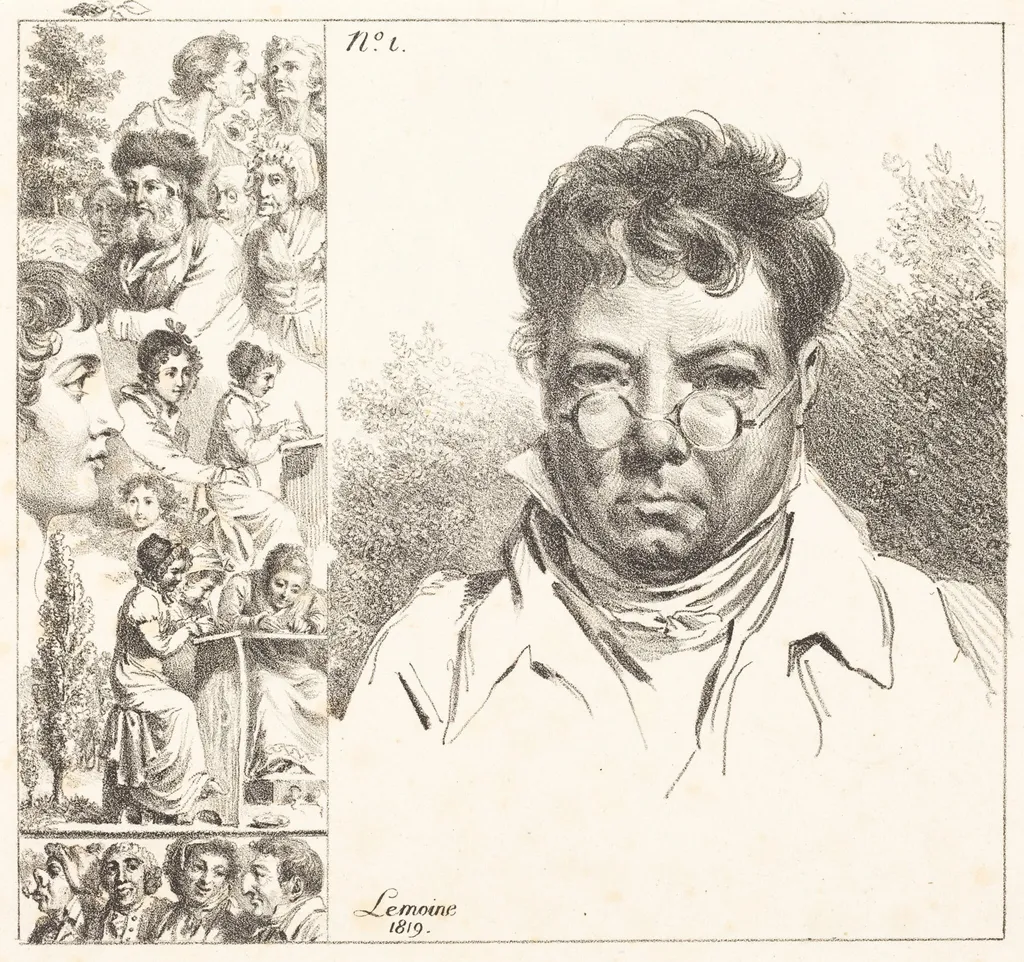
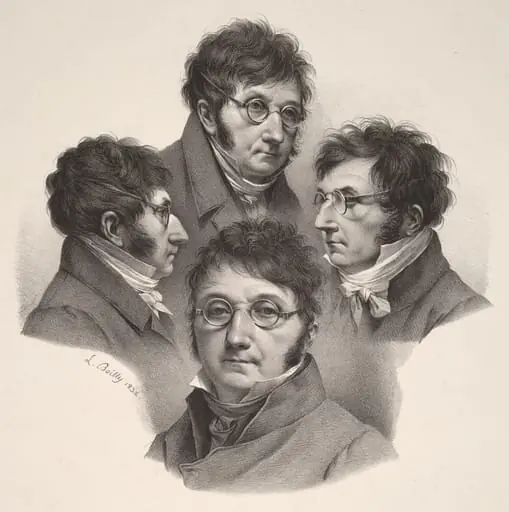
Self-Portrait and Other Heads is an ink print by the Romanticist artist Jacques Antoine Marie Lemoine. It dates from 1819 and is held in the collection of the National Gallery of Art. Jacques‑Antoine‑Marie Lemoine’s *Self‑Portrait and Other Heads* is a lithographic print executed on wove paper in 1819.
About this work
The artist used a method called lithography, where drawings are made on stone and printed.
This sketch shows a man with glasses and curly hair, drawn in a simple, rough style. Around him are smaller faces—some adults, some kids—all drawn quickly. The paper looks old, with smudges and uneven lines.
The big portrait is signed "Lemoine 1819," meaning it’s from that year. The artist used a method called lithography, where drawings are made on stone and printed.
Next, check out lithography to see how this printing trick works.
Overview
Jacques‑Antoine‑Marie Lemoine’s *Self‑Portrait and Other Heads* is a lithographic print executed on wove paper in 1819. The central figure, a bespectacled man with curly hair, is rendered in a loose, sketch‑like manner, surrounded by a group of smaller, quickly drawn faces that include both adults and children. The paper shows signs of age, with faint smudges and uneven line work characteristic of early lithographic practice.
Subject & Meaning
The composition juxtaposes Lemoine’s own likeness with a series of ancillary heads, suggesting a study of individual character and perhaps a commentary on the variety of contemporary portrait subjects he encountered. The informal rendering emphasizes spontaneity over formal idealization, highlighting the artist’s interest in capturing fleeting expressions.
Technique & Style
Created by drawing directly onto a lithographic stone, the image was transferred to paper through a chemical process that preserves the artist’s hand‑drawn lines. Lemoine’s use of a rough, gestural style on wove paper reflects the early 19th‑century experimentation with lithography as a means to reproduce portraiture quickly and affordably.
History & Provenance
Lemoine, a native of Rouen who trained at the local École des Beaux‑Arts before moving to Paris, signed the work “Lemoine 1819,” confirming its date of production. The print belongs to a period when the artist was expanding his portrait practice beyond pastel, chalk, oil, and watercolor into the newer medium of lithography.
Context
During the post‑Napoleonic era, French portraitists increasingly turned to lithography to meet the demand for affordable images of public figures such as actors, singers, and musicians—subjects Lemoine frequently depicted. This print exemplifies that shift, merging traditional portrait conventions with the immediacy of the new print technology.
Artist & collection

Artist
Jacques-Antoine-Marie Lemoine, also Lemoyne (17 July 1751 – 7 February 1824), was a French artist, known primarily for portraiture.