Artwork
Centaur (Le centaure)
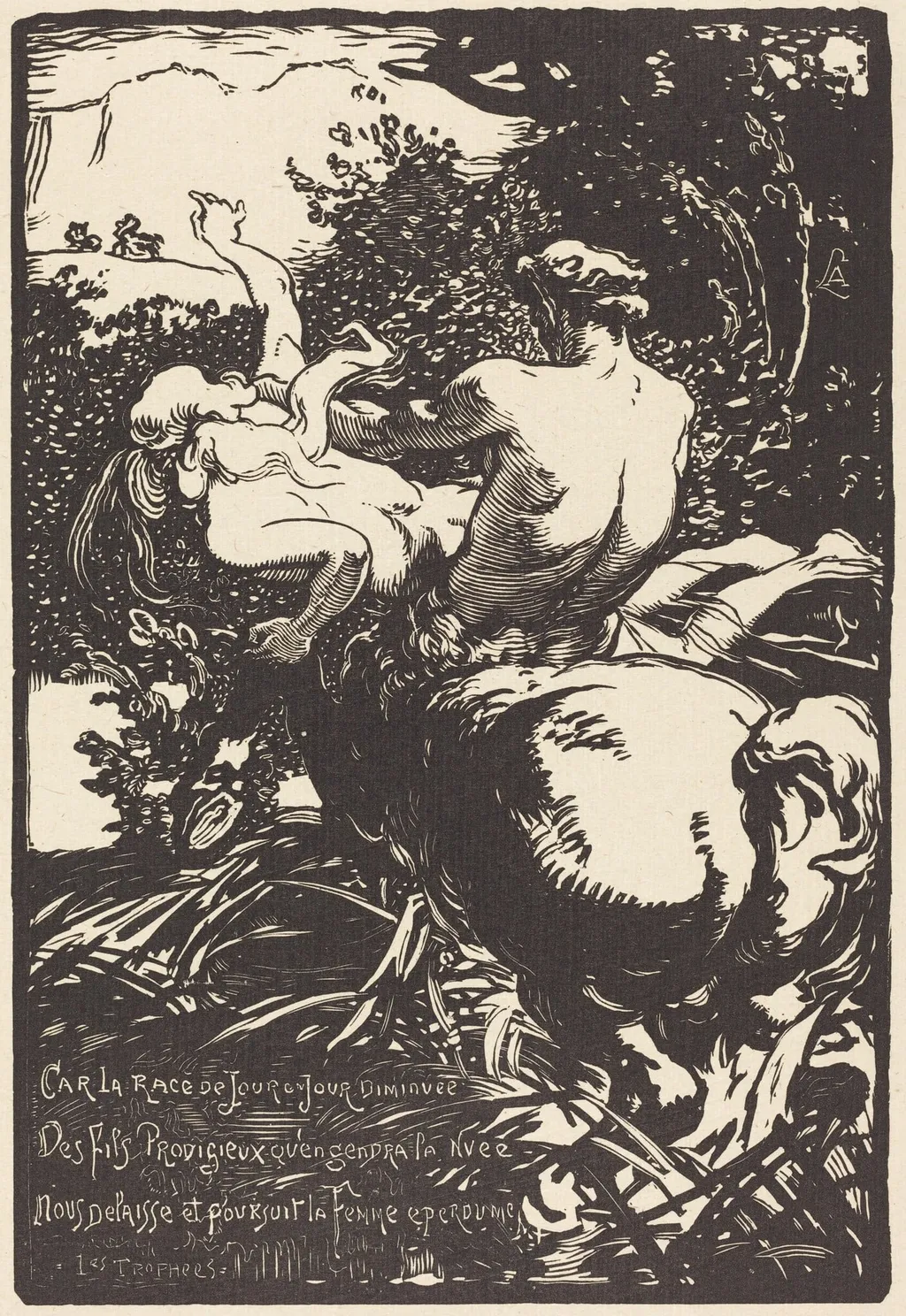
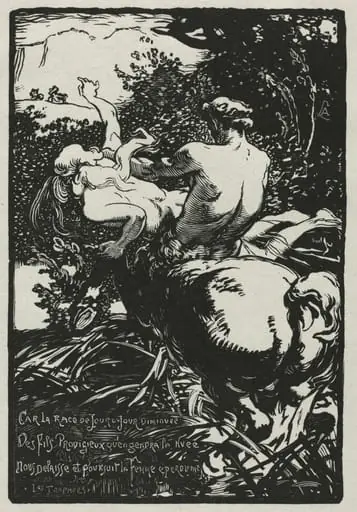
Centaur (Le centaure) is an ink print by the Impressionist artist Auguste Lepère. It dates from 1896 and is held in the collection of the National Gallery of Art.
About this work
Overview
Though trained as a painter and etcher, Lepère turned to the demanding craft of woodblock carving, elevating it beyond reproductive illustration.
Auguste Lepère’s 1896 wood engraving *Centaur* exemplifies the late 19th-century revival of wood engraving as a fine art form in France. Though trained as a painter and etcher, Lepère turned to the demanding craft of woodblock carving, elevating it beyond reproductive illustration. His work in this medium contributed to a broader European interest in handcrafted printmaking, emphasizing technical precision and expressive potential over mass production.
Subject & Meaning
The print portrays a mythological centaur entangled with a female figure and other shadowy forms, evoking a moment of primal conflict or transformation. The scene lacks clear narrative resolution, instead suggesting turbulence and emotional intensity. The inclusion of French text at the base hints at a literary or poetic source, possibly drawing from classical myth or contemporary symbolism, though the exact passage remains unverified.
Technique & Style
Lepère employed fine, dense cross-hatching and linear incisions to model form and depth using only black and white. The surface is densely textured, with overlapping strokes creating dramatic contrasts and a sense of movement. Background elements—twisting branches and foliage—are rendered with rhythmic, swirling lines that amplify the scene’s chaotic energy, showcasing the medium’s capacity for intricate detail without color.
History & Provenance
Created in 1896, the print emerged during a period when French artists were reevaluating traditional print techniques. Lepère was part of a small circle promoting wood engraving as an autonomous art form, distinct from commercial applications. While specific early ownership records are sparse, the work aligns with exhibitions of the Société des Aquafortistes and other print-focused groups of the era.
Context
Lepère’s work responded to broader artistic trends, including Symbolism and the Arts and Crafts movement, both of which valued emotional resonance and handcrafted detail. In contrast to industrialized reproduction, wood engraving offered a tactile, labor-intensive alternative. His focus on mythological subjects reflected a wider fascination with ancient narratives as vessels for psychological and spiritual themes.
Legacy
Lepère’s *Centaur* stands as a testament to the technical possibilities of wood engraving in the modern era. Though not widely known today, his efforts helped preserve the medium’s artistic credibility during a time of photographic and lithographic dominance. Later printmakers cited his precision and expressive use of line as influential in the 20th-century revival of relief printing.
Artist & collection
Artist
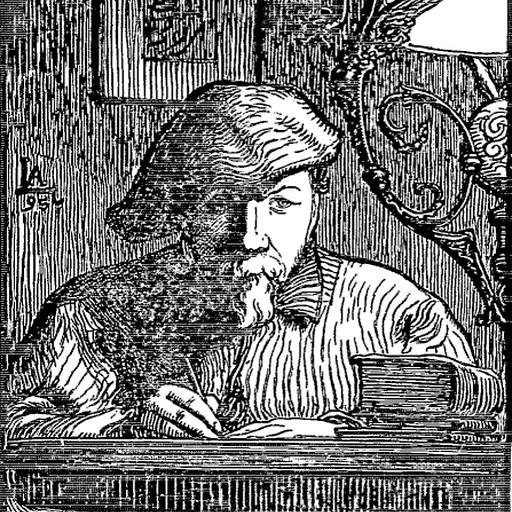
Louis-Auguste Lepère (30 November 1849 – 20 November 1918) was a French painter and etcher. Lepère is also considered a leader in the creative revival of wood engraving in Europe.