Artwork
Fall of Phaeton
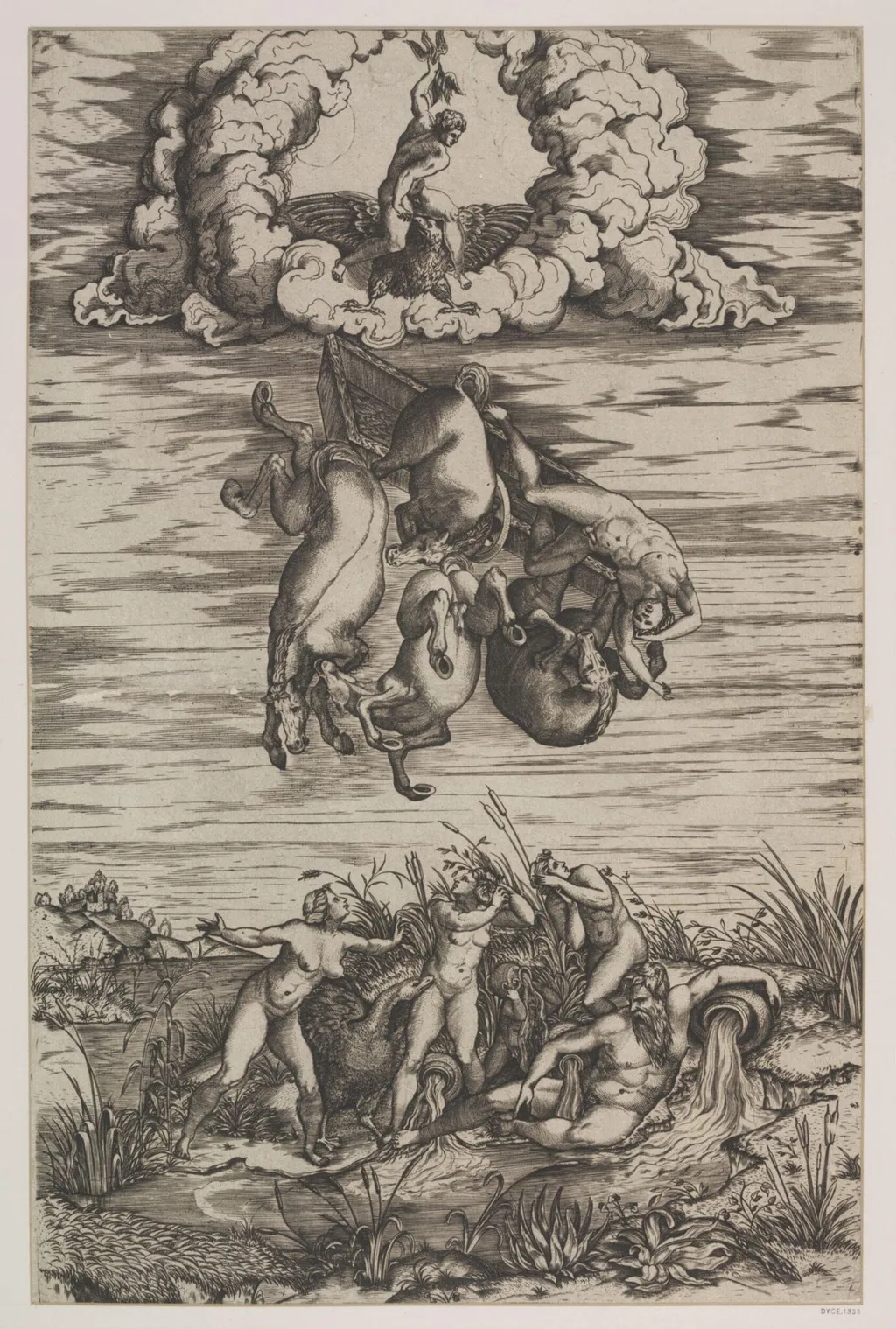
Fall of Phaeton is a print by Michele Greco Lucchese. It dates from 1550 and is held in the collection of the Victoria and Albert Museum.
About this work
Overview
The 1550 print titled *Fall of Phaeton* translates a design originally conceived by Michelangelo into a paper engraving executed by Michele Greco Lucchese.
The 1550 print titled *Fall of Phaeton* translates a design originally conceived by Michelangelo into a paper engraving executed by Michele Greco Lucchese. The work visualizes the classical myth in which the youthful Phaeton loses control of the sun‑chariot, plunging toward Earth. The composition is divided into a turbulent sky above and a chaotic terrestrial scene below, emphasizing the drama of the descent.
Subject & Meaning
The narrative centers on Phaeton’s catastrophic fall, a cautionary episode from Ovid’s *Metamorphoses* that warns against hubris. In the upper register, a winged figure amid clouds suggests divine intervention or the sun’s celestial realm, while the lower register gathers nude figures and animals reacting to the disaster, embodying the human and natural turmoil triggered by the mythic event.
Technique & Style
Lucchese’s engraving reproduces Michelangelo’s dynamic drawing through fine line work and cross‑hatching, creating a sense of movement and tension. The print’s contrast of sharply delineated forms—splayed horse limbs, contorted bodies, and swirling clouds—conveys kinetic energy. The use of chiaroscuro on paper enhances depth, while the crowded composition reflects the Mannerist taste for complex, intertwined figures.
History & Provenance
Created in 1550, the print belongs to a period when Michelangelo’s designs were widely disseminated through reproductive prints. Michele Greco Lucchese, an active engraver in mid‑sixteenth‑century Italy, was known for translating high‑profile drawings into prints for a broader audience. Surviving copies are held in several European collections, attesting to the work’s circulation among collectors of mythological imagery.
Context
The image reflects the Renaissance fascination with classical mythology and the moralizing potential of such stories. By rendering a dramatic moment from the *Metamorphoses*, the print aligns with contemporary humanist interests in antiquity and the didactic use of myth to explore themes of ambition, divine order, and the consequences of overreaching.
Artist & collection
Artist
Prints from the late 1500s often show dramatic religious scenes or classical myths in stark black and white.