Artwork
The Bathers
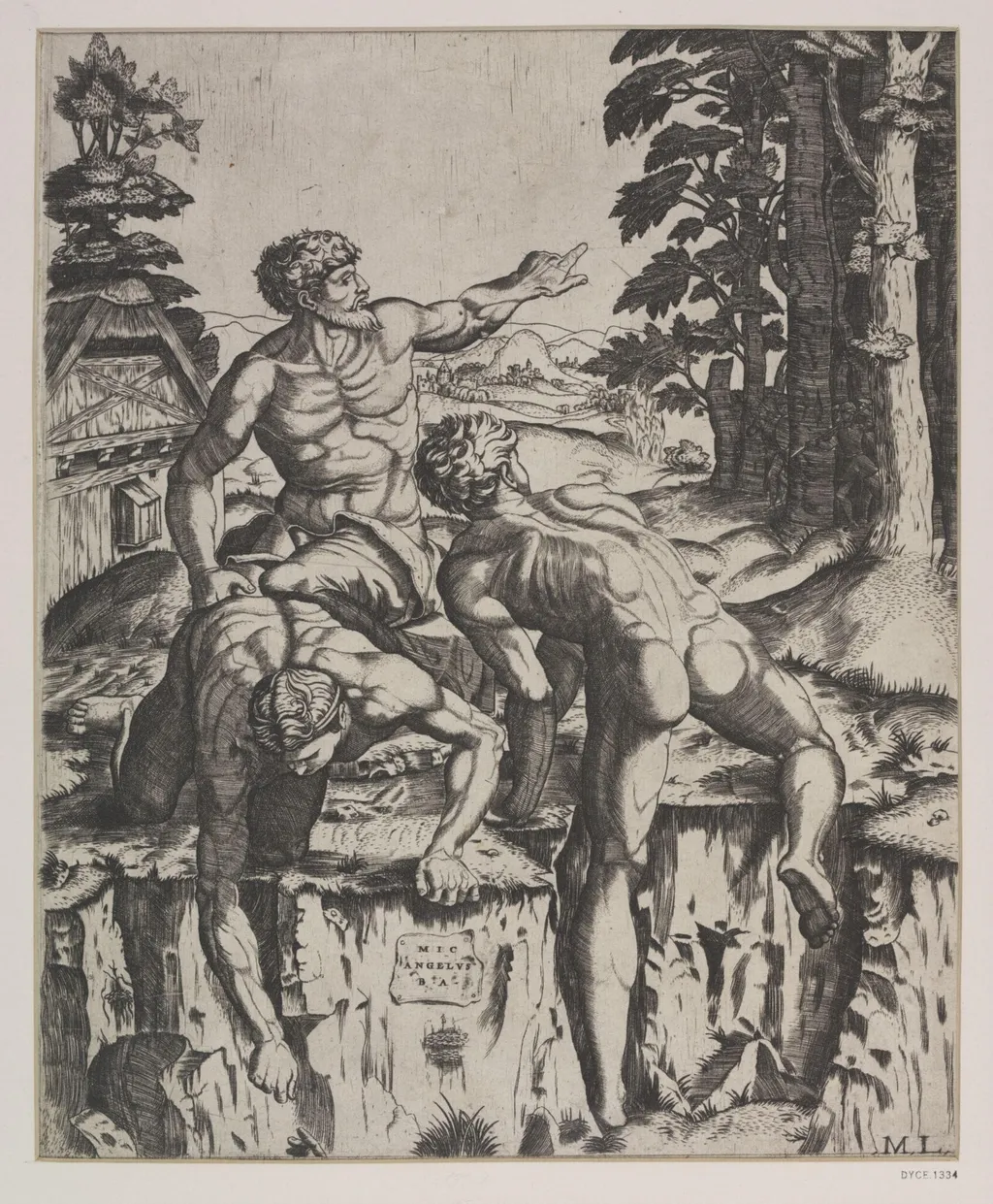
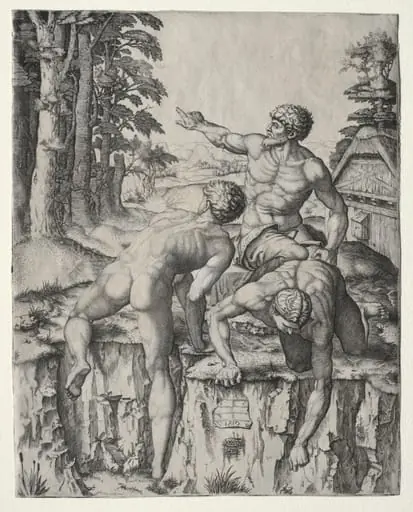
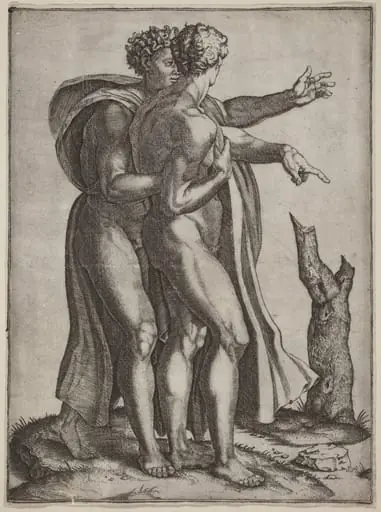
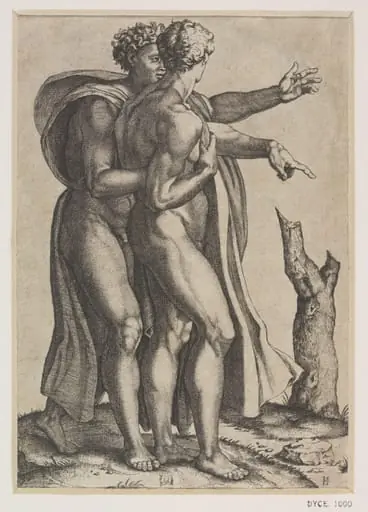
The Bathers is a print by Michele Greco Lucchese. It dates from 1550 and is held in the collection of the Victoria and Albert Museum.
About this work
Overview
Its format suggests it was produced as a reproductive print, intended to disseminate the figure studies of a major Renaissance artist.
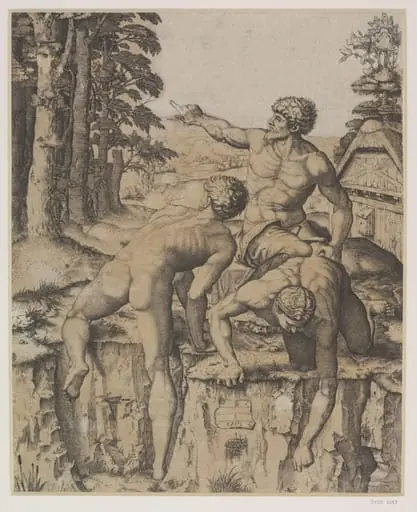
This print on paper, titled *The Bathers*, reproduces a compositional study originally conceived as a cartoon by Michelangelo, later associated with Michele Greco Lucchese. It bears the monogram 'M L' at the lower right, indicating its attribution. The work captures two male figures in a rugged natural setting, rendered with precise linework and dramatic tonal contrasts. Its format suggests it was produced as a reproductive print, intended to disseminate the figure studies of a major Renaissance artist.
Subject & Meaning
The two figures, both nude and powerfully built, are engaged in quiet, introspective poses—one standing with an arm raised, the other seated with head bowed. Their gestures lack narrative clarity, suggesting an emphasis on anatomical study rather than mythological storytelling. The inclusion of cloth and the isolated setting imply a focus on the human form as an object of contemplation, consistent with Renaissance ideals of bodily harmony and classical inspiration.
Technique & Style
The artist employed sharp, incisive lines and strong chiaroscuro to model the figures with sculptural volume. The contrast between deep shadows and bright highlights defines musculature and spatial depth, giving the forms a tangible presence despite the flatness of the paper. The rendering resembles a drawn sketch translated into print, prioritizing clarity of structure over decorative detail, reflecting the influence of preparatory drawing practices in Renaissance studios.
History & Provenance
The print derives from a lost cartoon attributed to Michelangelo, later linked to Michele Greco Lucchese, a follower active in the early 16th century. The monogram 'M L' appears consistently on related works, supporting its attribution. As a reproductive print, it likely circulated among artists and collectors to study Michelangelo’s figure compositions, preserving elements of his design after the original cartoon was no longer accessible.
Context
In early 16th-century Italy, artists frequently used prints to distribute compositional ideas and anatomical studies. This print reflects the widespread practice of copying and adapting Michelangelo’s figures, whose muscular forms became benchmarks for artistic training. The focus on the male nude, isolated in nature, aligns with humanist interests in classical antiquity and the idealized body as a subject of intellectual and aesthetic inquiry.
Legacy
Though not widely known today, this print contributed to the transmission of Michelangelo’s figure studies across generations of artists. Its precise line work and emphasis on anatomical structure influenced how Renaissance ideals were taught and reproduced in print form. It remains a tangible link between the original cartoon and the broader circulation of High Renaissance aesthetics through the medium of printmaking.
Artist & collection
Artist
Prints from the late 1500s often show dramatic religious scenes or classical myths in stark black and white.