Artwork
The Birth of Venus
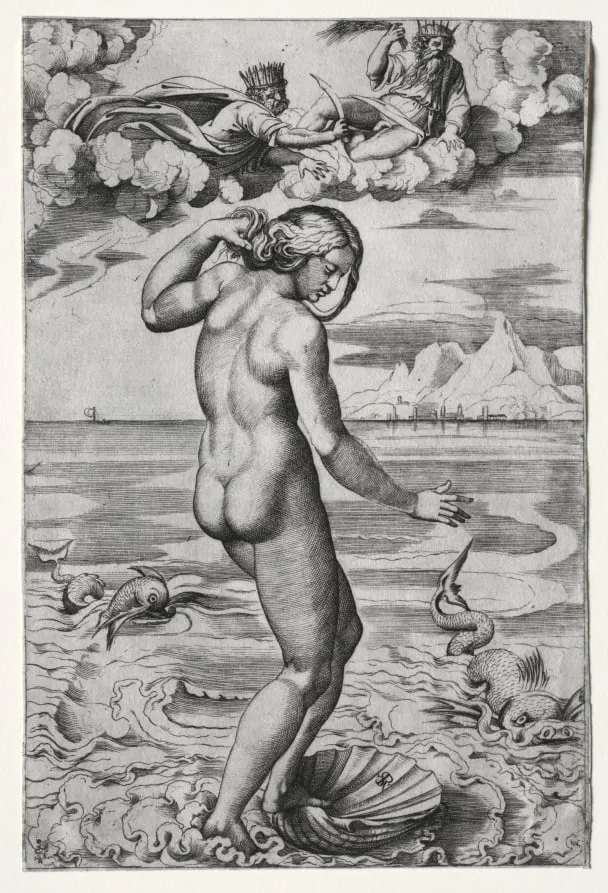
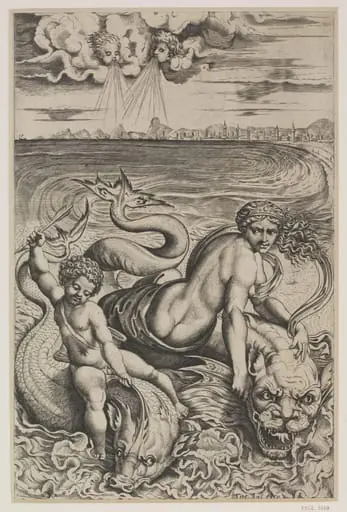
The Birth of Venus is a print by the Renaissance artist Marco Dente. It dates from 1516 and is held in the collection of the Cleveland Museum of Art.
About this work
Overview
Marco Dente produced an engraving based on a lost painting by Raphael, capturing a mythological scene from classical antiquity.
Marco Dente produced an engraving based on a lost painting by Raphael, capturing a mythological scene from classical antiquity. This print was part of a broader practice among Renaissance printmakers to reproduce the works of leading painters, ensuring wider dissemination of their compositions. Dente’s version preserves the delicate composition and narrative nuance of Raphael’s original, now vanished.
Subject & Meaning
The scene depicts Venus emerging from the sea on a seashell, born from oceanic foam after the castration of Uranus. Above, Saturn, god of time, readies his blade to sever his father’s body. The imagery reflects Renaissance fascination with classical myths, particularly those linking love, creation, and cosmic order. The nudity, though sensual, was conventional in private ecclesiastical spaces, where such themes were accepted as allegorical rather than profane.
Technique & Style
Dente rendered the scene with fine, controlled lines typical of engraving, emulating Raphael’s sfumato through subtle gradations of tone and soft contours. The figures are rendered with graceful elongation and restrained movement, mirroring the painter’s approach to form. The sea foam and drapery are delicately suggested rather than explicitly detailed, enhancing the ethereal quality of the moment.
History & Provenance
Raphael’s original painting was created for Cardinal Bernardo Dovizi da Bibbiena’s private bathroom in the Vatican, a space where classical themes were favored for their intellectual and decorative appeal. Dente’s engraving, made shortly after, became one of several reproductive prints that circulated across Europe. These prints preserved Raphael’s design after the painting’s disappearance and helped standardize his visual language among artists and collectors.
Context
In early 16th-century Rome, mythological nudes were common in private interiors, even among clergy, as symbols of humanist learning and aesthetic refinement. The stufetta, as Bibbiena’s bathroom was called, was designed as a sanctuary of culture, blending classical literature, art, and erotic allegory. Dente’s print reflects this environment, where sacred and profane boundaries were fluid in domestic settings.
Legacy
Dente’s engraving contributed to the international spread of Raphael’s stylistic innovations, influencing generations of printmakers and painters. By translating a lost painting into a durable medium, it ensured the survival of a composition that might otherwise have been forgotten. The print’s circulation helped cement the myth of Venus’s birth as a canonical subject in Renaissance visual culture.
Artist & collection

Artist
Marco Dente da Ravenna (1493–1527), usually just called Marco Dente, was an Italian engraver born in Ravenna in the latter part of the 15th Century.