Artwork
Respice Finem
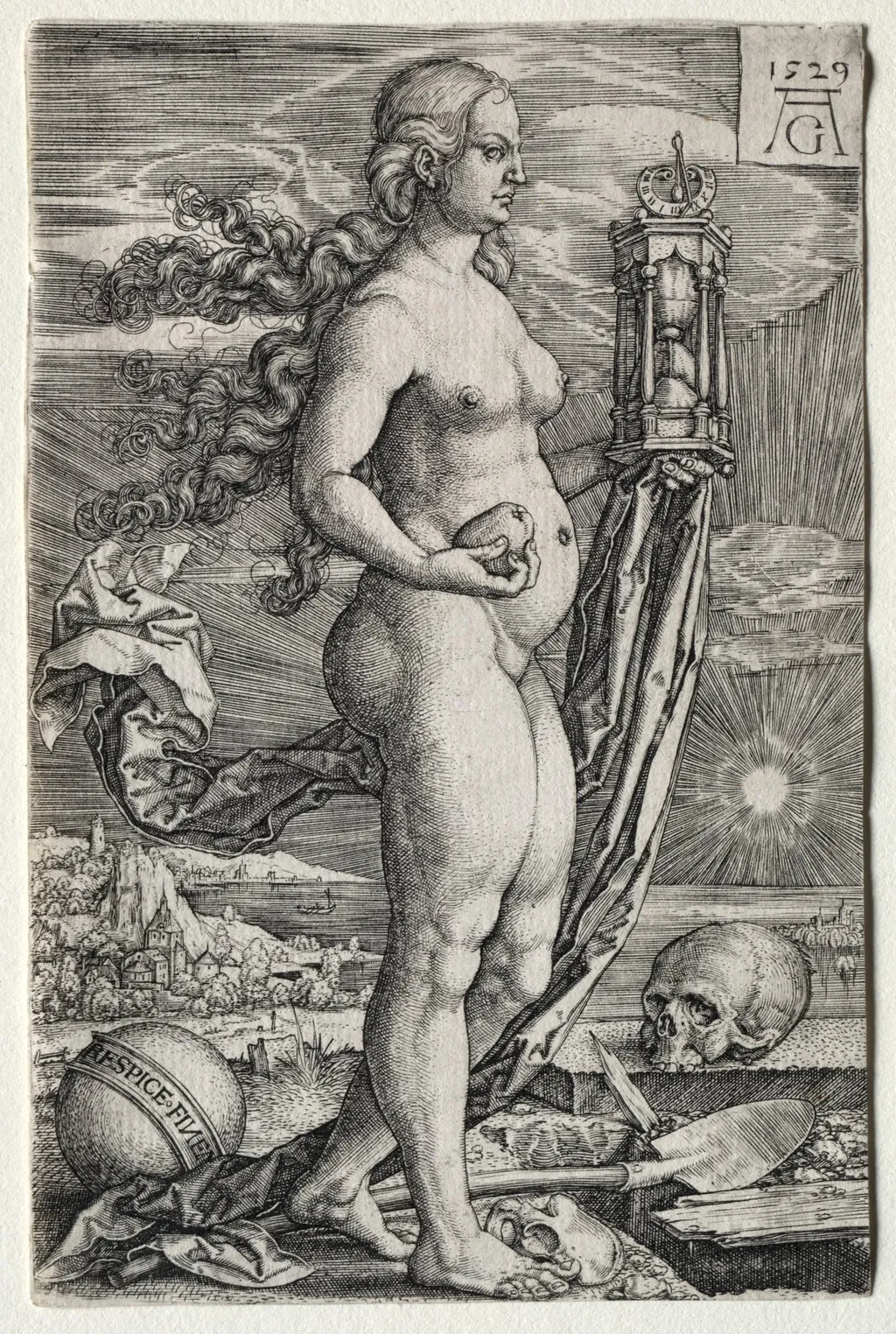
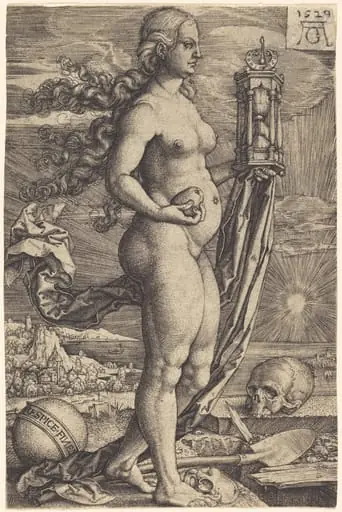
Respice Finem is a print by the Renaissance artist Heinrich Aldegrever. It dates from 1529 and is held in the collection of the Cleveland Museum of Art.
About this work
Overview
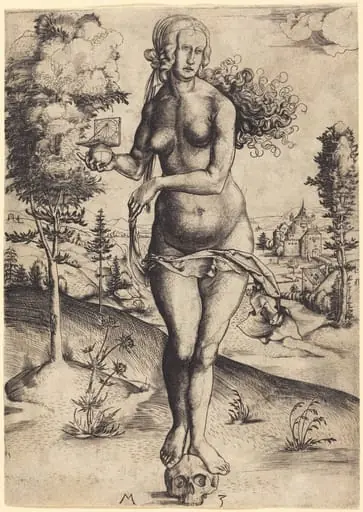
The work presents a solitary female figure in a landscape setting, surrounded by symbolic objects that evoke themes of time and mortality.
Respice Finem is a 1529 engraving by Heinrich Aldegrever, currently in the collection of The Cleveland Museum of Art. The work presents a solitary female figure in a landscape setting, surrounded by symbolic objects that evoke themes of time and mortality. Executed in fine linear detail, it reflects the Northern Renaissance tradition of moralizing imagery, blending human form with allegorical elements to convey a contemplative message.
Subject & Meaning
The central figure, nude except for a draped cloth, holds an hourglass in her left hand and an unidentified small object in her right. At her feet lie a skull, a trowel, and a ball inscribed with the Latin phrase 'Respice Finem'—'Consider the end.' These elements together form a memento mori: the hourglass and skull signify time’s passage and death, the trowel may allude to labor or burial, and the ball suggests the cyclical nature of existence.
Technique & Style
Aldegrever employed precise engraving techniques to render delicate textures and spatial depth. The figure is defined by clean, flowing lines, while the landscape background—featuring distant mountains, water, and a sun—recalls the atmospheric perspective common in German Renaissance prints. The composition is tightly controlled, with symbolic objects arranged to guide the viewer’s gaze toward the central message without overt drama.
History & Provenance
Created in 1529, the print was produced during Aldegrever’s active period in Westphalia, a time when humanist and religious themes were widely circulated through print media. The work entered the Cleveland Museum of Art’s collection in the 20th century, following a lineage of private European collections. Its survival in good condition reflects its enduring appeal among collectors of Northern Renaissance graphic art.
Context
Aldegrever worked alongside contemporaries like Albrecht Dürer, sharing an interest in moral allegory and meticulous draftsmanship. Respice Finem aligns with broader 16th-century European trends in vanitas imagery, where everyday objects were repurposed as reminders of life’s transience. The Latin inscription suggests a humanist audience familiar with classical phrases, reinforcing the print’s intellectual rather than devotional intent.
Legacy
Though not widely reproduced in modern scholarship, Respice Finem remains a representative example of Aldegrever’s skill in merging narrative symbolism with technical precision. It contributes to the understanding of how Northern Renaissance artists used printmaking to disseminate philosophical ideas beyond religious contexts, influencing later generations of moral allegorists in graphic arts.
Artist & collection

Artist
Heinrich Aldegrever or Aldegraf was a German painter and engraver. He was one of the "Little Masters", the group of German artists making small old master prints in the generation after Albrecht Dürer.