Artwork
The Agony in the Garden
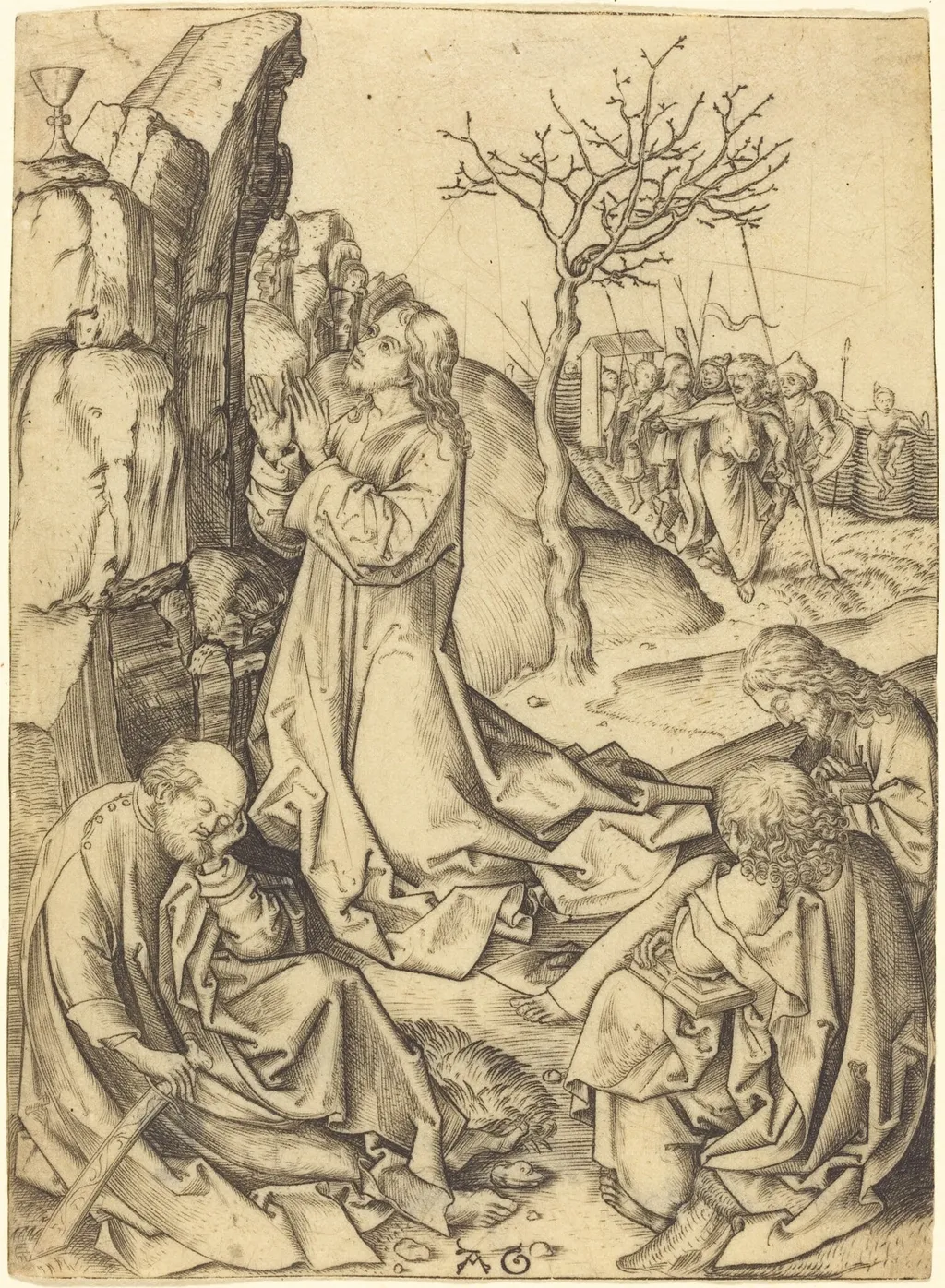
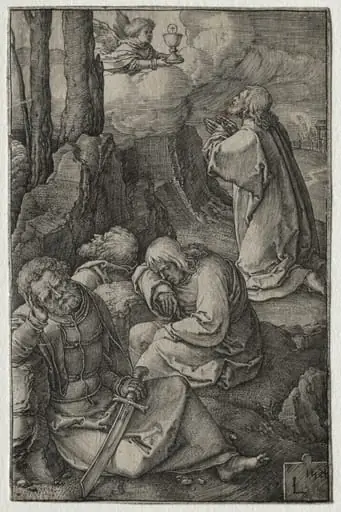
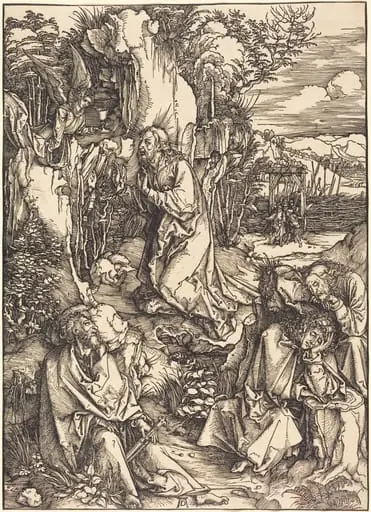
The Agony in the Garden is an ink print by the Renaissance artist Master AG. It dates from 1485 and is held in the collection of the National Gallery of Art. Created around 1485, this engraving on vellum depicts the moment before Christ’s arrest in the Garden of Gethsemane.
About this work
Overview
Created around 1485, this engraving on vellum depicts the moment before Christ’s arrest in the Garden of Gethsemane.
Created around 1485, this engraving on vellum depicts the moment before Christ’s arrest in the Garden of Gethsemane. The work is attributed to Master AG, an anonymous printmaker active in the late 15th century. Unlike woodcuts common at the time, this piece uses fine linear engraving on a durable animal skin surface, allowing for greater precision and tonal nuance in the depiction of a sacred narrative.
Subject & Meaning
The scene captures Jesus in prayer, his hands folded in anguish, while his disciples sleep nearby, fulfilling the biblical account of his emotional struggle before betrayal. In the distance, armed figures approach with torches, signaling the imminent arrest. The contrast between Christ’s vigilance and the disciples’ slumber underscores themes of spiritual readiness and human frailty, central to Christian meditation of the period.
Technique & Style
The artist employed fine-line engraving to render texture and depth, using dense cross-hatching to model forms and suggest shadow. The vellum support allowed for delicate, controlled lines that would have been difficult on paper. Light is carefully modulated to isolate Christ’s figure, drawing attention to his emotional state while the surrounding landscape recedes into atmospheric detail, enhancing the scene’s solemnity.
History & Provenance
The work survives as a rare example of engraving on vellum from the late 15th century, a practice uncommon due to cost and labor. Its survival suggests it was commissioned or collected by a private patron with access to high-quality printmaking. No definitive record of its early ownership exists, but its technical sophistication implies it was produced for a discerning, likely religiously inclined audience.
Context
This print emerged during a period of growing interest in devotional imagery in Northern Europe, where small-scale engravings were used for private contemplation. Artists like Master AG responded to the demand for portable, detailed religious scenes that could be studied in solitude. The work reflects the influence of both Italian compositional clarity and Northern European attention to minute detail.
Legacy
Though Master AG’s identity remains obscure, this engraving stands as a testament to the technical mastery possible in early printmaking. It influenced later artists in the use of light and psychological tension within confined compositions. As one of the few surviving vellum engravings from its time, it offers insight into the material practices and devotional culture of late medieval Europe.
Artist & collection