Artwork
Apollo
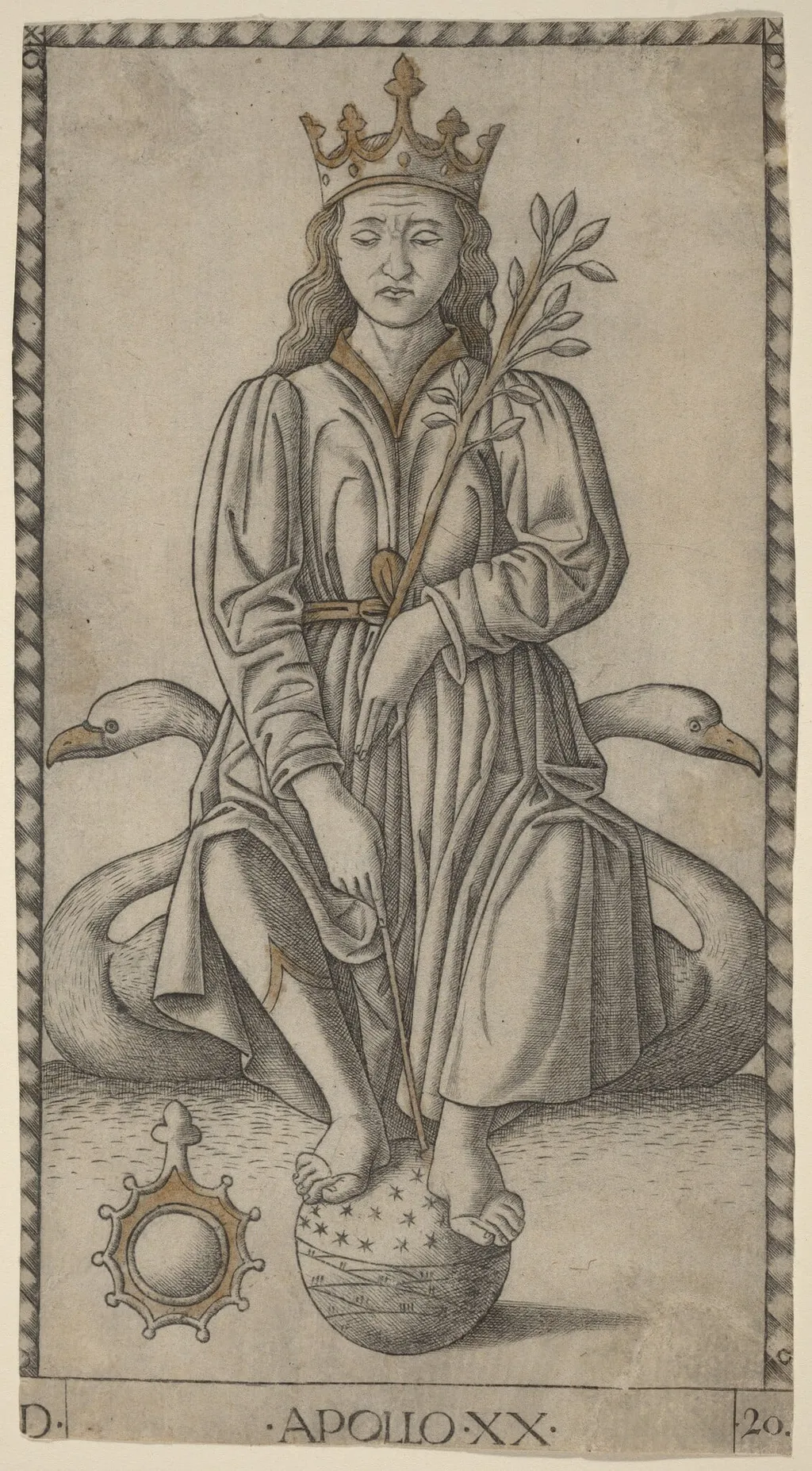
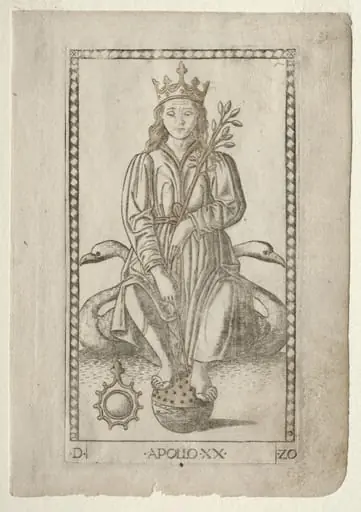
Apollo is an ink print by the Renaissance artist Master of the E-Series Tarocchi. It dates from 1465 and is held in the collection of the National Gallery of Art.
About this work
Overview
Created around 1465, this print bears the title Apollo and is attributed to the anonymous figure known as the Master of the E‑Series Tarocchi. Executed as an engraving enhanced with gilded details, the work presents a single, robed figure seated on a rocky outcrop. The composition is rendered primarily in black and white, with selective gold highlights that draw attention to specific elements.
Subject & Meaning
The central figure is identified as the god Apollo, distinguished by a crown and a laurel branch—traditional symbols of victory and poetic inspiration. He rests one foot upon a celestial sphere adorned with stars, a motif that may allude to his dominion over the heavens and the arts. Two small birds perched nearby add a naturalistic touch, reinforcing the mythological setting.
Technique & Style
Subtle cross‑hatching creates gradations of tone, while the gilded accents, applied after printing, emphasize the crown, laurel and the star‑studded globe.
The image is produced through intaglio engraving, employing fine, closely spaced lines to model form and suggest volume. Subtle cross‑hatching creates gradations of tone, while the gilded accents, applied after printing, emphasize the crown, laurel and the star‑studded globe. The background is deliberately sparse, using only a few linear strokes to convey texture without detracting from the central figure.
History & Provenance
Attributed to the Master of the E‑Series Tarocchi, an anonymous workshop active in mid‑15th‑century Italy, the print reflects the period’s interest in combining classical iconography with emerging print technologies. Though the original ownership record is unclear, the work has survived in several museum collections, indicating its circulation among collectors of early printed devotional and mythological imagery.
Artist & collection
Artist
Master of the E-Series Tarocchi
Master of the E-Series Tarocchi (b. 1400) was an Italian artist.