Artwork
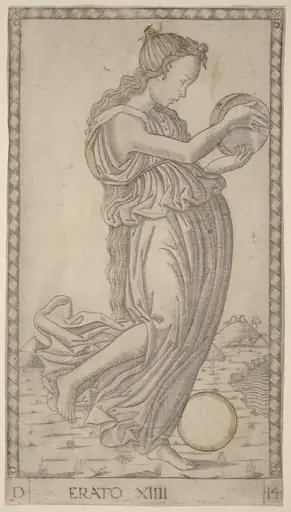
Erato (lyric and love poetry) (from the Tarocchi series D: Apollo and the Muses, #14)
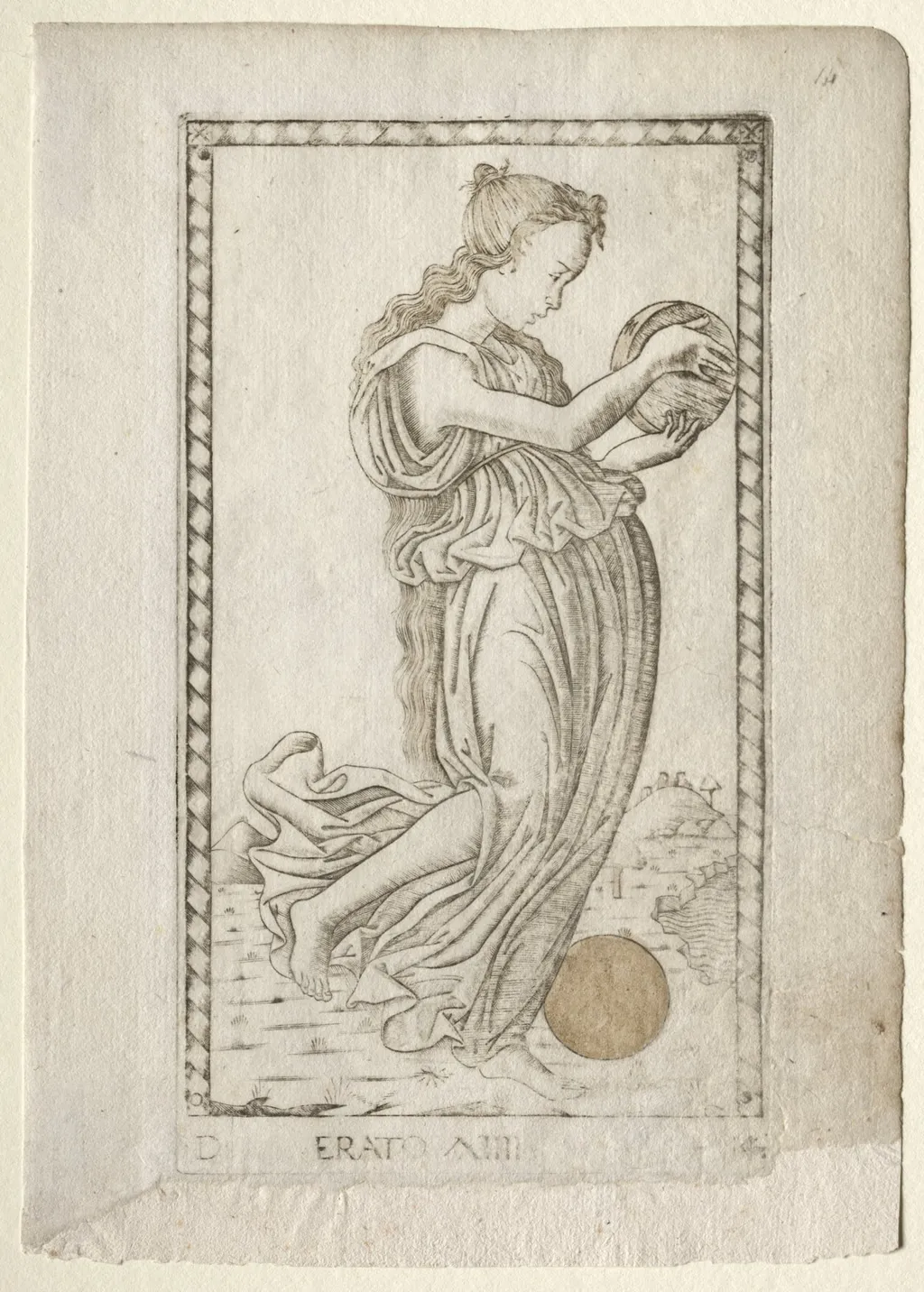
Erato (lyric and love poetry) (from the Tarocchi series D: Apollo and the Muses, #14) is a print by the Renaissance artist Master of the E-Series Tarocchi. It dates from 1467 and is held in the collection of the Cleveland Museum of Art.
About this work
Overview
Erato, the fourteenth plate in the sequence, embodies lyric and love poetry, rendered in fine linear detail characteristic of Renaissance engraving techniques.
This engraving belongs to the Tarocchi series labeled 'D,' known as Apollo and the Muses, a set of prints depicting the nine Greek Muses under the guidance of Apollo. Each figure represents a distinct domain of artistic and intellectual pursuit. Erato, the fourteenth plate in the sequence, embodies lyric and love poetry, rendered in fine linear detail characteristic of Renaissance engraving techniques.
Subject & Meaning
Erato is depicted as a graceful female figure in profile, facing right, holding a lyre and a bouquet of flowers—symbols of poetic inspiration and emotional expression. Though sometimes associated with dance, her primary role here aligns with lyric poetry, emphasizing personal and melodic verse. The serene, idealized form reflects classical ideals of beauty and divine inspiration, reinforcing her status as a celestial patron of artistic sentiment.
Technique & Style
The image is executed in delicate engraving, with fine, controlled lines defining the folds of her robe, the texture of her braided hair adorned with ribbons, and the subtle contours of her features. The background features minimal architectural elements, creating a sense of spatial depth without distraction. The precision of the technique highlights the elegance of the figure while maintaining the restrained aesthetic typical of the period’s printmaking.
History & Provenance
The Tarocchi series 'D' was likely produced in northern Italy during the early 16th century, possibly in Venice or Bologna, by an anonymous engraver influenced by humanist themes. The prints were circulated as collectible images, possibly used in card games or as educational tools. The Cleveland Museum of Art holds one of the known impressions, preserving its historical and artistic context within a broader Renaissance print tradition.
Context
The Tarocchi series reflects the Renaissance revival of classical mythology, where the Muses were reimagined as embodiments of intellectual and artistic virtues. Apollo’s leadership over the Muses symbolized the unity of reason and creativity. Such imagery was popular among educated elites who valued the integration of myth, music, and poetry as foundations of cultural refinement.
Legacy
Though not widely known today, the Tarocchi series contributed to the visual language of the Muses in early modern Europe. Its restrained elegance and mythological precision influenced later artistic representations of the arts, helping to standardize iconographic attributes—like the lyre and floral offerings—that continued to appear in Western art for centuries.
Artist & collection
Artist
Master of the E-Series Tarocchi
Master of the E-Series Tarocchi (b. 1400) was an Italian artist.

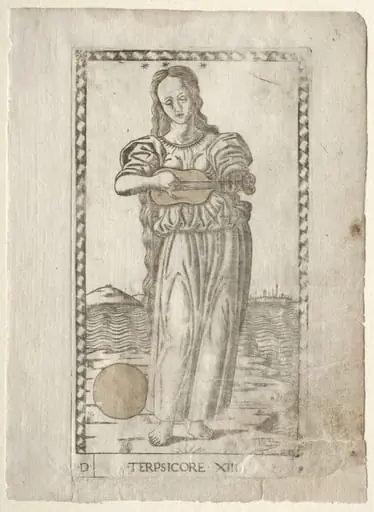 Terpsichore (dancing and song) (from the Tarocchi series D: Apollo and the Muses, #13)
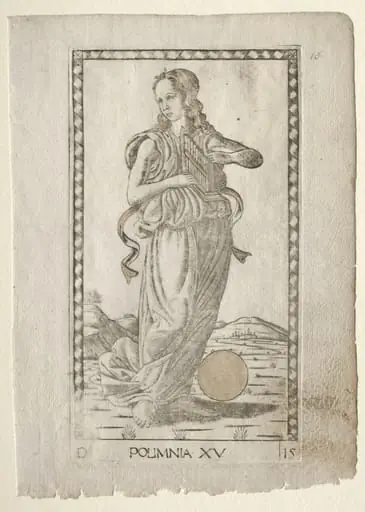 Polyhymnia (heroic hymns) (from the Tarocchi series D: Apollo and the Muses, #15)
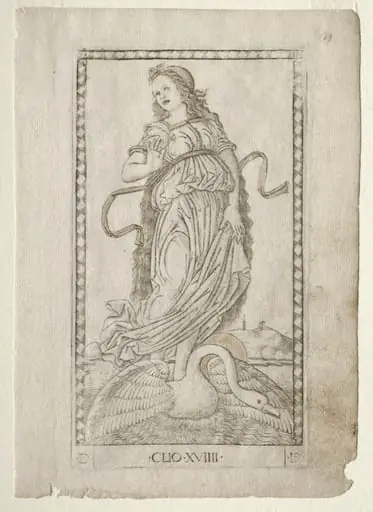 Clio (history) (from the Tarocchi series D: Apollo and the Muses, #19)
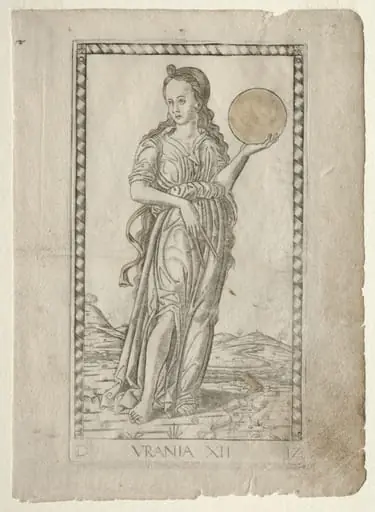 Urania (astronomy) (from the Tarocchi series D: Apollo and the Muses, #12)
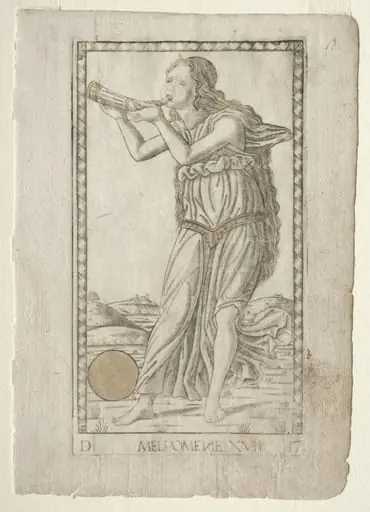 Melpomene (tragedy) (from the Tarocchi series D: Apollo and the Muses, #17)
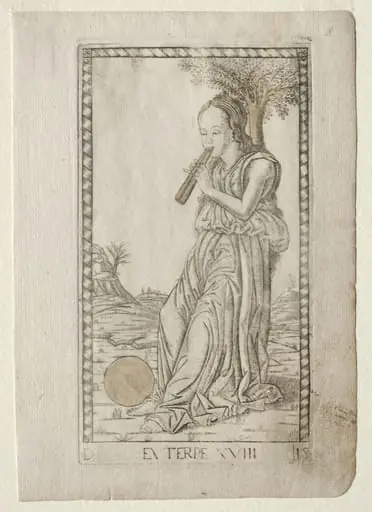 Euterpe (music, lyric poetry) (from the Tarocchi series D: Apollo and the Muses, #18)
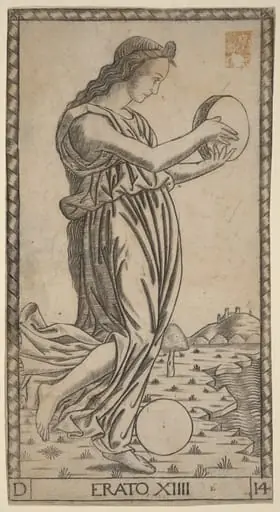 Erato
Erato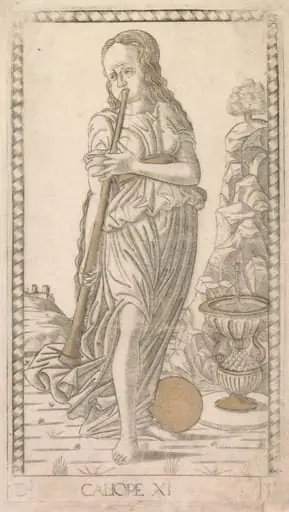 Calliope (from the Tarocchi series D: Apollo and the Muses, #11)
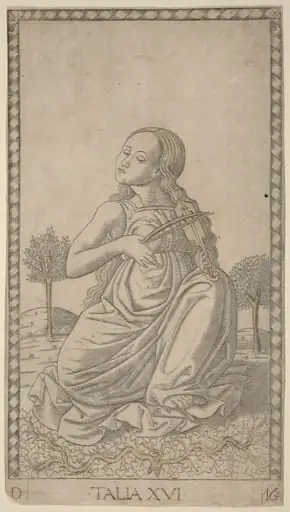
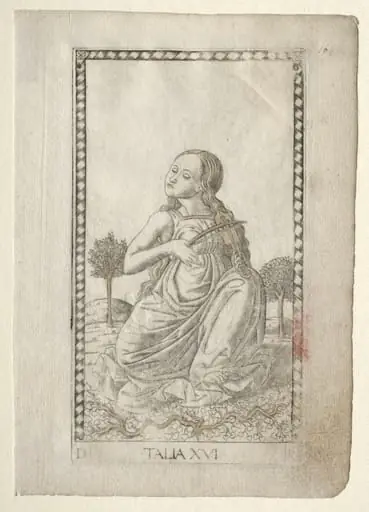 Thalia (comedy, pastoral poetry) (from the Tarocchi series D: Apollo and the Muses, #16)
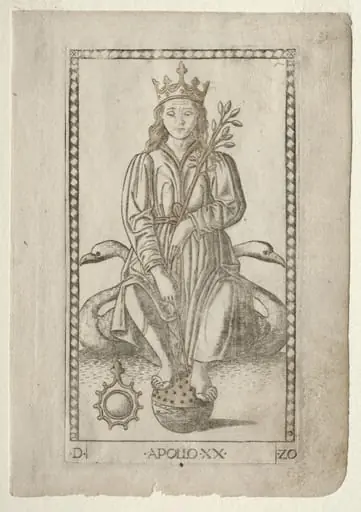 Apollo (from the Tarocchi, series D: Apollo and the Muses, #20)