Artwork
Polyhymnia (heroic hymns) (from the Tarocchi series D: Apollo and the Muses, #15)
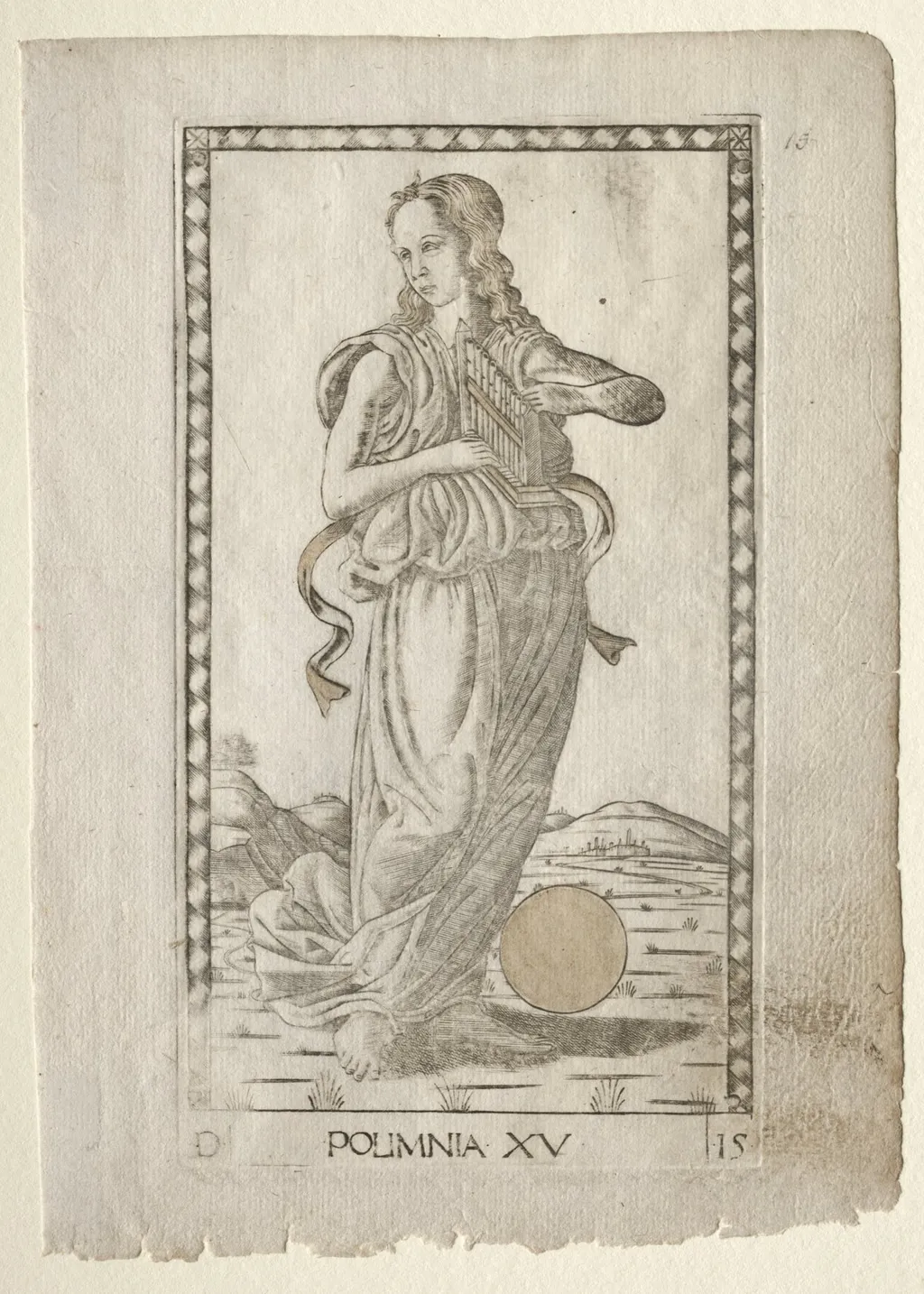
Polyhymnia (heroic hymns) (from the Tarocchi series D: Apollo and the Muses, #15) is a print by the Renaissance artist Master of the E-Series Tarocchi. It dates from 1467 and is held in the collection of the Cleveland Museum of Art. This engraving is the fifteenth card in the Tarocchi series labeled 'D,' known as Apollo and the Muses.
About this work
Overview
Polyhymnia, the subject here, represents heroic hymns and sacred poetry, depicted in a detailed, full-length portrait against a stylized landscape.
This engraving is the fifteenth card in the Tarocchi series labeled 'D,' known as Apollo and the Muses. Created in 15th-century Ferrara, it belongs to a deck that personifies the nine Greek Muses alongside their patron, Apollo. Each card associates a deity with a domain of knowledge or artistic expression. Polyhymnia, the subject here, represents heroic hymns and sacred poetry, depicted in a detailed, full-length portrait against a stylized landscape.
Subject & Meaning
Polyhymnia, whose name translates to 'many hymns,' is portrayed as a contemplative female figure embodying the reverence of sacred song. Unlike other Muses linked to dance or drama, she is associated with solemn, elevated verse. Her quiet demeanor and focused gaze reflect the meditative nature of divine inspiration. The portative organ she plays, not a lyre, underscores her connection to liturgical music, while the scroll at her feet symbolizes the written word as a vessel of divine knowledge.
Technique & Style
The engraving employs fine, precise lines to render texture and form, characteristic of early Italian printmaking. Light and shadow are carefully modulated to model the folds of her robe and the contours of her figure, suggesting a subtle chiaroscuro effect. The background, though imagined, includes gently rolling hills that frame the figure without distracting from her stillness. The composition balances elegance with restraint, emphasizing clarity over ornamentation.
History & Provenance
Produced in Ferrara during the 1470s–1480s, this print is part of a rare surviving set of tarot-like playing cards commissioned by a noble patron. The series pairs mythological figures with intellectual disciplines, reflecting Renaissance humanist interests. Though the full deck is incomplete, this card remains among the best-preserved examples. Its survival suggests it was valued not merely as a game piece but as a cultural artifact of intellectual symbolism.
Context
In Renaissance Italy, classical mythology was revived as a framework for understanding the arts and sciences. The Muses, once central to ancient Greek education, became emblematic of learned pursuits in courtly circles. This deck reflects Ferrara’s reputation as a center of humanist culture, where patrons sought to align their status with the intellectual legacy of antiquity. The choice of Polyhymnia highlights the era’s reverence for sacred and elevated poetic expression.
Legacy
The Tarocchi series, though not widely circulated, influenced later iconographic traditions in allegorical art. Polyhymnia’s depiction as a solemn, instrument-bearing figure became a reference point in subsequent representations of the Muses. The engraving’s integration of myth, music, and textual symbolism contributed to the visual language of Renaissance humanism, preserving a moment when classical ideals were reimagined through the medium of print.
Artist & collection
Artist
Master of the E-Series Tarocchi
Master of the E-Series Tarocchi (b. 1400) was an Italian artist.

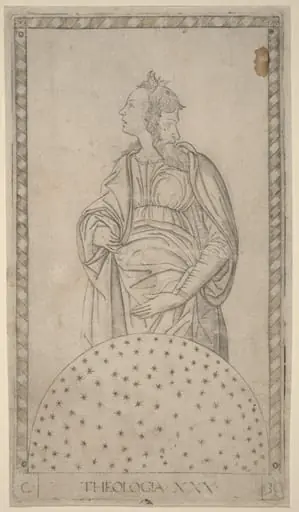
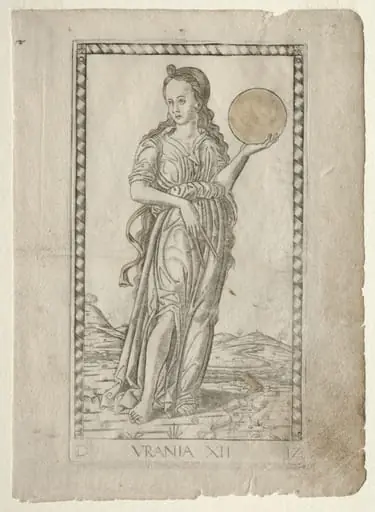 Urania (astronomy) (from the Tarocchi series D: Apollo and the Muses, #12)
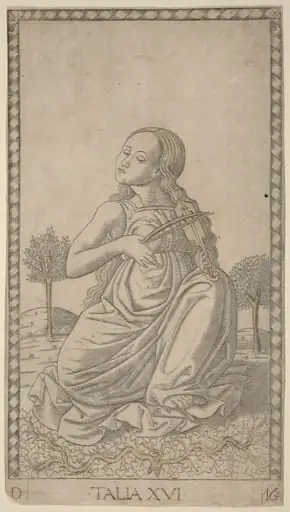
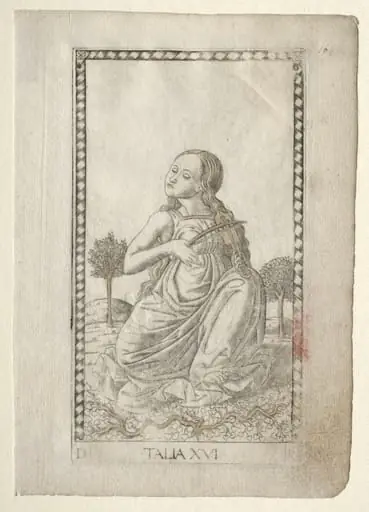 Thalia (comedy, pastoral poetry) (from the Tarocchi series D: Apollo and the Muses, #16)
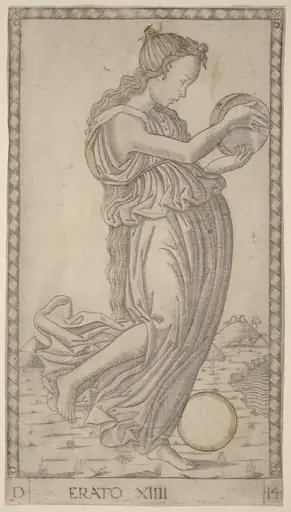
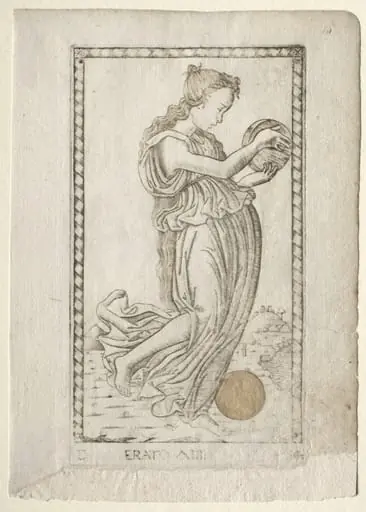 Erato (lyric and love poetry) (from the Tarocchi series D: Apollo and the Muses, #14)
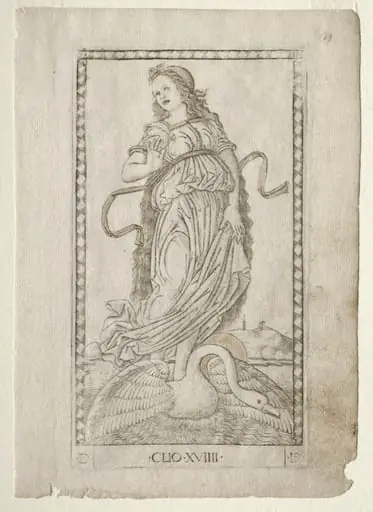 Clio (history) (from the Tarocchi series D: Apollo and the Muses, #19)
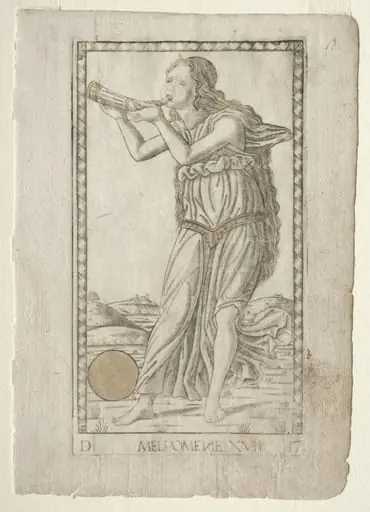 Melpomene (tragedy) (from the Tarocchi series D: Apollo and the Muses, #17)
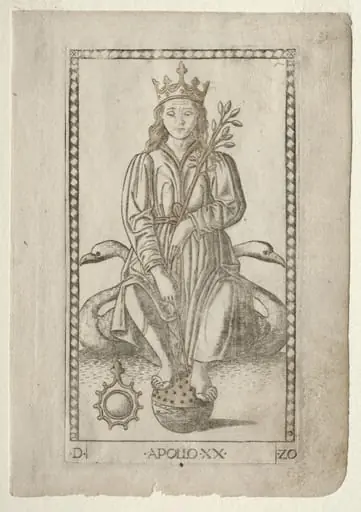 Apollo (from the Tarocchi, series D: Apollo and the Muses, #20)
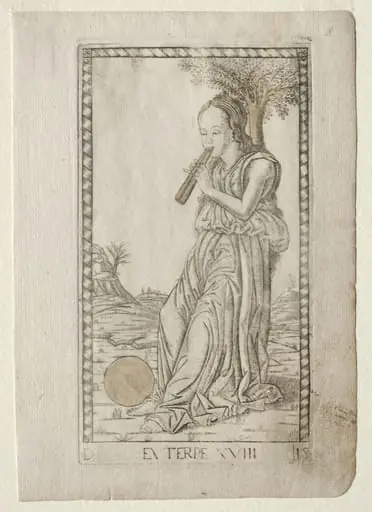 Euterpe (music, lyric poetry) (from the Tarocchi series D: Apollo and the Muses, #18)
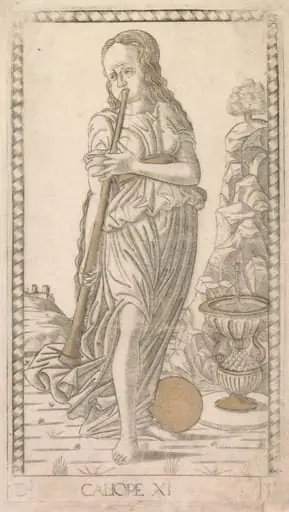 Calliope (from the Tarocchi series D: Apollo and the Muses, #11)