Artwork
Grammar (from the Tarocchi, series C: Liberal Arts, #21)
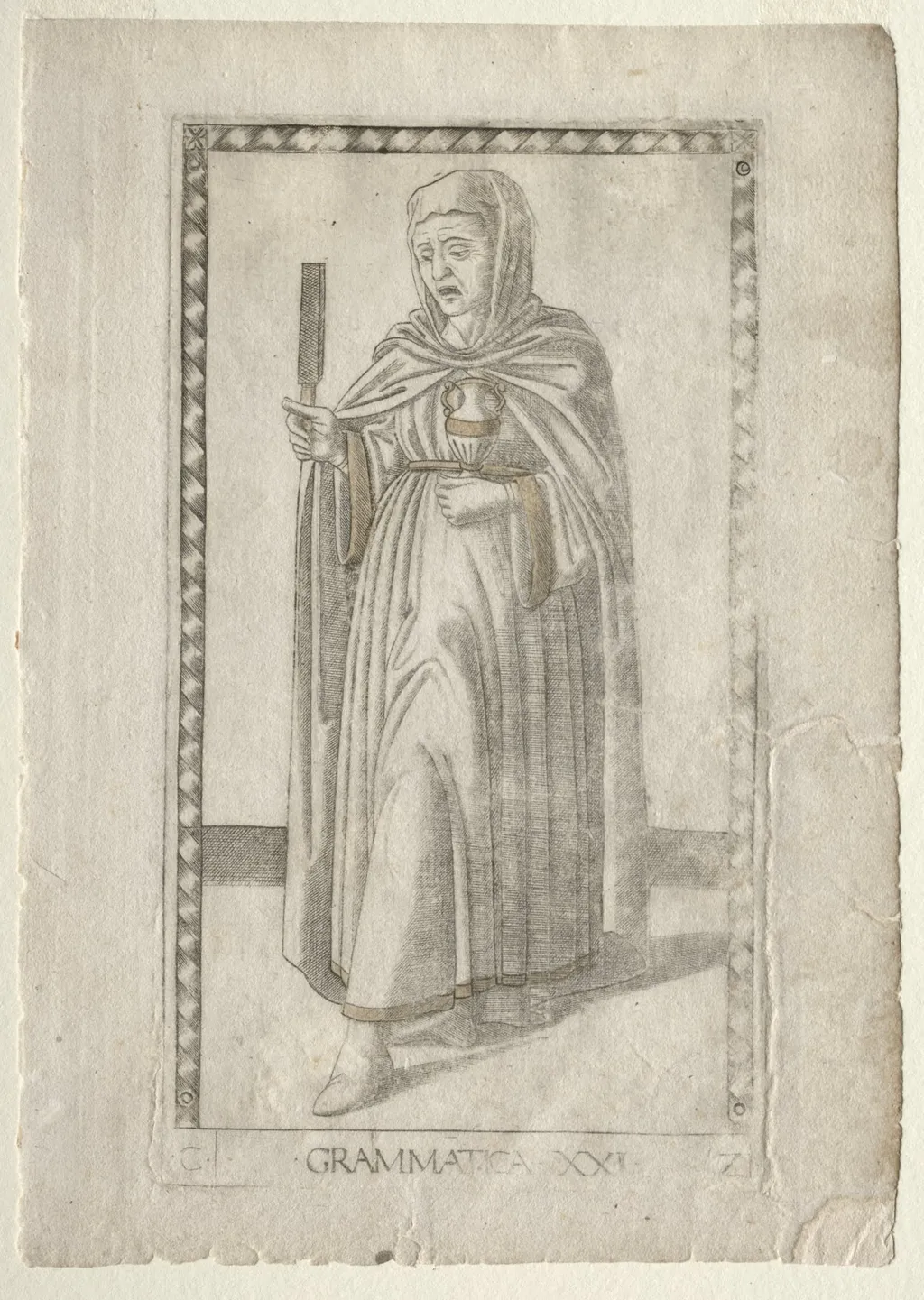
Grammar (from the Tarocchi, series C: Liberal Arts, #21) is a print by the Renaissance artist Master of the E-Series Tarocchi. It dates from 1467 and is held in the collection of the Cleveland Museum of Art.
About this work
Overview
The print depicts a standing female figure identified as Grammar, one of the allegorical personifications in the Tarocchi series C, which illustrates the liberal arts. She is shown in a simple interior, holding a book in her left hand and a rod‑like implement in her right, her gaze directed toward the viewer.
Subject & Meaning
In the medieval tradition, the liberal arts were divided into the Trivium—Grammar, Rhetoric, Logic—and the Quadrivium—Music, Geometry, Arithmetic, Astronomy. The Tarocchi set expands this scheme to ten disciplines by adding Poetry, Philosophy and Theology. Grammar, portrayed here, symbolizes the foundational skill of correct speech, a prerequisite for participation in civic life.
Technique & Style
The image is executed as an engraving, a printmaking method that allows fine line work and tonal variation. The figure’s drapery and the plain architectural backdrop are rendered with delicate hatching, emphasizing the calm, didactic atmosphere typical of late medieval allegorical prints.
History & Provenance
The Tarocchi cards were produced in the early sixteenth century for a learned audience, likely in Italy, and circulated as a portable visual encyclopedia of knowledge. This particular engraving belongs to the Cleveland Museum of Art’s collection, where it is displayed alongside the other nine allegorical figures of the series.
Context
Allegorical representations of the liberal arts emerged in the late Middle Ages as visual shorthand for educational ideals. By personifying each discipline as a woman, artists linked intellectual pursuits to virtues associated with femininity, such as grace and nurturing instruction.
Artist & collection
Artist
Master of the E-Series Tarocchi
Master of the E-Series Tarocchi (b. 1400) was an Italian artist.

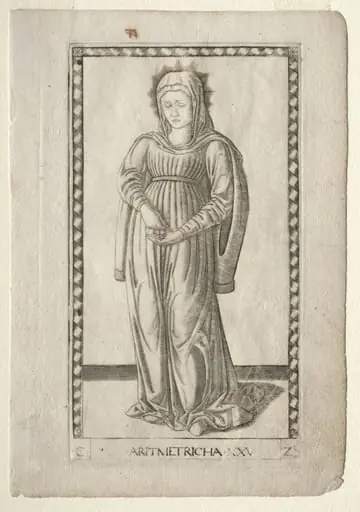 Arithmetic (from the Tarocchi, series C: Liberal Arts, #25)
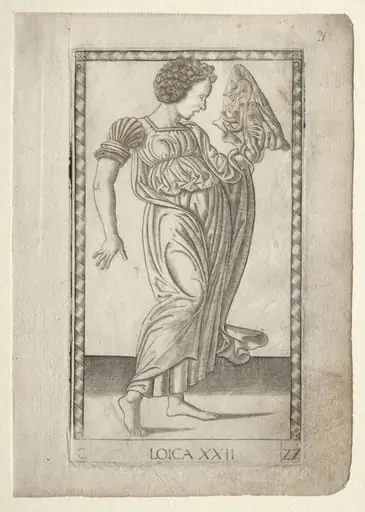 Logic (from the Tarocchi, series C: Liberal Arts, #22)
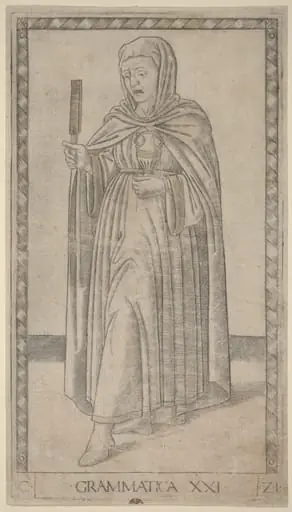 Grammatica (Grammar)
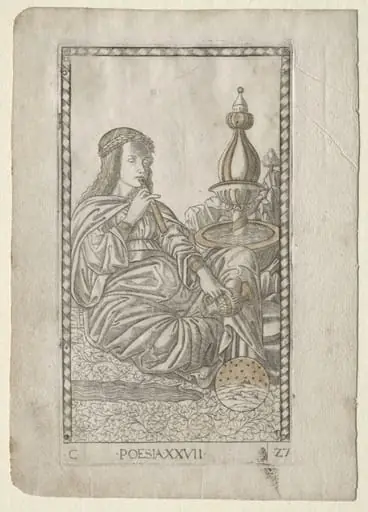 Poetry (from the Tarocchi, series C: Liberal Arts, #27)
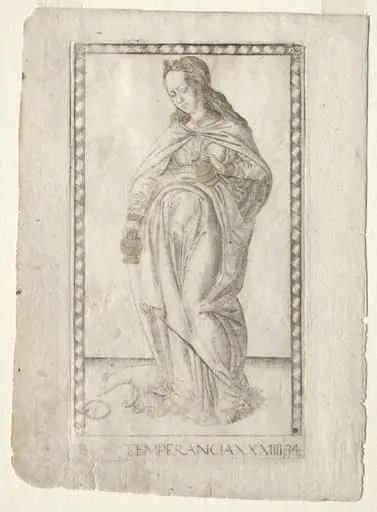 Temperance (from the Tarocchi, Series B: Cosmic Principles & Virtues, #34)
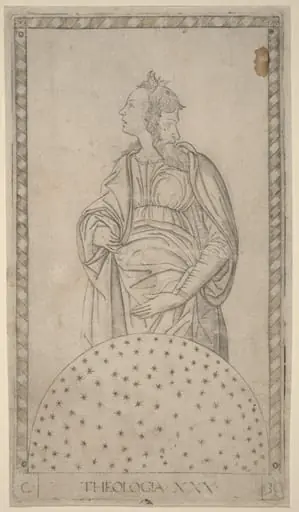
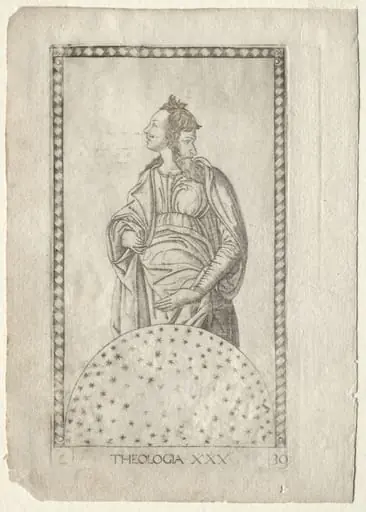 Theology (from the Tarocchi, series C: Liberal Arts, #30)
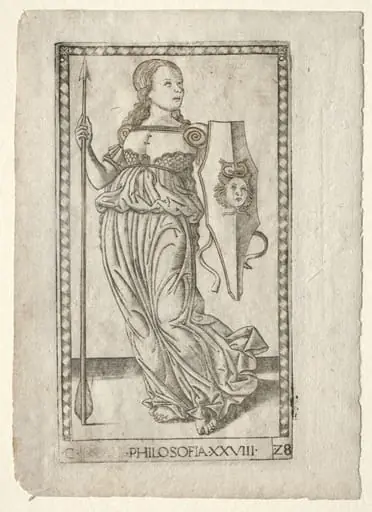 Philosophy (from the Tarocchi, series C: Liberal Arts, #28)