Artwork
Temperance (from the Tarocchi, Series B: Cosmic Principles & Virtues, #34)
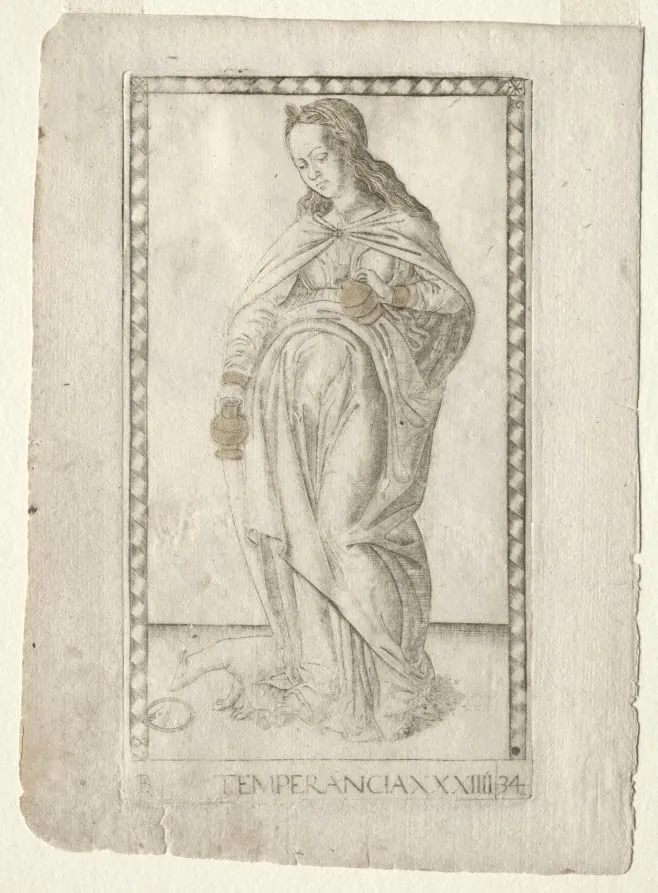
Temperance (from the Tarocchi, Series B: Cosmic Principles & Virtues, #34) is a print by the Renaissance artist Master of the E-Series Tarocchi. It dates from 1467 and is held in the collection of the Cleveland Museum of Art. This engraving is one of a series of playing cards produced in 15th-century Italy, likely in Ferrara, that depict moral and cosmic ideals.
About this work
The engraving is part of a set of cards—like early tarot—used for teaching or play.
A woman in a long robe pours liquid from one cup to another. She stands still, her face calm, like she’s measuring something important.
This is Temperance, one of the four cardinal virtues in Christian thought. The engraving is part of a set of cards—like early tarot—used for teaching or play. The artist didn’t sign it, so we call them the Master of the E-Series Tarocchi.
To see more works like this, look up *italy, ferrara, 15th century*.
Overview
This engraving is one of a series of playing cards produced in 15th-century Italy, likely in Ferrara, that depict moral and cosmic ideals. Known as Tarocchi, Series B, it belongs to a group illustrating the cardinal and theological virtues alongside abstract principles like Light and Time. The image of Temperance is rendered as a solitary female figure, engaged in the deliberate act of transferring liquid between vessels, symbolizing balance and restraint.
Subject & Meaning
Temperance is portrayed as a calm, full-length woman pouring liquid from one container to another, a visual metaphor for moderation and self-control. The presence of a small weasel or ermine gazing into a mirror beside her reinforces the theme of introspection and the avoidance of excess. In Christian moral teaching, this virtue was essential for maintaining harmony between desire and reason, forming a foundation for ethical conduct.
Technique & Style
Executed as a fine-line engraving, the image displays precise, delicate contours and subtle tonal gradations. The figure is rendered with restrained elegance, her posture steady and composed, emphasizing stillness over motion. The background is minimal, focusing attention on the symbolic objects and the figure’s poised action. The style aligns with Northern Italian printmaking traditions of the period, blending clarity with allegorical depth.
History & Provenance
The print is part of an unattributed series known as the Master of the E-Series Tarocchi, named for the distinctive engraving style and the lettered groupings of cards. No artist’s signature survives, and the exact origin remains uncertain, though stylistic evidence points to Ferrara around 1470–1480. These cards were likely used for both educational and recreational purposes among educated elites.
Context
In 15th-century Italy, moral virtues were frequently encoded in visual culture to reinforce religious and philosophical ideals. The Tarocchi series reflects the humanist revival of classical and Christian ethics, blending medieval symbolism with emerging Renaissance aesthetics. Such decks served not only as games but as tools for moral instruction, circulating among courtly and scholarly circles.
Legacy
Though not widely known outside specialist circles, this series represents an early fusion of allegorical imagery with the mechanics of playing cards. Its influence can be traced in later tarot decks and moral emblem books. The anonymity of its creator underscores the collaborative, functional nature of such works, designed not for individual fame but for cultural transmission.
Artist & collection
Artist
Master of the E-Series Tarocchi
Master of the E-Series Tarocchi (b. 1400) was an Italian artist.

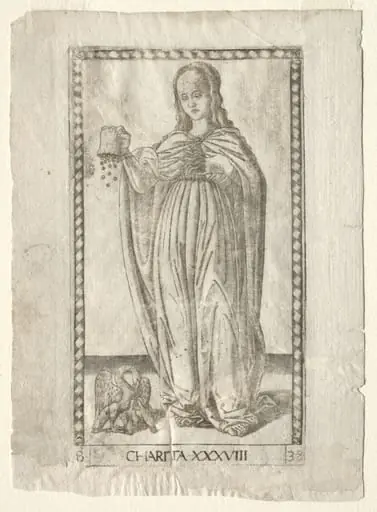 Charity (from the Tarocchi, series B: Cosmic Principles & Virtues, #38)
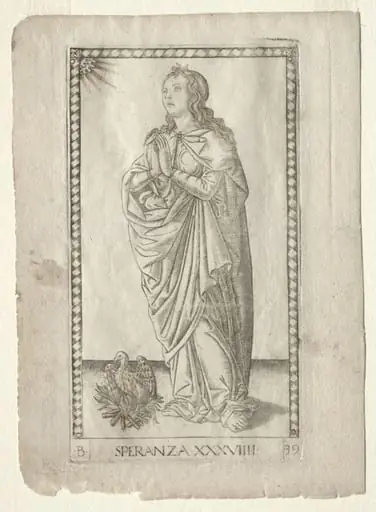 Hope (from the Tarocchi, series B: Cosmic Principles & Virtues, #39)
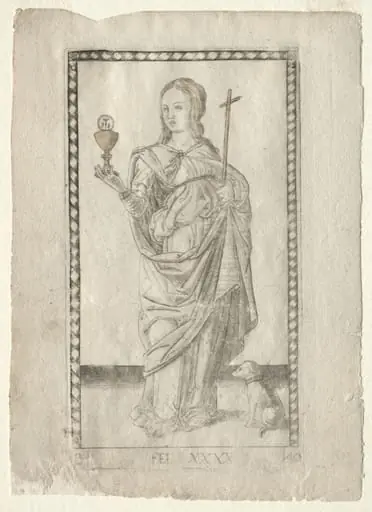 Faith (from the Tarocchi, series B: Cosmic Principles & Virtues, #40)
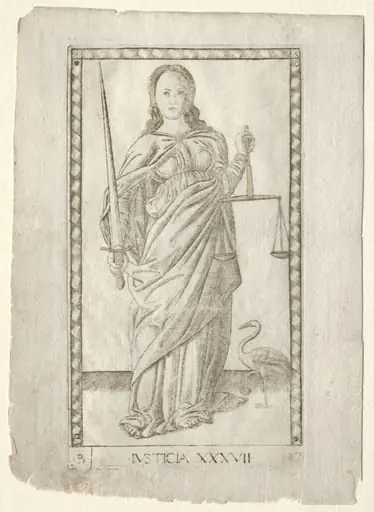 Justice (from the Tarocchi, series B: Cosmic Principles & Virtues, #37)
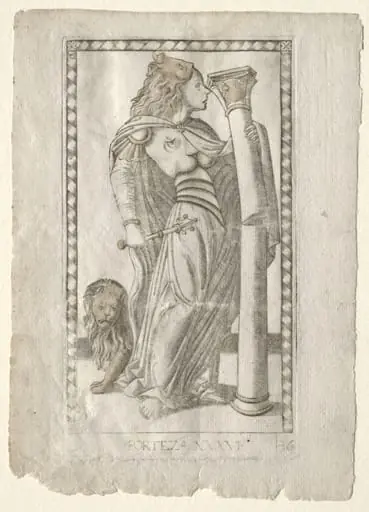 Forteza (from the Tarocchi, series B: Cosmic Principles & Virtues, #36)
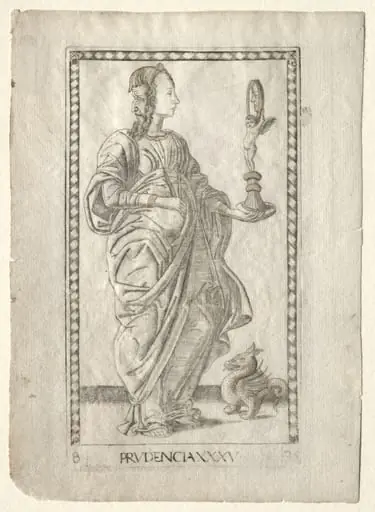 Prudence (from the Tarocchi, series B: Cosmic Principles & Virtues, #35)
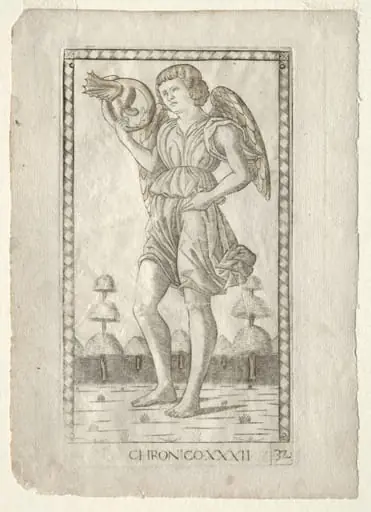 Genius of Time (from the Tarocchi, series B: Cosmic Principles & Virtues, #32)
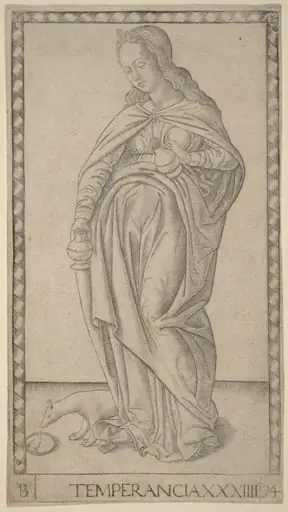 Temperancia (Temperance)
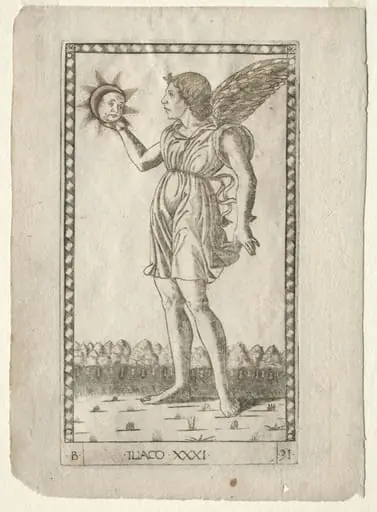 Genius of the Sun (from the Tarocchi, series B: Cosmic Principles & Virtues, #31)