Artwork
Mars (from the Tarocchi, series A: Firmaments of the Universe, #45)
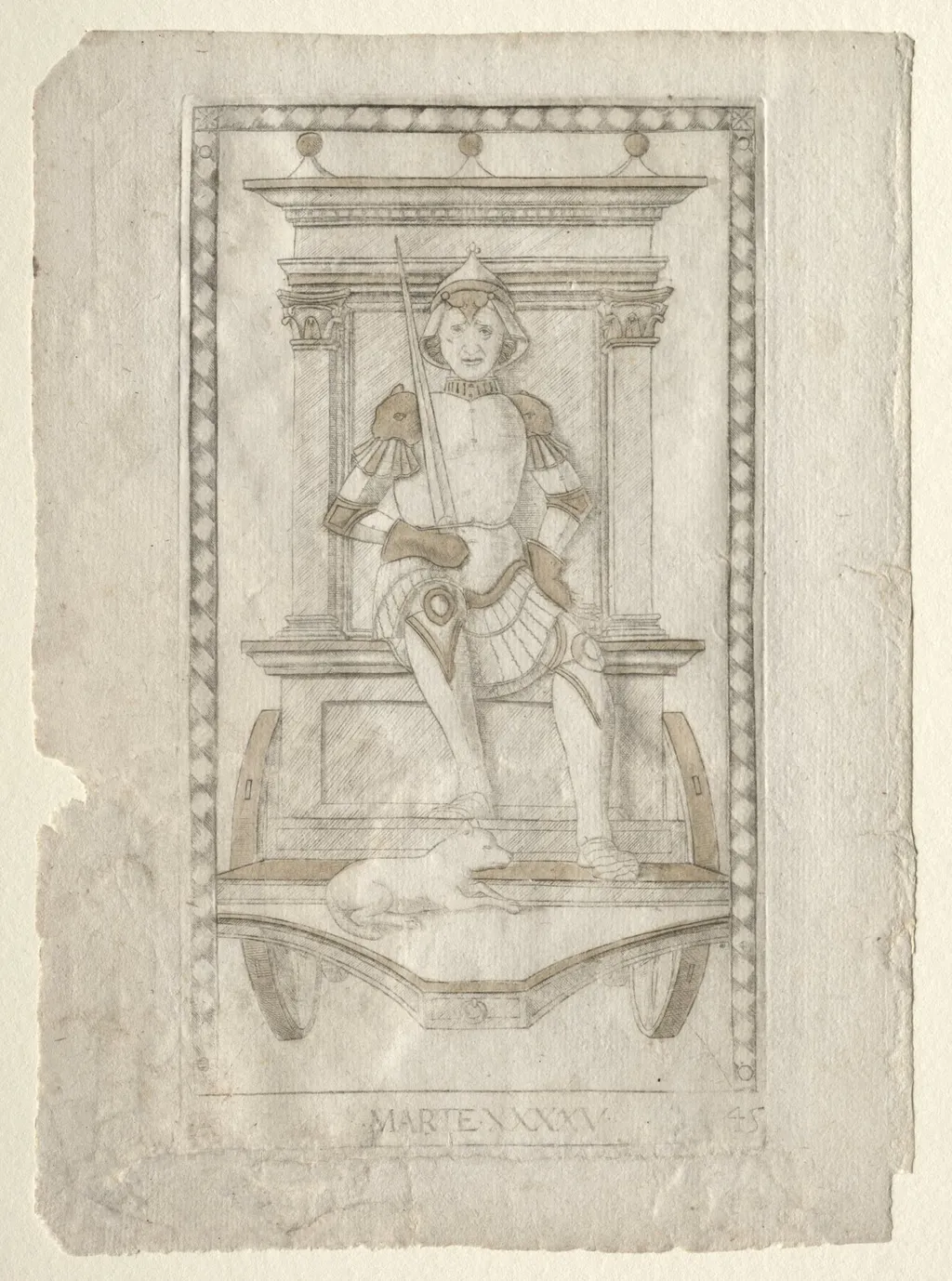
Mars (from the Tarocchi, series A: Firmaments of the Universe, #45) is a print by the Renaissance artist Master of the E-Series Tarocchi. It dates from 1467 and is held in the collection of the Cleveland Museum of Art.
About this work
Overview
The image is one of a larger group of engravings attributed to the anonymous artist known as the Master of the E-Series Tarocchi.
This engraving belongs to the Tarocchi series labeled 'A,' known as Firmaments of the Universe, which depicts the seven classical planets and three celestial spheres thought to separate them from the Prima Causa, the ultimate source of all existence. Mars is the fourth subject in this sequence, rendered as a human embodiment of the planet rather than an abstract symbol. The image is one of a larger group of engravings attributed to the anonymous artist known as the Master of the E-Series Tarocchi.
Subject & Meaning
Mars is portrayed as a seated, armored male figure in frontal pose, holding a sword aloft in his right hand. His throne resembles a chariot, evoking ancient associations with war and celestial motion. At his feet, a wolf—symbolic of ferocity and wildness—reinforces the planet’s traditional link to aggression and martial power. The composition reflects a Renaissance synthesis of astrological belief and classical mythology, positioning Mars not merely as a celestial body but as an active, divine agent in the cosmic order.
Technique & Style
Executed as a fine-line engraving, the image relies on precise incised lines to define form and texture, with subtle shading to suggest volume and depth. The figure’s armor and drapery are rendered with meticulous detail, contrasting with the simpler, more schematic background. The frontal, symmetrical composition and rigid posture reflect a formal, hieratic approach common in early Renaissance iconography, emphasizing dignity and cosmic authority over naturalistic movement.
History & Provenance
The engraving was likely produced in northern Italy during the late 15th century, possibly for a private collector interested in astrological and philosophical themes. It survives as part of a fragmented series, with few complete sets known today. The attribution to the Master of the E-Series Tarocchi is based on stylistic comparisons with other engravings sharing similar iconography and technical execution, though the artist’s true identity remains unknown.
Context
This work emerged during a period when astrology and astronomy were deeply intertwined in intellectual life. The Tarocchi series reflects a humanist effort to map the cosmos according to Ptolemaic cosmology, blending classical mythology with medieval and Renaissance scientific thought. Such imagery was used in scholarly circles and among the elite to visualize the hierarchical structure of the universe, reinforcing the idea that celestial bodies influenced earthly affairs.
Legacy
Though not widely reproduced or publicly exhibited in its time, the Tarocchi series has gained scholarly attention for its rare fusion of astrological symbolism and graphic art. It offers insight into how Renaissance viewers conceptualized the heavens—not as distant objects, but as inhabited realms governed by divine forces. The series remains a key example of early printed iconography bridging esoteric tradition and emerging scientific inquiry.
Artist & collection
Artist
Master of the E-Series Tarocchi
Master of the E-Series Tarocchi (b. 1400) was an Italian artist.

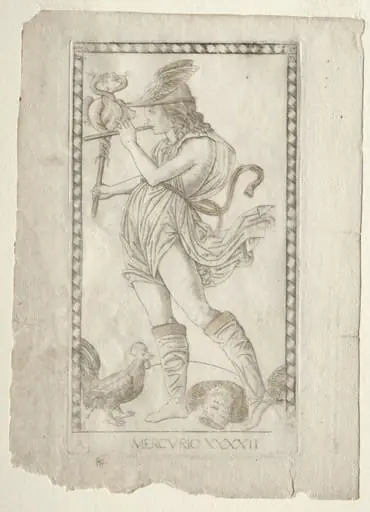 Mercury (from the Tarocchi, series A: Firmaments of the Universe, #42)
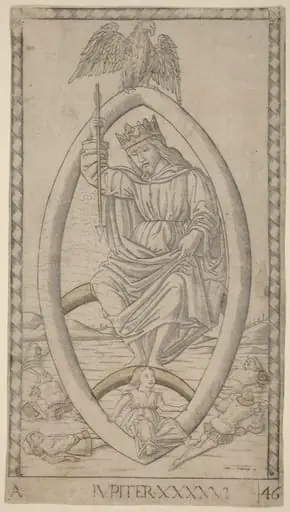
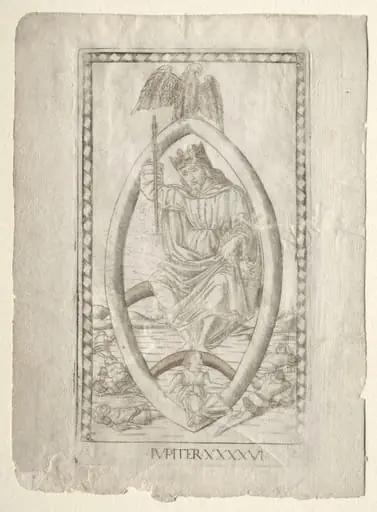 Jupiter (from the Tarocchi, series A: Firmaments of the Universe, #46)
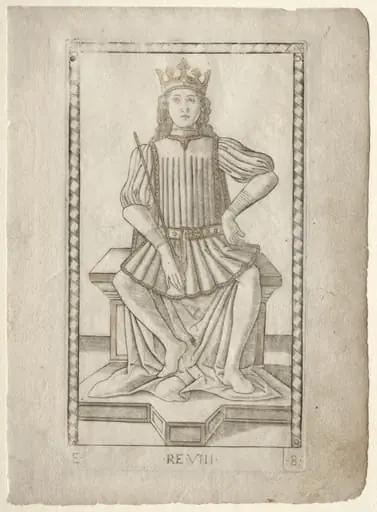 The King (from the Tarocchi, series E: Conditions of Man, #8)
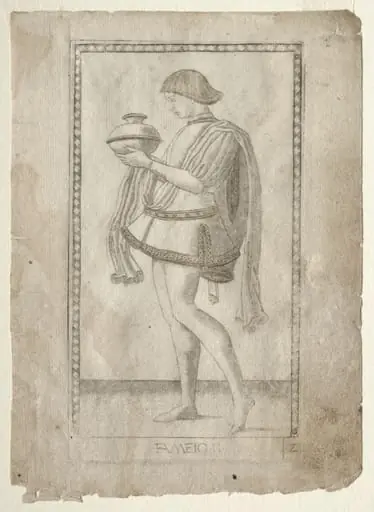 The Servant (from the Tarocchi, series E: Conditions of Man, #2)
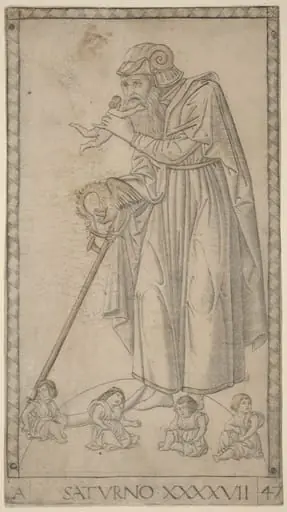
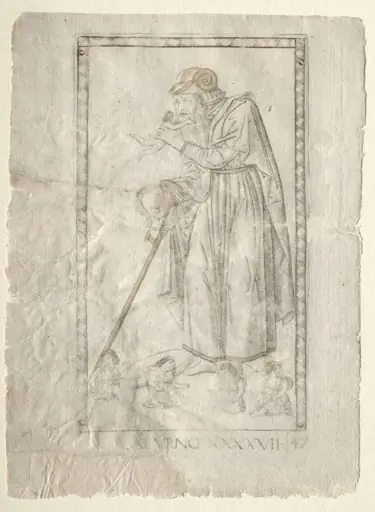 Saturn (from the Tarocchi, series A: Firmaments of the Universe, #47)
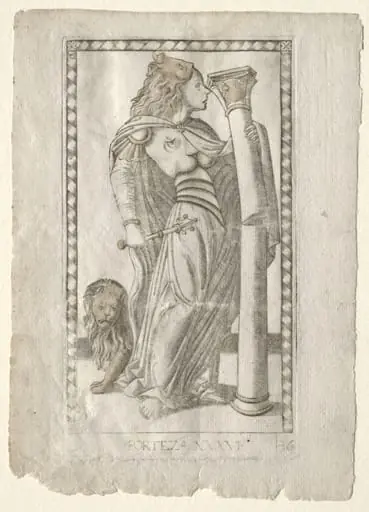 Forteza (from the Tarocchi, series B: Cosmic Principles & Virtues, #36)
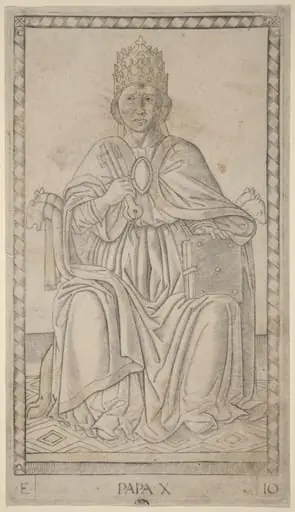
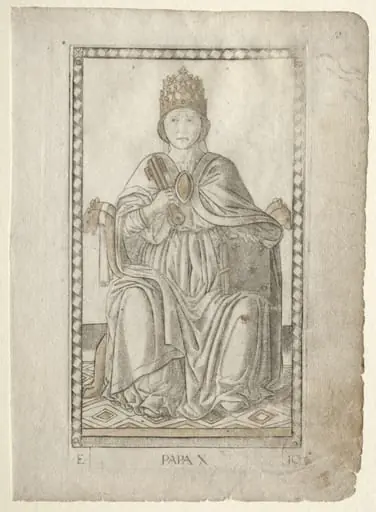 The Pope (from the Tarocchi, series E: Conditions of Man, #10)