Artwork
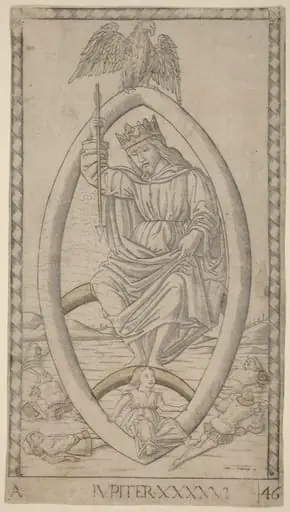
Jupiter (from the Tarocchi, series A: Firmaments of the Universe, #46)
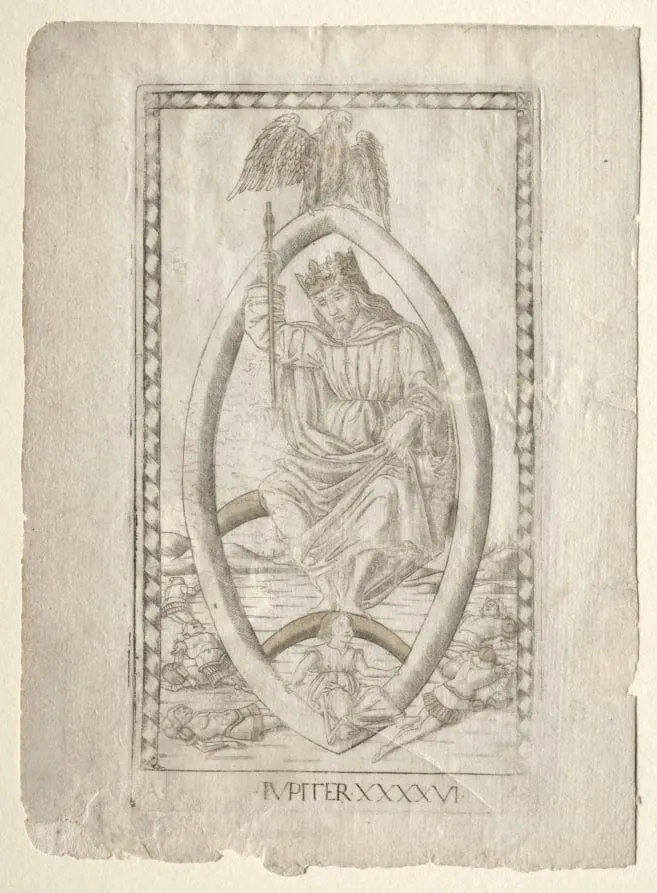
Jupiter (from the Tarocchi, series A: Firmaments of the Universe, #46) is a print by the Renaissance artist Master of the E-Series Tarocchi. It dates from 1467 and is held in the collection of the Cleveland Museum of Art. This engraving, Jupiter, is part of a series known as the Tarocchi, specifically group A, Firmaments of the Universe.
About this work
The artist grouped Jupiter with other planets and heavenly layers to show how people in 1400s Italy pictured the universe.
You see a crowned man sitting sideways on a throne, holding a scepter and a scroll. He’s labeled “Iupiter,” the Roman name for Jupiter, king of the gods.
This print is one of the earliest tarot-like cards we know—made before tarot decks even existed. The artist grouped Jupiter with other planets and heavenly layers to show how people in 1400s Italy pictured the universe. The lines are crisp, like a woodcut, but no one knows exactly how it was made.
To see more of these early cosmic cards, look up the subject: italy, ferrara, 15th century.
Overview
This engraving, Jupiter, is part of a series known as the Tarocchi, specifically group A, Firmaments of the Universe. It is one of a set of prints depicting celestial bodies and spheres.
Subject & Meaning
The print personifies Jupiter, the Roman king of the gods, as a crowned figure seated on a double rainbow within a mandorla. The surrounding landscape includes dead soldiers, while an eagle and a child adorn the top and bottom of the mandorla.
Technique & Style
The engraving features crisp lines reminiscent of woodcut techniques, although its exact method of production is unknown. The style is characteristic of 15th-century Italian prints.
Context
Created in 15th-century Italy, likely in Ferrara, this print is among the earliest known examples of tarot-like cards, predating the development of tarot decks. It represents Jupiter as part of a cosmological schema.
Artist & collection
Artist
Master of the E-Series Tarocchi
Master of the E-Series Tarocchi (b. 1400) was an Italian artist.

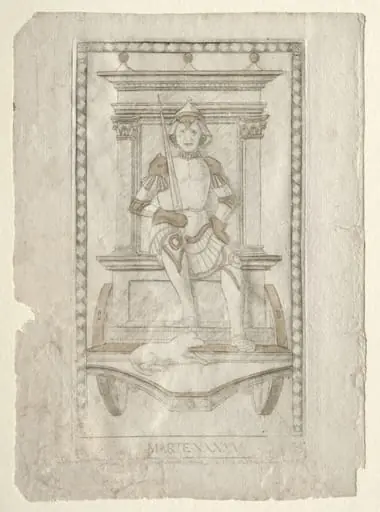 Mars (from the Tarocchi, series A: Firmaments of the Universe, #45)
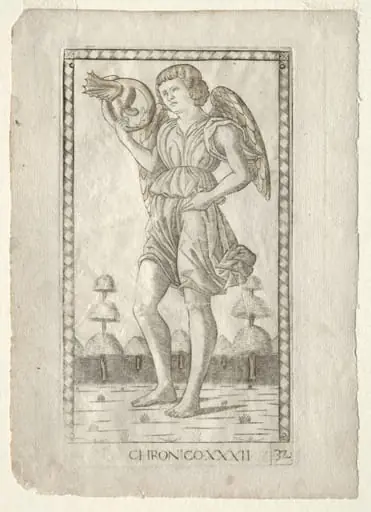 Genius of Time (from the Tarocchi, series B: Cosmic Principles & Virtues, #32)
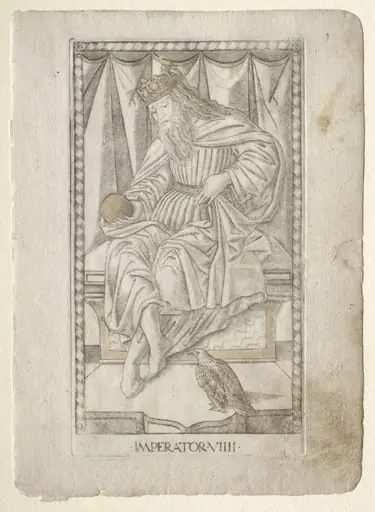 The Emperor (from the Tarocchi, series E: Conditions of Man, #9)
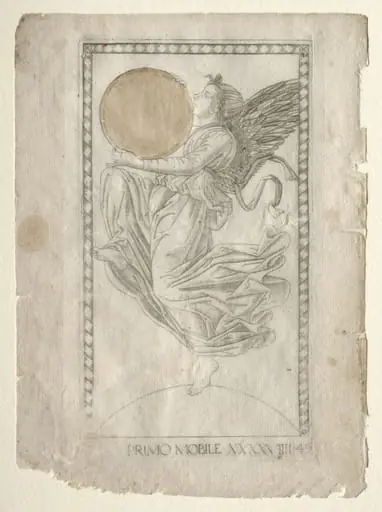 The Angel of the Ninth Sphere (from the Tarocchi, series A: Firmaments of the Universe, #49)
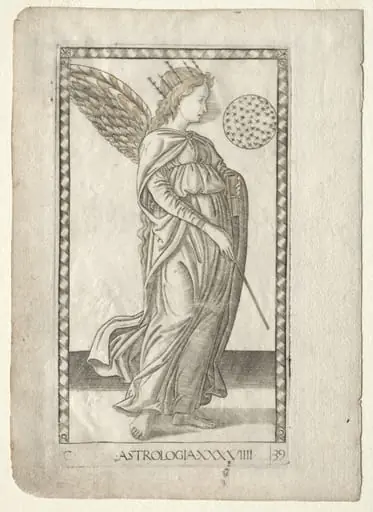 Astrology (from the Tarocchi, series C: Liberal Arts, #29)
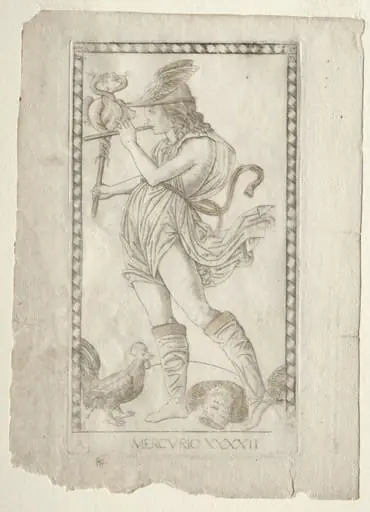 Mercury (from the Tarocchi, series A: Firmaments of the Universe, #42)
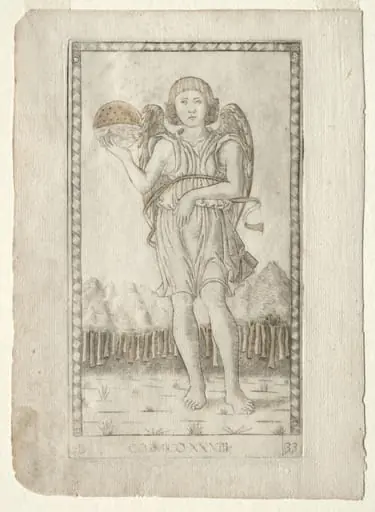 Genius of the World (from the Tarocchi, series B: Cosmic Principles & Virtues, #33)
 Apollo (from the Tarocchi, series D: Apollo and the Muses, #20)
 Luna (from the Tarocchi, series A: Firmaments of the Universe, #41)
 The King (from the Tarocchi, series E: Conditions of Man, #8)
 The Angel of the Eighth Sphere (from the Tarocchi, series A: Firmaments of the Universe, #48)