Artwork
Music (from the Tarocchi, series C: Liberal Arts, #26)
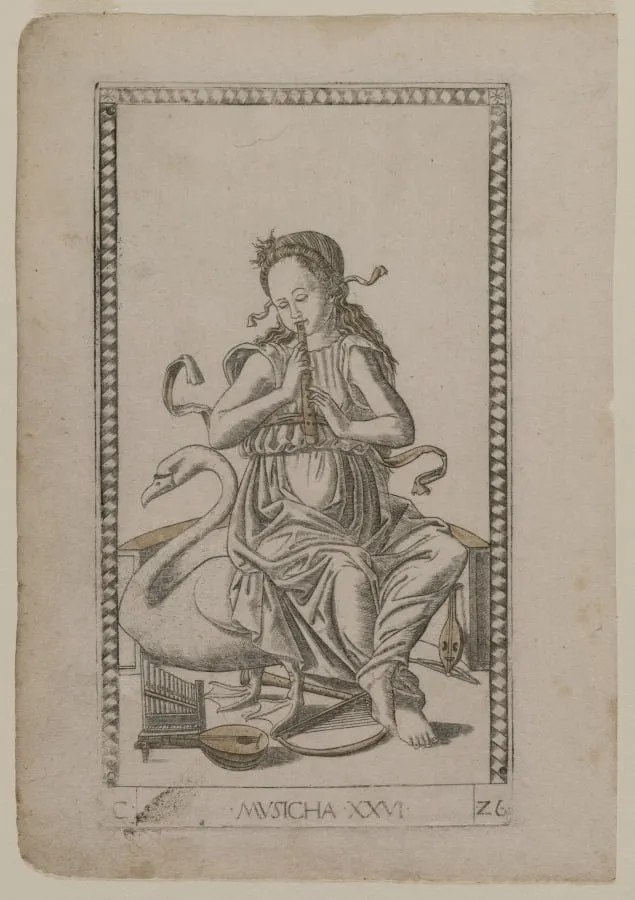
Music (from the Tarocchi, series C: Liberal Arts, #26) is a print by the Renaissance artist Master of the E-Series Tarocchi. It dates from 1467 and is held in the collection of the Cleveland Museum of Art.
About this work
Overview
Music is depicted as one of ten arts, expanded beyond the traditional seven to include Poetry, Philosophy, and Theology, reflecting Renaissance humanist ideals.
This engraving belongs to a 15th-century Italian deck known as the Tarocchi, specifically the subset labeled 'C' representing the Liberal Arts. Unlike modern tarot decks used for divination, this series functioned as an educational tool for aristocratic audiences, illustrating classical disciplines through allegorical imagery. Music is depicted as one of ten arts, expanded beyond the traditional seven to include Poetry, Philosophy, and Theology, reflecting Renaissance humanist ideals.
Subject & Meaning
The figure of Music, named Musicha, is portrayed as a young woman holding a trumpet and balanced scales. The trumpet signifies the art’s expressive power, while the scales suggest harmony and mathematical order—core principles in medieval music theory. She stands atop a modest pedestal, surrounded by instruments, reinforcing her dominion over sonic practice. The swan, traditionally linked to a final, transcendent song, is absent here, replaced by a more grounded, intellectual symbolism.
Technique & Style
The engraving employs fine, precise lines to model light and shadow, creating subtle volume without heavy shading. Details of instruments and tiled flooring are rendered with meticulous clarity, emphasizing craftsmanship over dramatic effect. The composition is contained within a simple interior space, focusing attention on the allegorical figure and her attributes. The style reflects the Northern European influence on Italian printmaking of the period, prioritizing clarity and symbolic legibility.
History & Provenance
Produced in northern Italy during the mid-1400s, this print was part of a larger set commissioned by or for the educated elite. Such decks were not used for games of chance but as visual aids in humanist education. The artist, likely trained in engraving traditions of the Rhineland or Lombardy, adapted classical themes into a format accessible to noble patrons. No definitive record of the original owner survives, but the set’s survival suggests it was valued as a cultural artifact.
Context
The Liberal Arts were foundational to Renaissance education, rooted in ancient Greco-Roman pedagogy and revived through humanist circles. Music, as part of the Quadrivium, was not merely performance but the study of numerical ratios and cosmic order. Depicting it as a female allegory aligned with medieval traditions of personifying abstract concepts, making complex ideas tangible for students. This print reflects a broader trend of visualizing knowledge as both intellectual and aesthetic.
Legacy
Though the Tarocchi series was not widely reproduced, its imagery influenced later emblem books and educational illustrations. The fusion of classical subject matter with accessible visual allegory helped bridge medieval scholasticism and Renaissance humanism. Today, surviving prints like this one serve as primary evidence of how early modern elites engaged with intellectual traditions—not through texts alone, but through carefully designed visual systems.
Artist & collection
Artist
Master of the E-Series Tarocchi
Master of the E-Series Tarocchi (b. 1400) was an Italian artist.

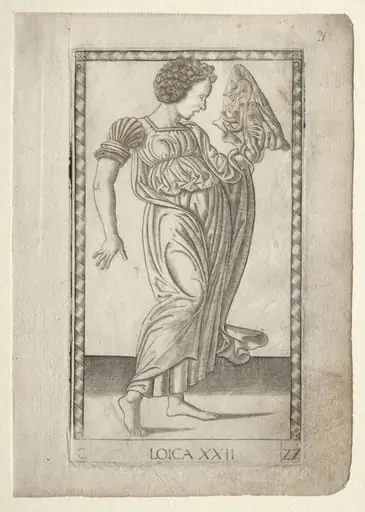 Logic (from the Tarocchi, series C: Liberal Arts, #22)
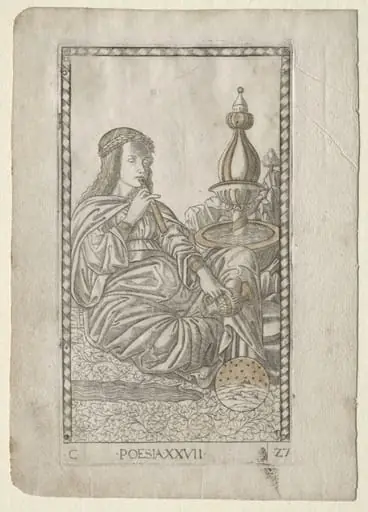 Poetry (from the Tarocchi, series C: Liberal Arts, #27)
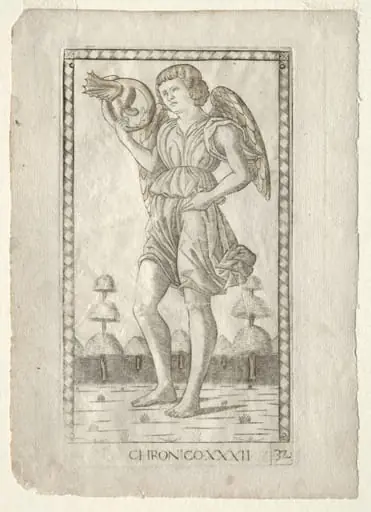 Genius of Time (from the Tarocchi, series B: Cosmic Principles & Virtues, #32)
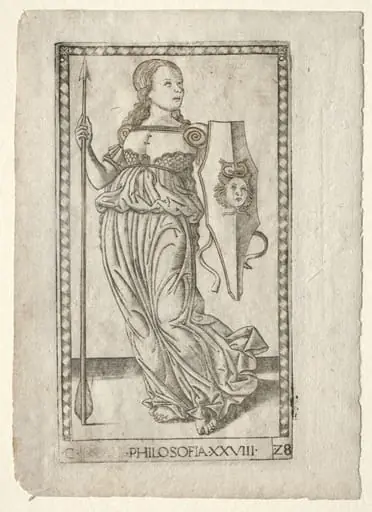 Philosophy (from the Tarocchi, series C: Liberal Arts, #28)
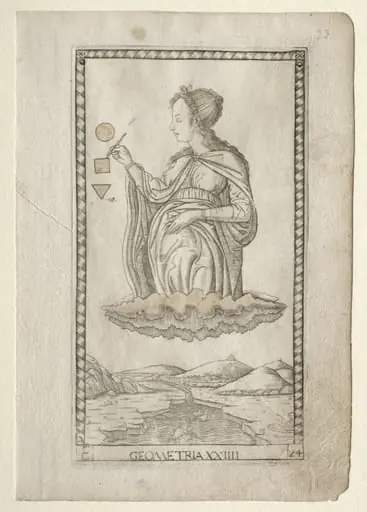 Geometry (from the Tarocchi, series C: Liberal Arts, #24)
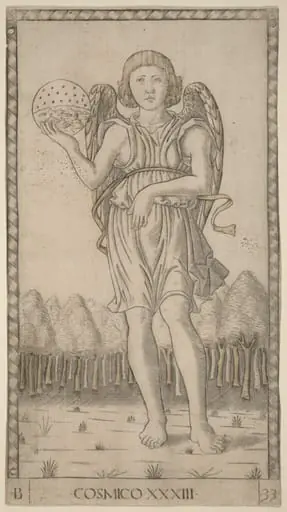
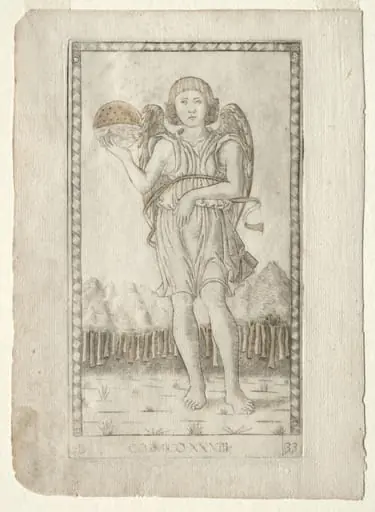 Genius of the World (from the Tarocchi, series B: Cosmic Principles & Virtues, #33)