Artwork
Maler und Modell (Umkreis)
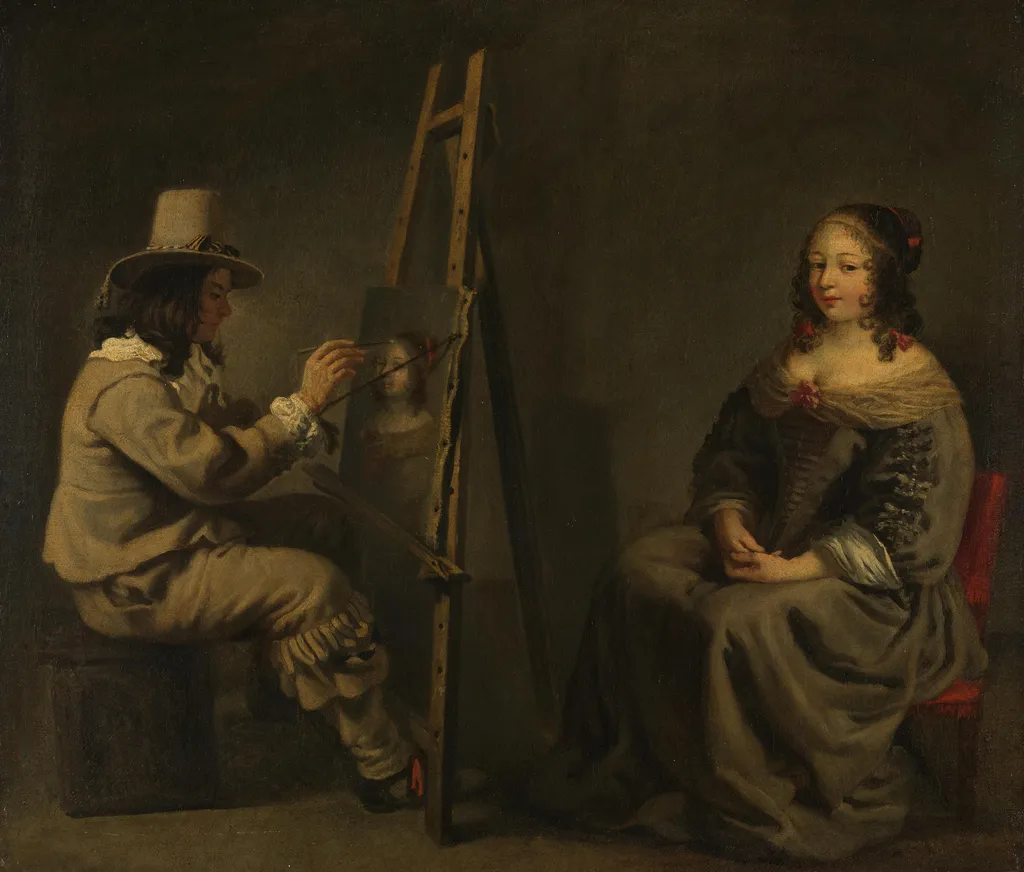
Maler und Modell (Umkreis) is an oil painting by the French Classical Baroque artist Mathieu Le Nain. It dates from 1642 and is held in the collection of the Bavarian State Painting Collections.
About this work
Overview
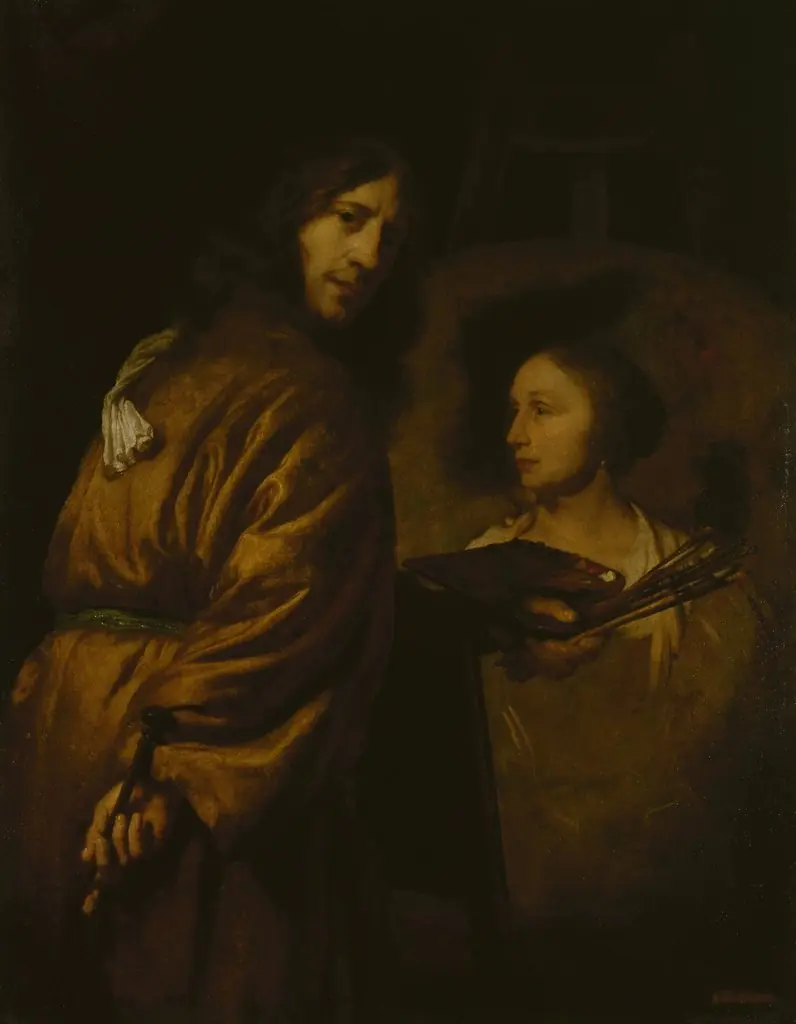
An oil painting from the early 1640s, attributed to the circle of Mathieu Le Nain, portrays a studio scene with a male artist and a female sitter. The work is held in the Alte Pinakothek in Munich. Its composition centers on the quiet interaction between the two figures, framed by a dark, undefined background that enhances their presence through contrast and focused illumination.
Subject & Meaning
The painting captures a moment of artistic creation, with the man actively engaged in painting while the woman observes him. Though her portrait is only partially visible on the canvas, her gaze suggests a reciprocal awareness between artist and subject. The scene reflects the intimate, often unspoken dynamics of the studio, where labor and observation coexist without overt narrative.
Technique & Style
Chiaroscuro is employed to model the figures with subtle gradations of light and shadow, giving form and volume without relying on visible light sources. The dark background isolates the subjects, directing attention to their gestures and attire. Brushwork is restrained, favoring naturalistic rendering over decorative detail, consistent with the Northern European tradition of quiet realism.
History & Provenance
The painting entered the collection of the Alte Pinakothek in the 19th century, cataloged under the broader Le Nain circle due to stylistic affinities with Mathieu Le Nain’s known works. While not definitively signed or dated, its execution aligns with mid-17th-century French genre painting, likely produced in Paris during the artist’s active years.
Context
In 17th-century France, depictions of artists at work were rare compared to Dutch equivalents. This painting reflects a growing interest in the studio as a site of quiet dignity, distinct from theatrical or allegorical portrayals. It aligns with a broader trend of domestic realism, emphasizing the everyday rituals of artistic practice without idealization.
Legacy
The work contributes to the understanding of how artists represented their own profession in early modern Europe. Its restrained tone and focus on process, rather than spectacle, offer insight into the social and spatial dynamics of the artist’s studio. It remains a quiet testament to the uncelebrated labor behind portraiture.
Own this work as a print
Artist & collection

 Self-Portrait
 Self-portrait of the artist with his wife Isabella de Wolff in the inn
 Self-Portrait
 The Artist's Studio
 The Painter in his Studio
 Self-portrait of the Artist with his Daughter Antonia
 A Couple Drinking
 The Lace Maker
 Self-Portrait at Her Easel
 Music-making company
 Portrait of Catherine Duchemin
 A young Painter