Artwork
Saint Anthony of Padua
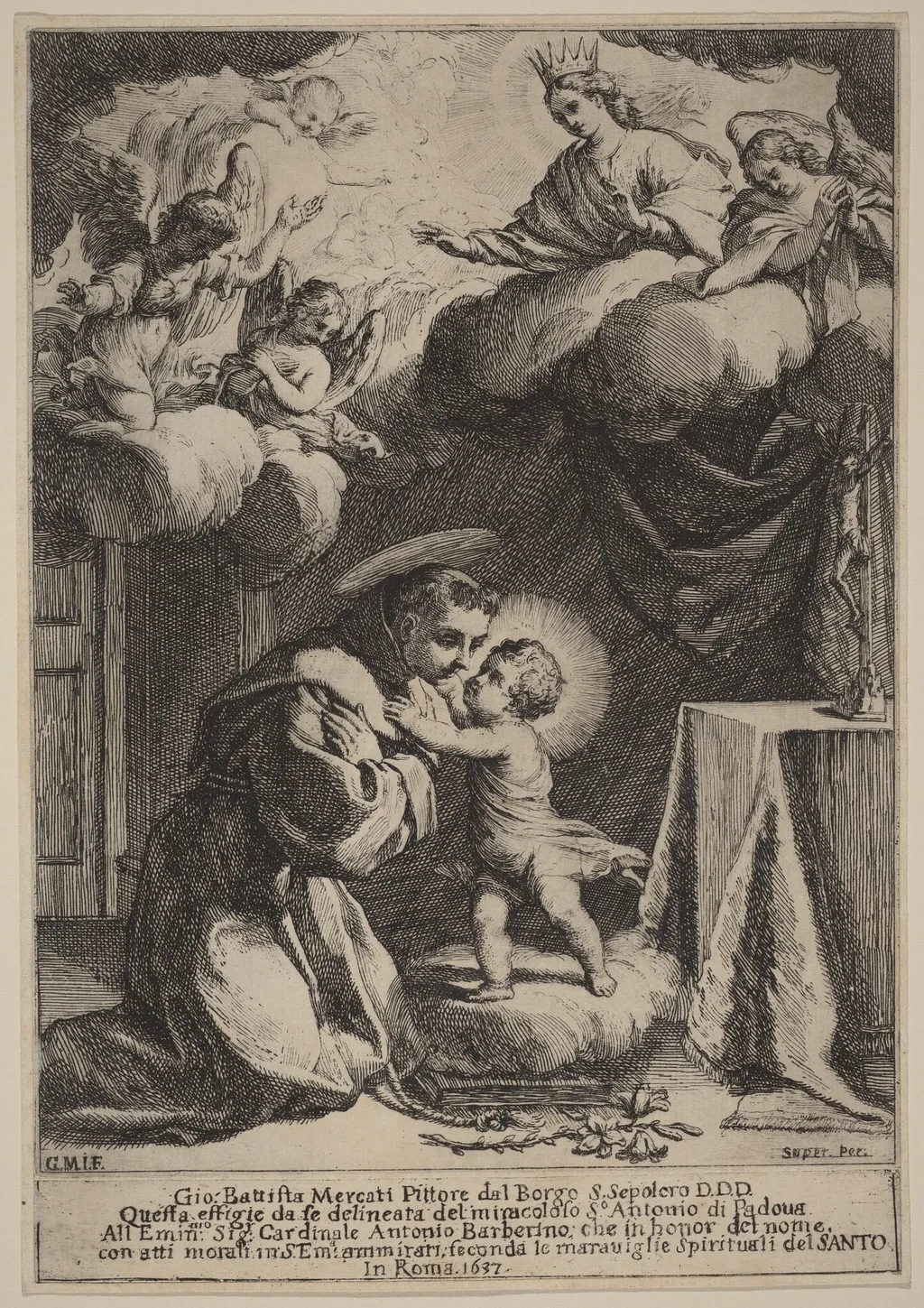
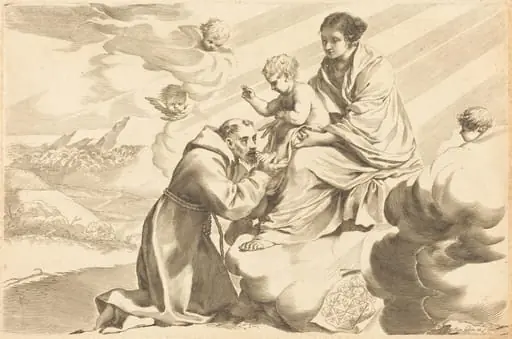
Saint Anthony of Padua is an ink print by the Baroque artist Giovanni Battista Mercati. It dates from 1640 and is held in the collection of the National Gallery of Art.
About this work
Overview
Giovanni Battista Mercati’s 1640 etching entitled Saint Anthony of Padua presents a devotional scene rendered on laid paper from two copper plates.
Giovanni Battista Mercati’s 1640 etching entitled Saint Anthony of Padua presents a devotional scene rendered on laid paper from two copper plates. The composition centers on a man cradling a child, both gazing upward, while a host of angels hover above, some bearing symbolic objects such as a book and a cross. An altar with a candle and an open book occupies the lower space, completing the religious narrative.
Subject & Meaning
The central figure is identified as Saint Anthony, a Franciscan preacher renowned for his miracles, depicted in humble attire and a simple hat. The infant, likely representing a child of the faithful or a symbolic soul, reaches toward divine light, suggesting intercession and spiritual guidance. The surrounding angels reinforce the celestial approval of the saint’s prayers, while the altar’s candle and text allude to liturgical devotion.
Technique & Style
Mercati employed a dual‑plate etching process, allowing intricate overlapping of lines and tonal variation. Through careful acid biting, he achieved gradations of darkness that model the figures, giving them a three‑dimensional presence despite the monochrome medium. The use of laid paper contributes a subtle texture, enhancing the depth of shadows and the delicate rendering of angelic drapery.
History & Provenance
Created in the mid‑seventeenth century, this print reflects the Counter‑Reformation’s emphasis on accessible religious imagery. While specific ownership records are scarce, the work aligns with Mercati’s broader output of devotional prints intended for private contemplation and distribution among the faithful. Its survival on paper suggests it was valued enough to be preserved within collections of religious prints.
Artist & collection