Artwork
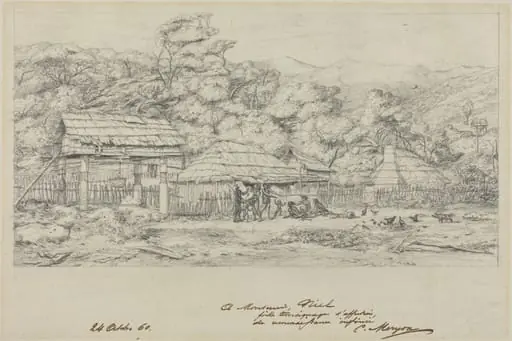
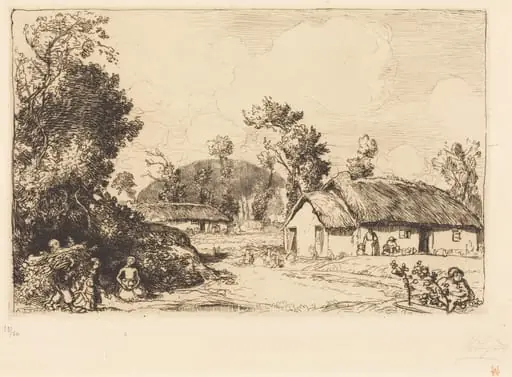
Greniers indigènes et habitations à Akaroa, presqu'Ile de Banks, 1845 (Native Barns and Huts at Akaroa, Banks' Peninsula, 1845)
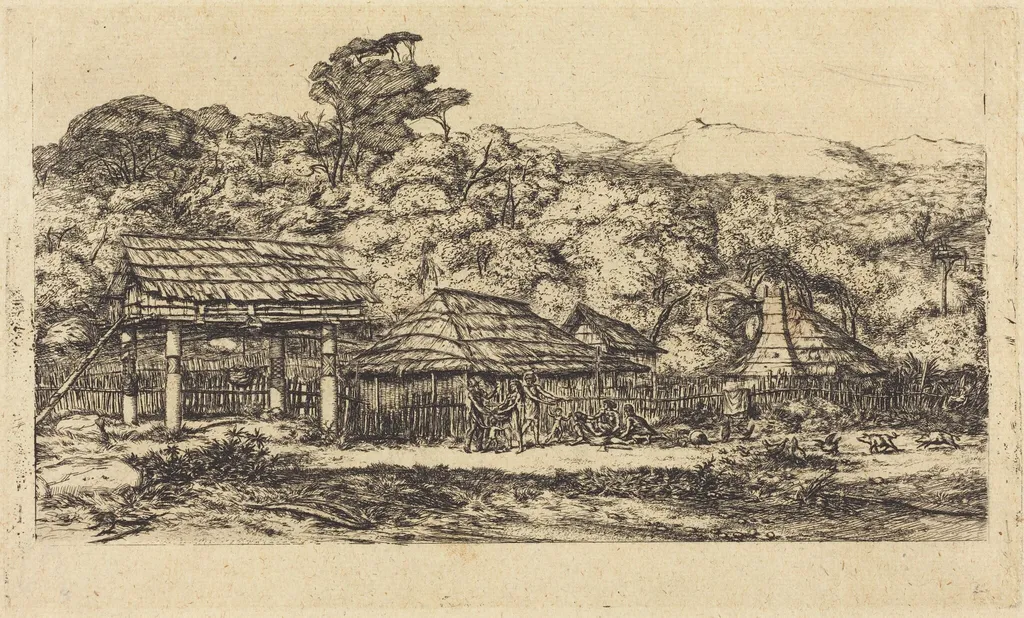
Greniers indigènes et habitations à Akaroa, presqu'Ile de Banks, 1845 (Native Barns and Huts at Akaroa, Banks' Peninsula, 1845) is an ink print by the Impressionist artist Charles Meryon. It dates from 1865 and is held in the collection of the National Gallery of Art.
About this work
Overview
Though Meryon is best known for his Parisian urban scenes, this work reflects his broader interest in documenting architectural forms across cultures.
Created in 1865, this etching by Charles Meryon captures a Māori settlement on Banks Peninsula, New Zealand, nearly two decades after his visit. Though Meryon is best known for his Parisian urban scenes, this work reflects his broader interest in documenting architectural forms across cultures. Executed in etching on green laid paper, it exemplifies his technical precision and sensitivity to spatial depth, despite his color blindness limiting his use of pigment.
Subject & Meaning
The scene portrays a modest Māori village with thatched huts and storage barns, arranged along a gentle slope. Figures in the foreground engage in daily activities—tending a fire, resting, or working—suggesting quiet domestic life. The composition avoids romanticization, presenting the structures and inhabitants with observational neutrality. It records a moment of Indigenous life in early colonial New Zealand, preserving details of vernacular architecture before widespread European influence.
Technique & Style
Meryon employed fine, controlled etching lines to render texture in thatch, timber, and earth. The green-toned paper enhances the tonal range, allowing subtle gradations of light and shadow to define form. His use of cross-hatching and delicate stippling gives the scene a tactile realism, emphasizing the weight of structures and the natural contours of the landscape. The absence of color directs focus to line and composition, characteristic of his graphic discipline.
History & Provenance
Meryon traveled to New Zealand in 1845 as a naval officer, sketching scenes during a brief stop at Akaroa. He later developed these studies into finished etchings in Paris, including this one. The work remained within European collections, primarily in France, and was not widely exhibited until the late 19th century. Its survival as a rare non-European subject in his oeuvre underscores its significance in his broader graphic project.
Context
Produced during a period of rapid colonial expansion in New Zealand, the etching stands apart from contemporary imperial imagery by avoiding overt political messaging. Instead, it offers a quiet, unembellished record of Indigenous architecture and daily life. Meryon’s approach reflects the 19th-century European fascination with ethnographic observation, yet his restraint distinguishes it from more sensationalized depictions of Indigenous peoples.
Legacy
This etching is among the few works by Meryon that document non-European subjects, making it a rare point of comparison in his oeuvre. It has been studied for its technical mastery and its value as a visual record of pre-colonial Māori settlement patterns. While overshadowed by his Parisian views, it remains a significant example of cross-cultural observation in 19th-century printmaking.
Artist & collection
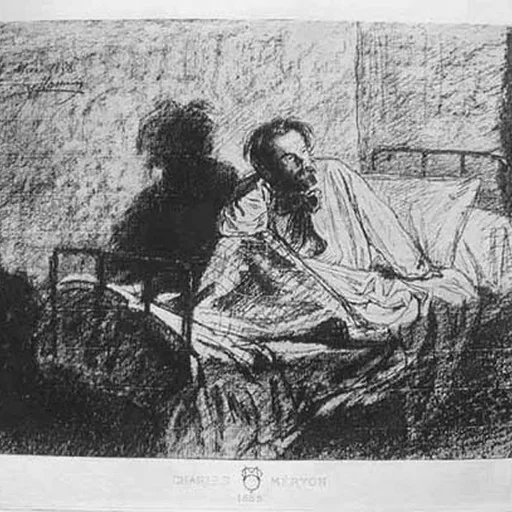
Artist
Charles Meryon (sometimes Méryon, 23 November 1821 – 14 February 1868) was a French artist who worked almost entirely in etching, as he had colour blindness.