Artwork
Samuel Rogers, Poet
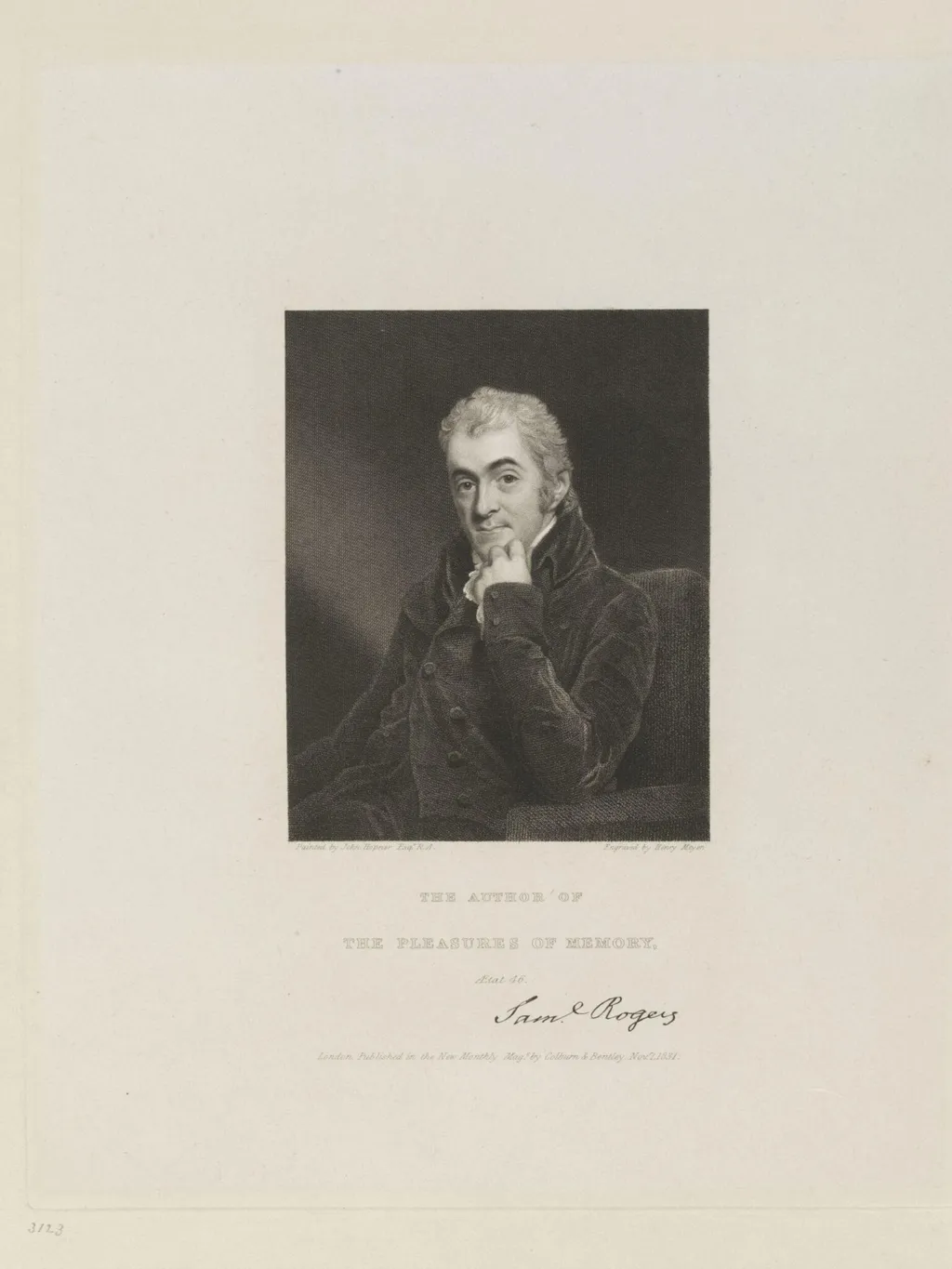
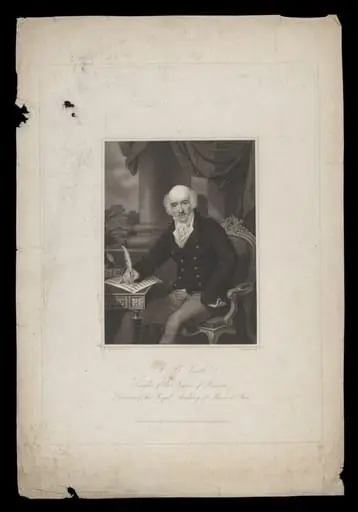
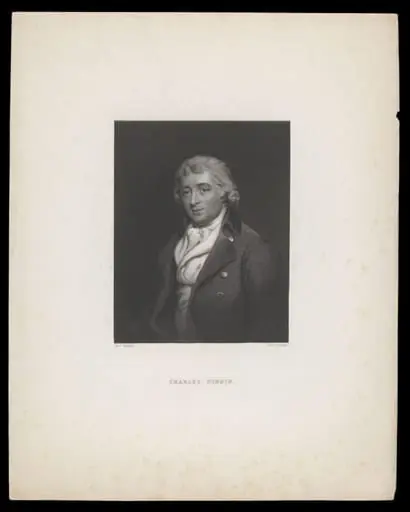
Samuel Rogers, Poet is a print by Henry Meyer. It is held in the collection of the Victoria and Albert Museum. This black-and-white print depicts Samuel Rogers, the English poet, at age forty-six, rendered in profile to the left.
About this work
Overview
The print carries the subtitle identifying him as the author of 'The Pleasures of Memory,' anchoring his identity in his literary work.
This black-and-white print depicts Samuel Rogers, the English poet, at age forty-six, rendered in profile to the left. Created by Henry Meyer, it is a reproductive engraving based on a painting by John Hoppner. The composition isolates Rogers against a dark, unadorned background, emphasizing his contemplative demeanor. The print carries the subtitle identifying him as the author of 'The Pleasures of Memory,' anchoring his identity in his literary work.
Subject & Meaning
Samuel Rogers is portrayed not as a public figure but as an introspective thinker, his hands gently supporting his chin in a pose suggestive of quiet reflection. The absence of symbolic objects or elaborate setting directs attention to his expression, inviting viewers to consider the inner life of the poet. The label referencing his most famous poem reinforces the cultural expectation that literary merit resides in contemplation and intellectual depth.
Technique & Style
Henry Meyer employed engraving techniques to translate Hoppner’s painted portrait into a reproducible print, using fine lines to model form and texture. The monochrome palette enhances the sculptural quality of Rogers’s face, while the plain background eliminates distraction. The precision of the lines captures the texture of his high-collared coat and the subtle contours of his features, reflecting the conventions of 19th-century portrait reproduction.
History & Provenance
The print was produced in the early 19th century as part of a broader effort to disseminate images of notable literary figures. Based on Hoppner’s original portrait, Meyer’s engraving circulated widely, contributing to Rogers’s public recognition. The Victoria and Albert Museum holds an example, indicating its archival significance as a document of literary portraiture and print culture of the period.
Context
During the early 1800s, engraved portraits of poets and writers were commonly published to celebrate intellectual achievement and foster cultural identity. Rogers, a prominent figure in London’s literary circles, was frequently depicted in this manner. Such prints served both as personal mementos and as tools for shaping public perception of authors, linking their image to their written legacy.
Legacy
Though Rogers’s poetry is less widely read today, this print endures as a visual record of how literary figures were visually codified in their time. It exemplifies the role of reproductive engraving in shaping public memory and the intersection of literature and portraiture. The work remains a reference point for understanding the material culture of 19th-century literary celebrity.
Artist & collection