Artwork
Morning, Canonicut Island
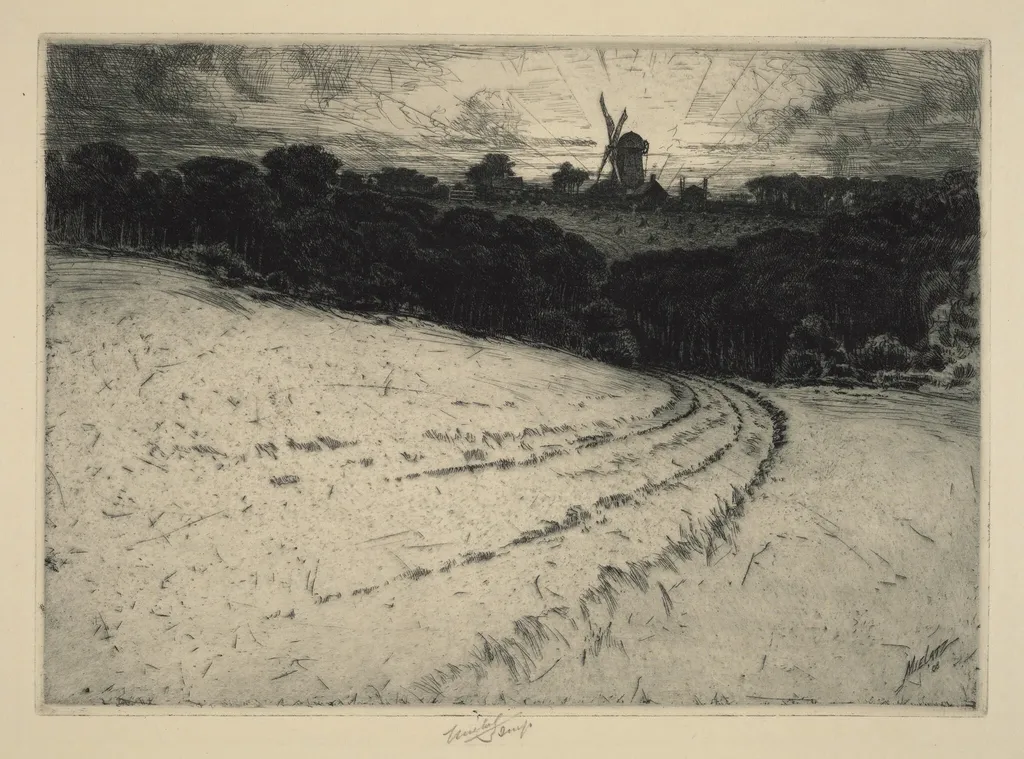
Morning, Canonicut Island is an ink print by Charles Frederick William Mielatz. It dates from 1908 and is held in the collection of the National Gallery of Art.
About this work
Overview
This work exemplifies his technical precision and sustained interest in the interplay between built environments and natural landscapes during the early 1900s.
Charles Frederick William Mielatz produced *Morning, Canonicut Island* in 1908 as an etching, part of his broader engagement with graphic arts. Born in Prussia and active in the United States, he specialized in prints that captured architectural and rural scenes. This work exemplifies his technical precision and sustained interest in the interplay between built environments and natural landscapes during the early 1900s.
Subject & Meaning
The scene depicts a solitary dirt path winding through an open field, leading toward a distant cluster of buildings and a solitary windmill. The absence of human figures and the quiet isolation of the structures suggest a contemplative, early morning atmosphere. The composition emphasizes stillness and solitude, with the landscape appearing untouched and undisturbed, evoking a sense of quiet transition between night and day.
Technique & Style
Mielatz employed traditional etching methods, incising lines into a metal plate with a needle before inking and printing. The sky is rendered with rapid, angular strokes that convey turbulence, while the ground uses irregular, scratchy textures to suggest uneven earth. The contrast between the delicate, linear sky and the dense, tactile terrain highlights his mastery of tonal variation and surface rhythm in intaglio printmaking.
History & Provenance
Created during Mielatz’s mature period in America, the print emerged from a time when etching experienced a revival among American artists. Though specific ownership history is not documented, the work aligns with his broader output exhibited in early 20th-century print societies and galleries, where his architectural subjects were consistently recognized for their technical rigor and atmospheric sensitivity.
Context
In the early 1900s, American printmakers increasingly turned to etching as a medium for personal expression, moving beyond reproduction toward original artistic statements. Mielatz’s focus on rural structures reflected a broader cultural interest in regional identity and the quiet dignity of everyday landscapes, positioning his work within a movement that valued craftsmanship and intimate observation over grand narrative.
Legacy
Mielatz’s etchings, including *Morning, Canonicut Island*, contributed to the recognition of American printmaking as a serious artistic discipline. His precise handling of texture and light influenced later generations of printmakers who sought to capture the subtleties of place through direct, hand-crafted methods. Though less widely known today, his work remains a quiet benchmark in the history of American graphic arts.
Artist & collection

Artist
Charles Frederick William Mielatz
Charles Frederick William Mielatz (né Karl Friedrich Wilhelm Mielatz; May 24, 1864 – July 2, 1919) was a Prussian-born American etcher, graphic artist, painter, lithographer, and educator.

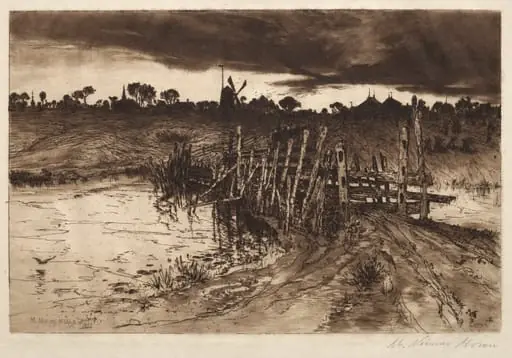 Tween the Gleamin and the Mirk, When the Kye come Hame
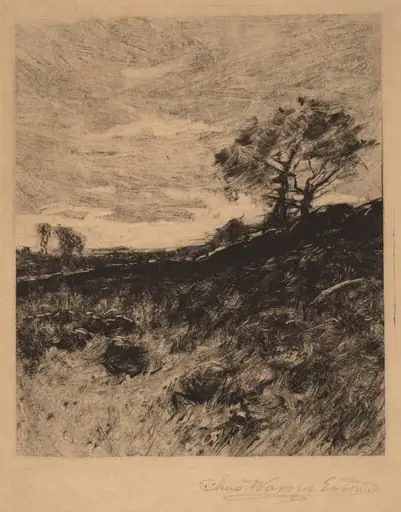 Landscape
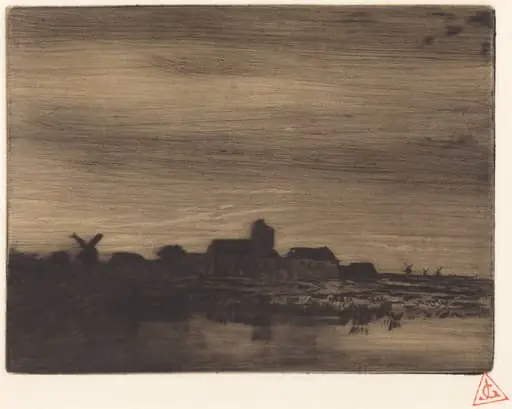 Waterside Village
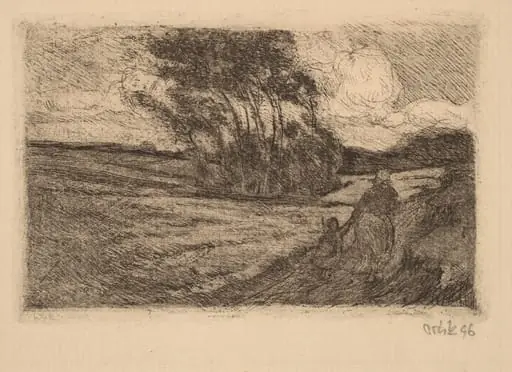 Thunderstorm (Small)
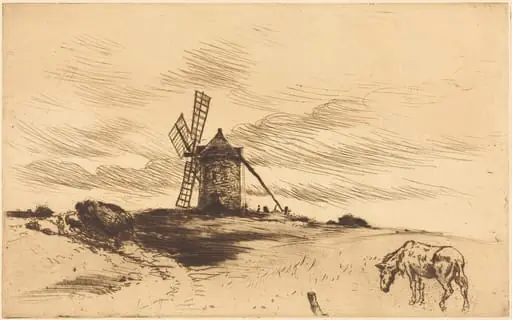 The Mill at Saint Jacut (Le moulin de Saint Jacut)
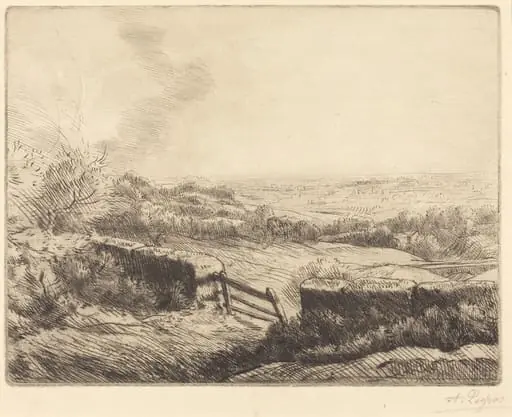 The Gate (L'entree du champ)
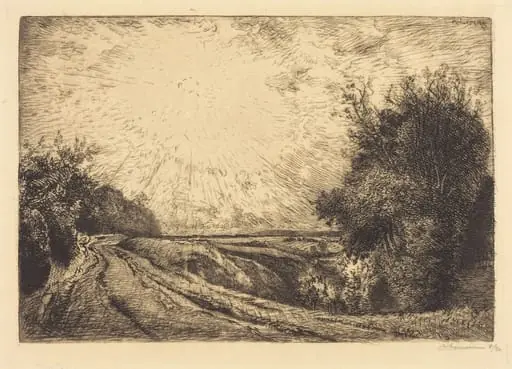 Route from La Houssoye, Crevecoeur-le-Grand (Route de La Houssoye, Crevecoeur)
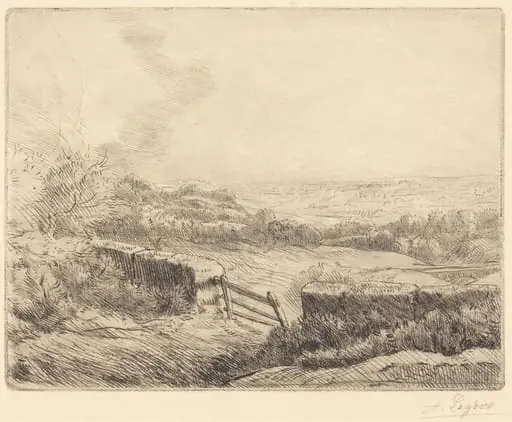 The Gate (L'entree du champ)
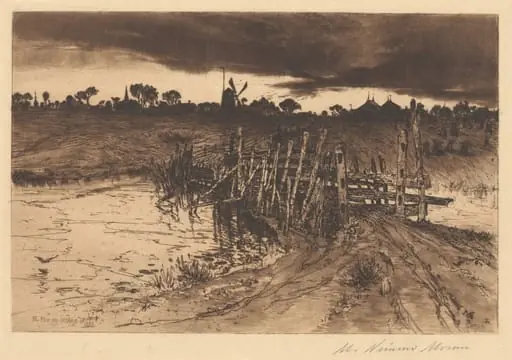 'Tween the Gloaming and the Mirk
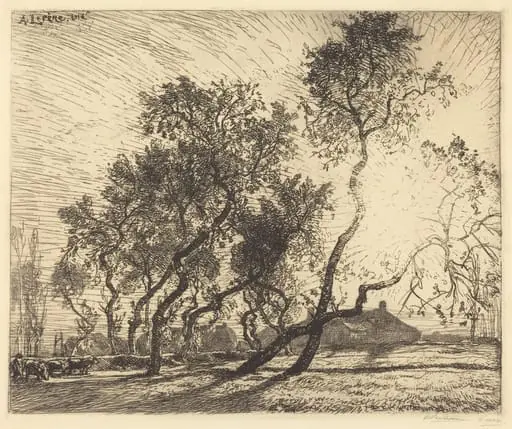 La Ferme aux peupliers de Hollande
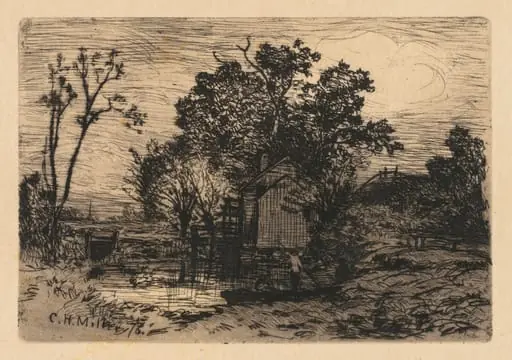 Cottage and Two Figures in a Boat
 Sunset (Le soir (Coucher de soleil))