Artwork
Pescar
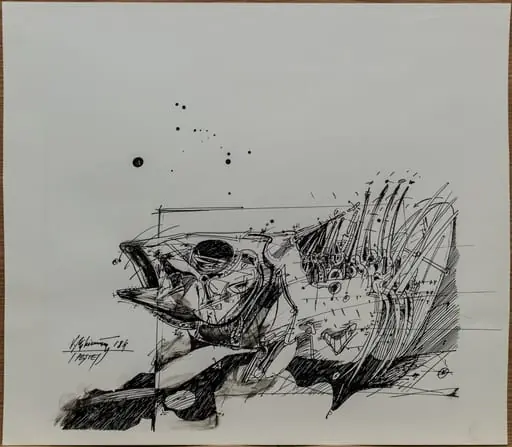
Pescar is a drawing by Vintilă Mihăescu. It dates from 1950 and is held in the collection of the Gavrila Simion Eco-Museum Research Institute Tulcea.
About this work
Overview
Pescar is a small-scale work on brown paper, dated approximately 1950, attributed to Romanian artist Vintilă Mihăescu.
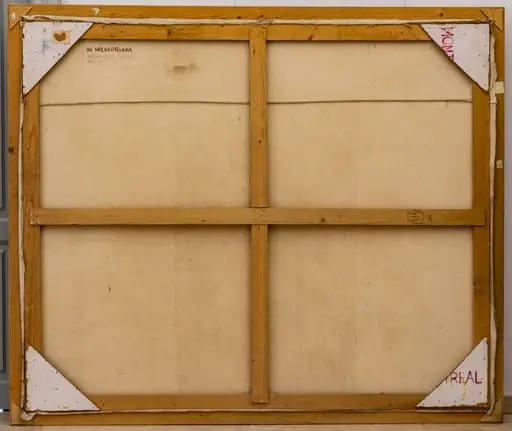
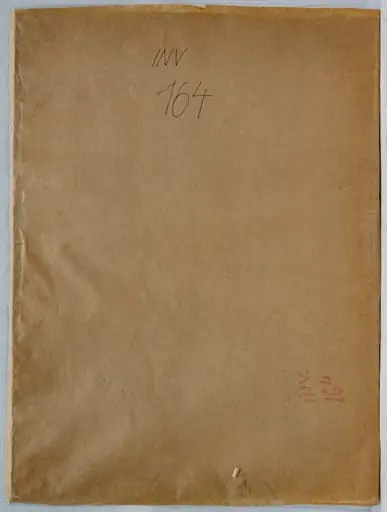
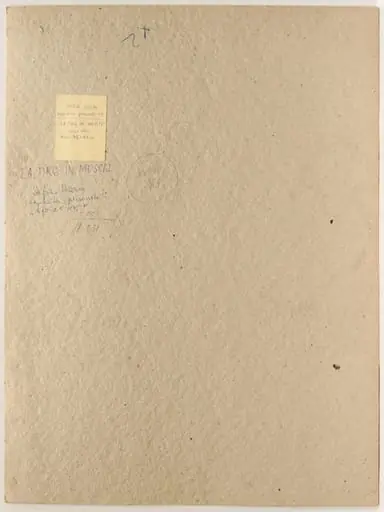
Pescar is a small-scale work on brown paper, dated approximately 1950, attributed to Romanian artist Vintilă Mihăescu. It resides in the collection of the Museum of Ethnography. The surface retains the natural texture of the paper, with a faint sheen suggesting minimal handling or varnish. A barely legible blue inscription appears near the top, while a cursive signature, date, and indistinct markings are located in the lower right corner, indicating a personal or preparatory intent.
Subject & Meaning
The title 'Pescar'—meaning 'fisherman' in Romanian—hints at a thematic focus on labor or rural life, common in Mihăescu’s oeuvre. No figurative elements are discernible in the image, suggesting the work may be an abstract or symbolic study rather than a direct representation. The ambiguity of the inscription and the lack of clear imagery leave the subject open to interpretation, possibly reflecting a moment of observation or memory rather than a finished composition.
Technique & Style
Mihăescu employed simple materials—brown paper and blue ink—to create a restrained, intimate piece. The subtle sheen on the surface implies careful handling, perhaps with a light wash or glaze. The handwriting, though indistinct, reveals a deliberate, personal touch. The absence of bold forms or vibrant color aligns with a contemplative approach, emphasizing materiality and gesture over narrative clarity, consistent with his interest in quiet, observational art.
History & Provenance
The work entered the Museum of Ethnography’s collection after Mihăescu’s lifetime, likely through donation or acquisition from his estate. Its modest scale and informal nature suggest it was not intended for public display during the artist’s lifetime. The presence of a signature and date indicates it was preserved as a personal artifact, possibly among other studies or notes that documented his creative process over time.
Context
Created in the early 1950s, Pescar emerged during a period of state-enforced artistic conformity in Romania. While many artists adapted to socialist realism, Mihăescu maintained a quieter, introspective practice. This work, devoid of ideological messaging, reflects a personal engagement with everyday life and materiality, offering a subtle counterpoint to the dominant public art of the era.
Legacy
Pescar contributes to the understanding of Mihăescu’s private artistic practice, revealing his preference for understated expression over public spectacle. As a fragmentary, intimate object, it underscores the value of sketches and personal notes in tracing an artist’s evolving vision. Its preservation in an ethnographic museum highlights its cultural resonance beyond formal aesthetics, as a record of individual experience within a broader social context.
Artist & collection
Artist
Vintilă Mihăescu made drawings, paintings, and sculpture that often centered on people and daily life by water.
Museum
Gavrila Simion Eco-Museum Research Institute Tulcea
Continue through works from the same source collection.