Artwork
Portret de bărbat cu pălărie
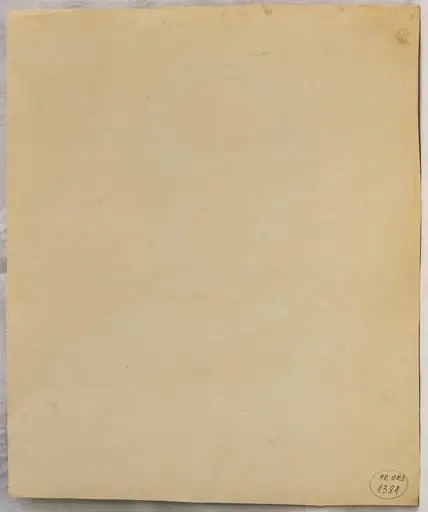
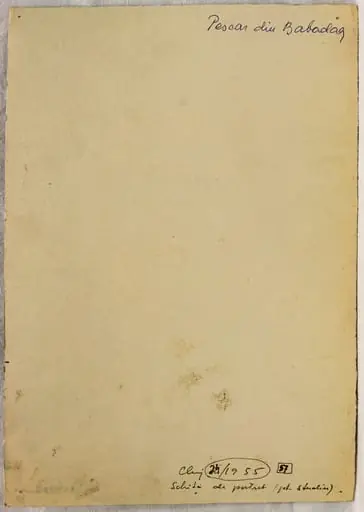
Portret de bărbat cu pălărie is a print by Eugenia Iftodi. It is held in the collection of the Gavrila Simion Eco-Museum Research Institute Tulcea. This is a small, aged sheet of paper, faintly yellowed and frayed at the edges, bearing only a handwritten numeral: 'Nr ord.
About this work
The blankness is the point—this might be an empty frame waiting for something, or a record of a lost work.
This is a faded yellowed sheet of paper with almost nothing on it. There’s a tiny handwritten number in the corner: "Nr ord. 1882." The edges are slightly uneven, and the paper looks old and worn.
The blankness is the point—this might be an empty frame waiting for something, or a record of a lost work. The number suggests it was once filed in an archive.
Next, check out the Museum of Ethnography to see what else they hold.
Overview
This is a small, aged sheet of paper, faintly yellowed and frayed at the edges, bearing only a handwritten numeral: 'Nr ord. 1882.' Its minimal appearance suggests it was never intended as a finished artwork but rather as a placeholder or archival marker. The absence of imagery is deliberate, pointing to a lost or unexecuted portrait once cataloged within a collection.
Subject & Meaning
The work implies the existence of a portrait of a man wearing a hat, now vanished. The number indicates it was part of a systematic inventory, likely used to track artworks in storage or transit. Its emptiness functions as a silent testament to absence—perhaps a record of a piece destroyed, misplaced, or never completed, leaving only its administrative trace.
Technique & Style
No visual composition exists beyond the faint traces of paper aging and the precise, utilitarian handwriting of the catalog number. The material is ordinary archival paper, unadorned and unaltered by artistic intervention. The style is purely documentary, prioritizing identification over aesthetics, reflecting institutional practices rather than creative expression.
History & Provenance
The object likely originated in a private or institutional archive where artworks were numbered for cataloging. Its survival suggests it was retained as part of a record, even after the associated portrait disappeared. The Museum of Ethnography may hold related materials, indicating this fragment was once part of a broader collection of visual and cultural documentation.
Context
In the late 19th century, institutions increasingly systematized their holdings using numbered catalogs. This paper reflects that trend—a mundane artifact of administrative order, not artistic intent. Its survival underscores how archival practices preserve traces of works lost to time, turning bureaucratic remnants into historical clues.
Legacy
As a fragment of an absent work, it invites reflection on the fragility of cultural records. It does not celebrate a lost portrait but rather the systems meant to preserve it. Its quiet presence in a museum collection transforms an administrative slip into a quiet monument to impermanence and the limits of documentation.
Artist & collection
Artist
Eugenia Iftodi made prints and drawings of everyday life in mid-20th-century Romania.
Museum
Gavrila Simion Eco-Museum Research Institute Tulcea
Continue through works from the same source collection.