Artwork
Portrait of a seated woman
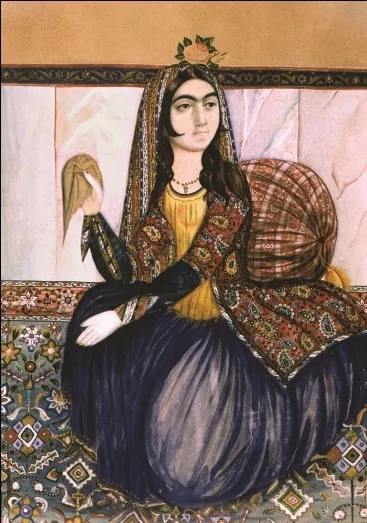
Portrait of a seated woman is an unspecified painting by Mirza Gadim Iravani. It dates from 1870 and is held in the collection of the National Art Museum of Azerbaijan.
About this work
The painting depicts a woman sitting on a patterned rug, wearing a long, dark skirt and a yellow top.
The painting depicts a woman sitting on a patterned rug, wearing a long, dark skirt and a yellow top. She has a headscarf with a floral pattern and is holding a small, round object in her right hand.
The woman's attire and the rug suggest a traditional setting, possibly from the 19th century. The artist's use of color and pattern adds depth to the scene.
To learn more about the artist's style and technique, explore the work of Mirza Gadim Iravani.
Overview
Painted in 1870 by Mirza Gadim Iravani, this portrait captures a seated woman in a quiet, intimate moment. Iravani, an Azerbaijani artist trained in Persian miniature traditions, applied his expertise in fine detail and decorative patterning to this work. Though modest in scale, the painting reflects his broader practice of blending regional aesthetics with the refined techniques of courtly illustration, often commissioned under Russian imperial patronage in the Caucasus.
Subject & Meaning
The woman is depicted seated on a richly patterned rug, dressed in a dark skirt and a yellow upper garment, her head covered by a floral-print scarf. She holds a small, round object—possibly a fruit, a mirror, or a vessel—suggesting domesticity or ritual. Her composed posture and direct gaze convey quiet dignity. The setting, devoid of overt narrative, emphasizes personal presence over storytelling, aligning with the introspective tone common in 19th-century regional portraiture.
Technique & Style
Iravani employed fine brushwork and layered pigments to render textures with precision: the weave of the rug, the sheen of fabric, and the delicate lines of the headscarf’s floral motif. His palette is restrained yet nuanced, with warm yellows and deep earth tones creating visual harmony. The composition follows miniature traditions—flat perspective, emphasis on surface decoration, and careful attention to ornamental detail—while avoiding the exaggerated stylization of earlier Persian models.
History & Provenance
Created during a period of Russian administrative influence in the Caucasus, the painting likely originated from Iravani’s work for local elites, possibly linked to the Erivan Sardar’s Palace. It entered institutional collections in the 20th century, now held in the National Art Museum of Azerbaijan, the Art Museum of Georgia, and the Hermitage. These holdings reflect its recognition as a representative example of Azerbaijani artistic production under imperial patronage.
Context
In the late 19th century, Azerbaijani artists like Iravani navigated shifting cultural landscapes, maintaining Persian-derived visual languages while adapting to new political realities under Russian rule. His work bridged courtly miniature traditions and emerging secular portraiture. This portrait, though not overtly political, embodies the quiet persistence of local aesthetics amid broader imperial frameworks, offering insight into the daily lives of women in regional elite circles.
Legacy
Iravani’s portraits, including this one, are studied as key examples of transitional 19th-century Caucasian art. They preserve techniques and visual codes that might otherwise have faded under modernization. His influence is evident in later Azerbaijani artists who sought to reconcile traditional craftsmanship with contemporary representation. The painting’s presence in major regional museums underscores its role in documenting a distinct cultural moment.
Artist & collection
Artist
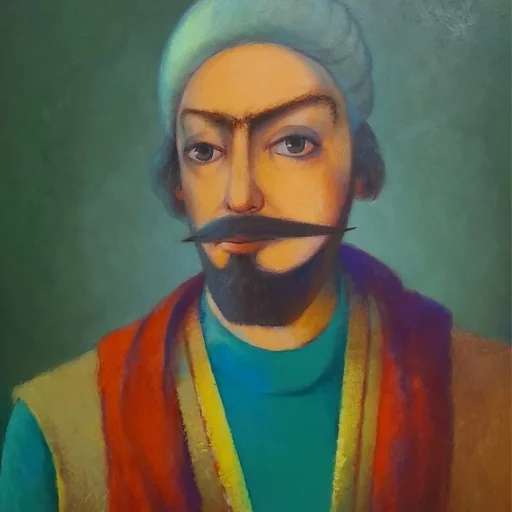
Mirza Kadym Irevani was a ornamentalist artist and portraitist, whose work mostly consisted of typical Persian miniatures and lacquers.

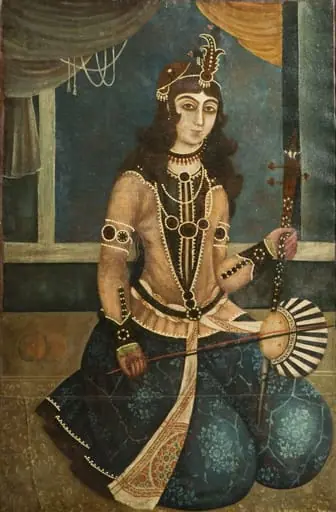 Woman playing a <i>kamānchah</i>
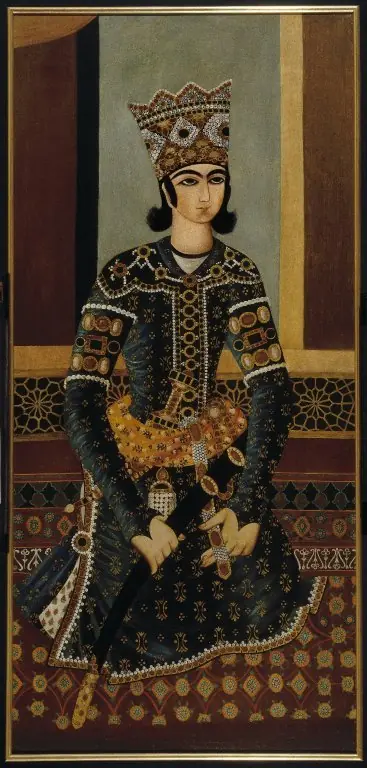 Seated Prince
 Untitled
 Portrait of a Prince (Possibly Mohammad Mirza)
 Head of a Beauty
 Bani Thani
 Untitled
 Personaj citind o scrisoare
 Officer of the Guards
 A European Woman Pouring Wine into a Cup
 A Qajar prince and his attendant
 Portrait of Âdile Hanim, a Turkish woman from Constantinople