Artwork
A Rustic Bridge
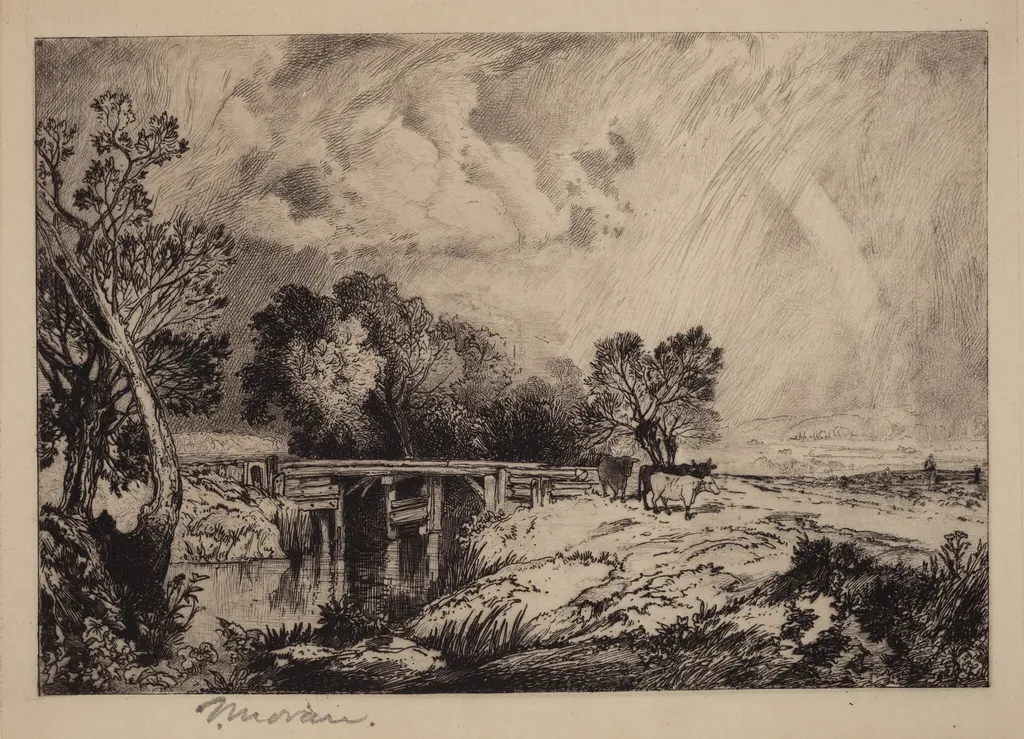
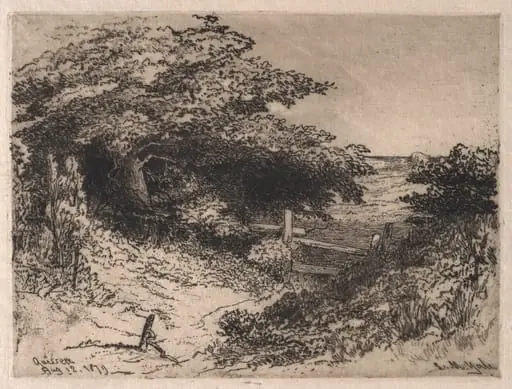
A Rustic Bridge is an ink print by the Impressionist artist Thomas Moran. It dates from 1879 and is held in the collection of the National Gallery of Art.
About this work
Overview
Thomas Moran produced *A Rustic Bridge* in 1879 as a black etching, reflecting his engagement with printmaking alongside his better-known landscape paintings.
Thomas Moran produced *A Rustic Bridge* in 1879 as a black etching, reflecting his engagement with printmaking alongside his better-known landscape paintings. Though associated with the Hudson River School, this work departs from his grand western vistas, focusing instead on a quiet rural scene. Created during his tenure as an illustrator for *Scribner’s Monthly*, the piece exemplifies his technical precision and sensitivity to natural detail in smaller-scale works.
Subject & Meaning
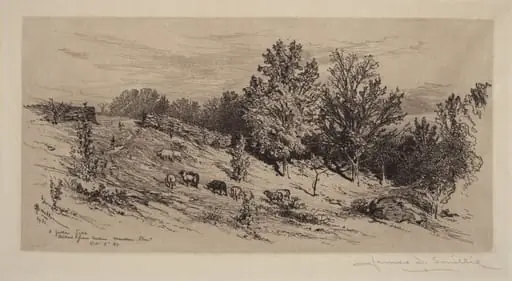
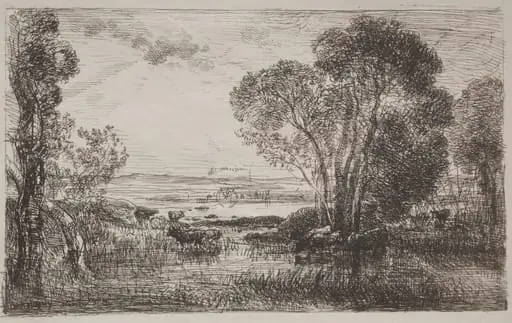
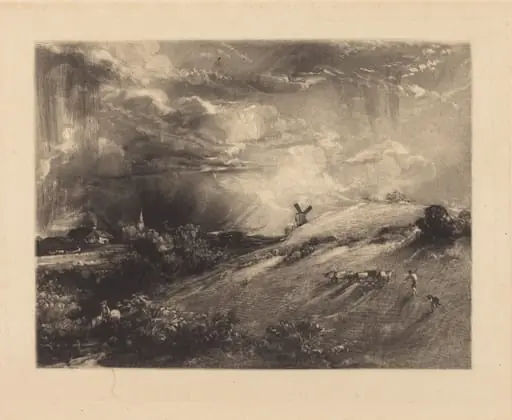
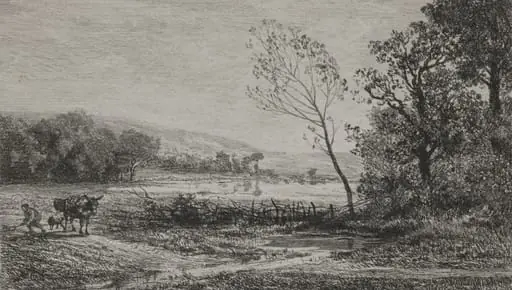
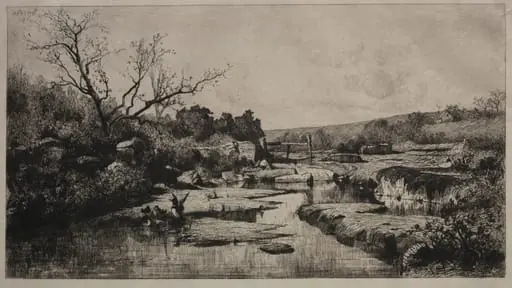
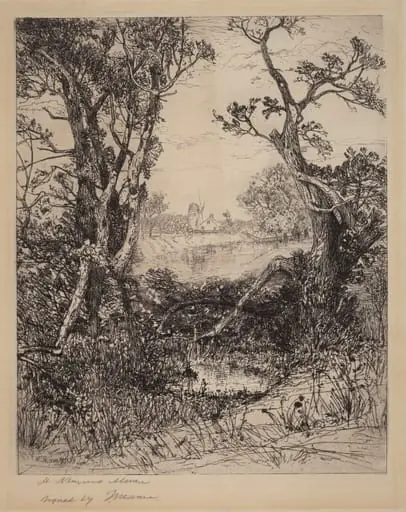
The etching depicts a modest wooden bridge crossing a still stream, flanked by dense vegetation and framed by gentle hills. A few cattle graze in the far distance, suggesting pastoral life without intrusion. The absence of human figures enhances the sense of solitude, while the careful arrangement of elements conveys a quiet harmony between land and water. The scene evokes contemplation rather than narrative, inviting stillness rather than awe.
Technique & Style
Moran employed fine, controlled lines typical of etching to build texture in foliage, water, and earth. Varied line density and cross-hatching create subtle gradations of light and shadow, lending depth to the shallow space. The composition avoids dramatic contrast, favoring muted tones and soft transitions that reinforce the scene’s tranquility. His hand reveals the influence of 19th-century topographical drawing, refined into a lyrical, intimate mode.
History & Provenance
Created during Moran’s active years in New York, the etching emerged from a period when he and his wife, Mary Nimmo Moran, were both producing prints. Though not widely exhibited at the time, it was likely circulated among collectors of American prints. The work remains part of a broader body of Moran’s graphic output, distinct from his oil paintings but equally reflective of his observational discipline and love for the American landscape.
Context
In the late 1870s, American artists increasingly turned to printmaking as a means of reaching broader audiences and exploring intimate subjects. Moran’s shift from large-scale western panoramas to modest rural scenes mirrored a growing interest in domesticated nature. His studio environment, shared with his brother Edward and wife Mary, fostered a collaborative atmosphere where print techniques were refined and exchanged among family artists.
Legacy
While less celebrated than his monumental western views, *A Rustic Bridge* exemplifies Moran’s versatility and his commitment to capturing quiet moments in nature. The etching contributes to the recognition of American printmaking as a legitimate artistic medium in the late 19th century. It remains a quiet testament to his ability to convey serenity through disciplined draftsmanship, influencing later generations of landscape printmakers.
Own this work as a print
Artist & collection
Artist
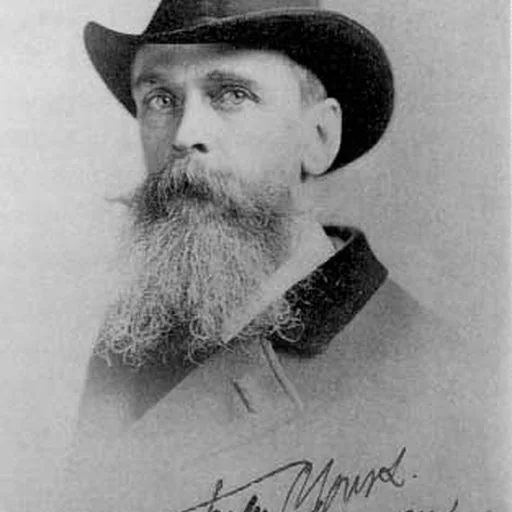
Thomas Moran (February 12, 1837 – August 25, 1926) was an American painter and printmaker of the Hudson River School in New York whose work often featured the Rocky Mountains.