Artwork
Judah Giving Tamar the Pledge
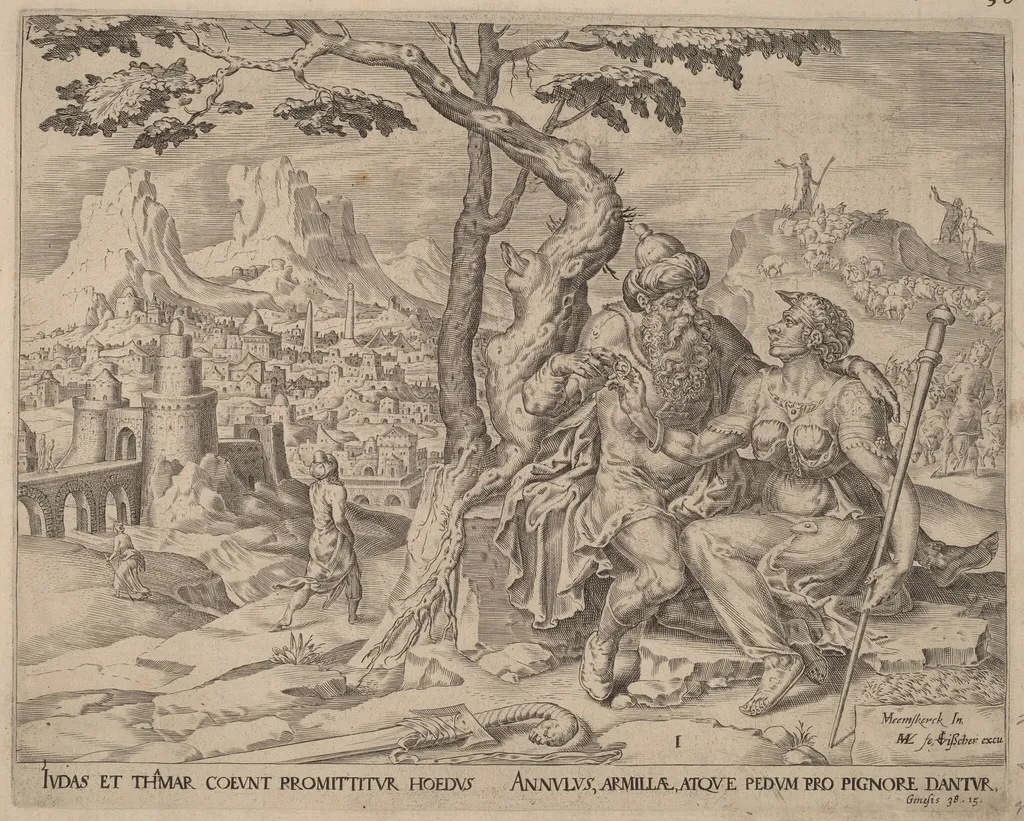
Judah Giving Tamar the Pledge is an ink print by the Renaissance artist Herman Jansz Muller. It dates from 1566 and is held in the collection of the National Gallery of Art.
About this work
Overview
The composition is tightly focused on two central figures beneath a gnarled tree, with a distant urban landscape and a solitary figure on a hill adding depth.
This engraving, dated around 1566, is the work of Dutch artist Herman Jansz Muller. Executed in fine linear detail typical of Renaissance printmaking, it depicts a moment from the biblical story of Judah and Tamar. The composition is tightly focused on two central figures beneath a gnarled tree, with a distant urban landscape and a solitary figure on a hill adding depth. Latin inscriptions at the base reference the narrative’s theme of pledged obligation.
Subject & Meaning
The scene illustrates Judah, disguised as a roadside stranger, handing Tamar his seal and staff as a pledge for her services. Unaware of her identity, he unknowingly fulfills a moral duty later revealed in Genesis. The kneeling posture of Tamar and Judah’s guarded gesture convey tension between deception and impending revelation. The lone figure on the hill may symbolize divine witness, reinforcing the story’s moral weight.
Technique & Style
Muller employed fine, controlled lines to render texture and form, characteristic of Northern European engraving traditions. The tree’s bark, Judah’s staff, and the distant city’s architecture are rendered with meticulous precision. Delicate cross-hatching defines fabric folds and facial features, while the background recedes through diminishing detail. The small scale enhances the intimacy of the moment, inviting close inspection.
History & Provenance
Created in the mid-16th century, the print likely circulated among collectors and religious audiences in the Low Countries. Muller, active in Amsterdam, produced biblical scenes for both devotional and educational use. No definitive early ownership records survive, but similar engravings from his workshop appear in institutional collections, suggesting modest but steady distribution during the Reformation era.
Context
In the decades after the Protestant Reformation, biblical narratives were frequently depicted in prints to educate lay audiences. Muller’s work aligns with a broader trend of visual storytelling drawn from the Old Testament, often emphasizing moral ambiguity and divine justice. The inclusion of Latin text reflects the scholarly culture of the time, where literacy and religious knowledge intersected in printed media.
Legacy
Though not widely known today, Muller’s engraving exemplifies the quiet influence of Dutch printmakers in disseminating biblical stories during the 16th century. Its technical precision and narrative restraint reflect a preference for understated drama over theatricality. The work remains a modest but valuable artifact of how religious texts were visually interpreted for private contemplation in early modern Europe.
Artist & collection


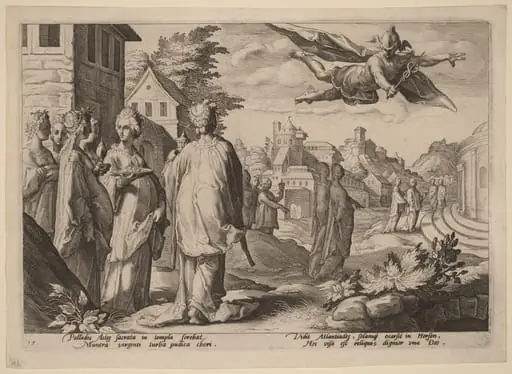 Mercury Falling in Love with Herse
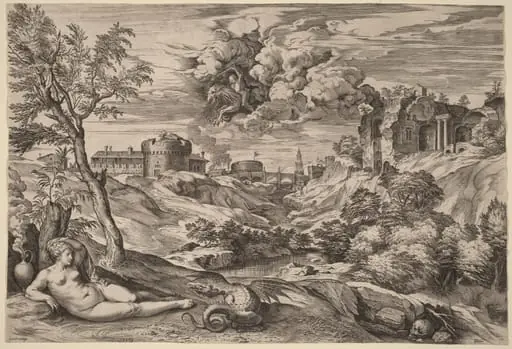 Landscape with Roger Liberating Angelica
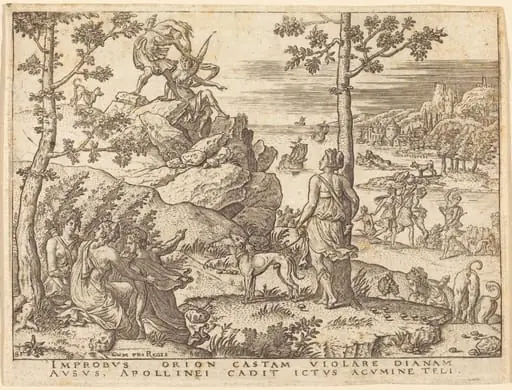 Orion Killed by Apollo
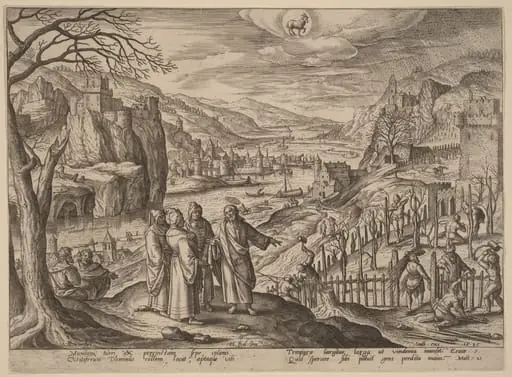 The Parable of the Two Sons and the Unjust Husbandmen
 Thisbe Frightened by the Lion
 Clymene Urging Phaeton to Find Helios
 Landscape with Roger Liberating Angelica
 The Baptism of Christ
 God Appearing to Moses
 The Parable of the Barren Fig Tree
 Allegory of Life