Artwork
Orion Killed by Apollo
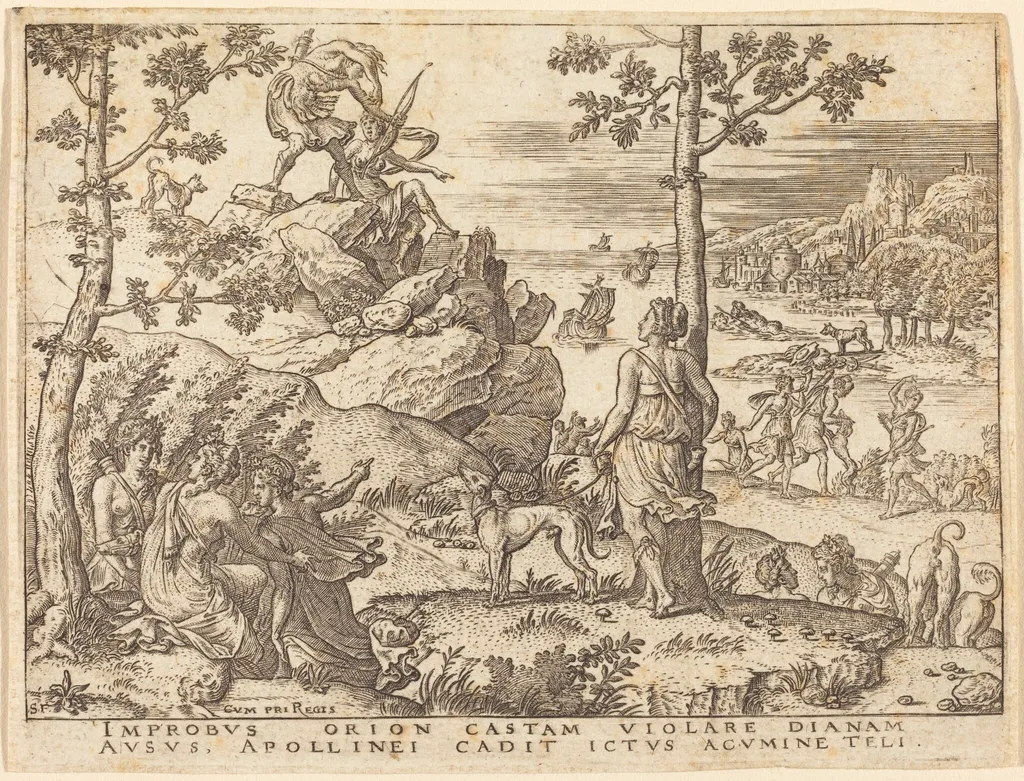
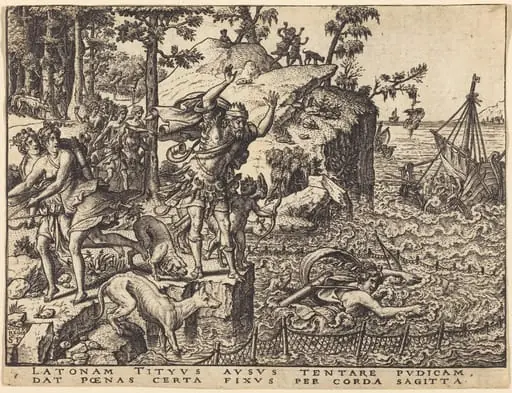
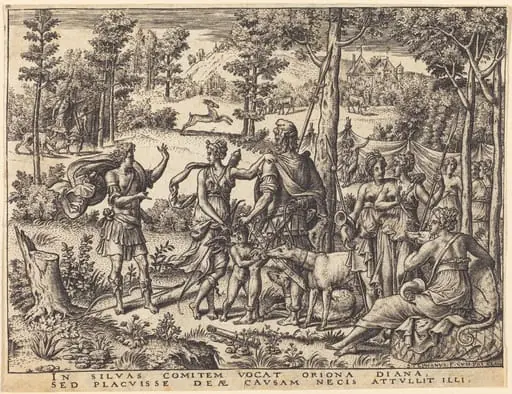
Orion Killed by Apollo is an ink print by the Renaissance artist Etienne Delaune. It dates from 1551 and is held in the collection of the National Gallery of Art. Created in 1551 by Étienne Delaune, this engraving illustrates a moment from Greek myth in which Orion, the hunter, meets his end.
About this work
Overview
Delaune’s use of cross-hatching gives the scene a sense of weight and spatial depth, characteristic of Northern Mannerist printmaking of the mid-16th century.
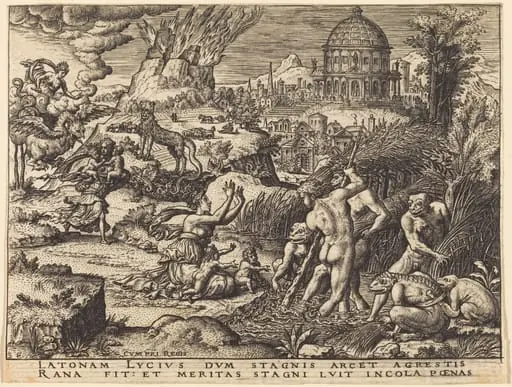
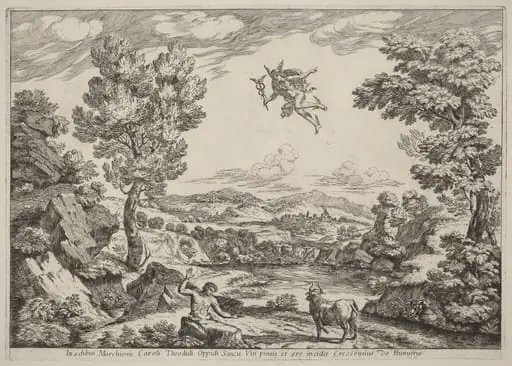
Created in 1551 by Étienne Delaune, this engraving illustrates a moment from Greek myth in which Orion, the hunter, meets his end. Rendered in fine linear detail, the work belongs to a tradition of Renaissance prints that translated classical narratives into visual form. Delaune’s use of cross-hatching gives the scene a sense of weight and spatial depth, characteristic of Northern Mannerist printmaking of the mid-16th century.
Subject & Meaning
The scene depicts Orion, fallen and lifeless, with a dog positioned over his body—a symbol of loyalty or perhaps his own hunting companion. In the background, a distant city suggests the realm of mortals, contrasting with the divine intervention implied by Apollo’s unseen presence. The moment captures the myth’s tragic turn: Orion’s death, often attributed to Apollo’s jealousy or divine retribution, is rendered not as action but as stillness, emphasizing fate’s inevitability.
Technique & Style
Delaune employed meticulous engraving techniques, using fine, intersecting lines to model form and suggest texture. The foreground figures are sharply defined, while the background cityscape recedes through diminishing detail and lighter lines. The composition avoids overt motion, instead focusing on stillness and emotional gravity. This controlled precision reflects the influence of Italian draftsmanship filtered through French Mannerist sensibilities.
History & Provenance
The engraving was produced during Delaune’s time in Paris, where he worked for the French court and produced designs for goldsmiths and printmakers. It likely circulated among educated collectors interested in classical themes. No early ownership records are widely documented, but its survival in multiple museum collections suggests it was valued for its technical skill and mythological subject matter in the late Renaissance.
Context
In mid-16th century France, mythological subjects were favored by humanist patrons seeking to align contemporary art with antiquity. Delaune’s work emerged alongside a surge in printed illustrations of classical texts, often used as models for other artists. His engravings bridged Italian compositional ideals and Northern European attention to detail, contributing to a broader European visual language rooted in classical narrative.
Legacy
Though not widely known today, Delaune’s engravings influenced later generations of printmakers through their refined line work and narrative restraint. 'Orion Killed by Apollo' exemplifies how mythological themes were adapted for private contemplation rather than public display. Its preservation in institutional collections underscores its role as a quiet but significant artifact of Renaissance print culture.
Artist & collection