Artwork
Untitled
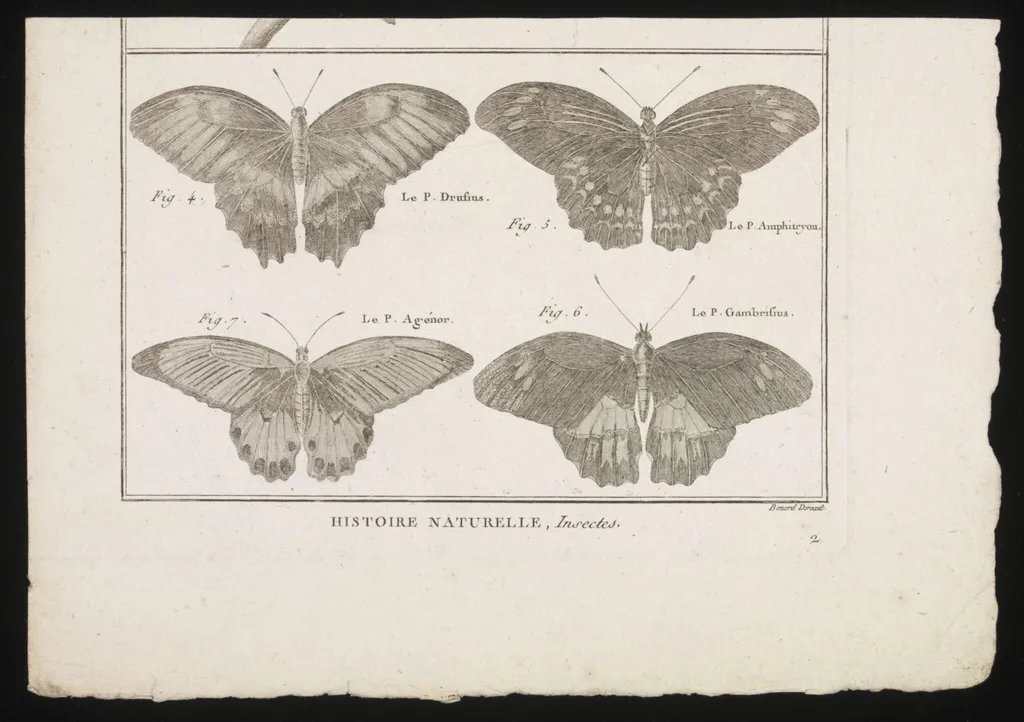
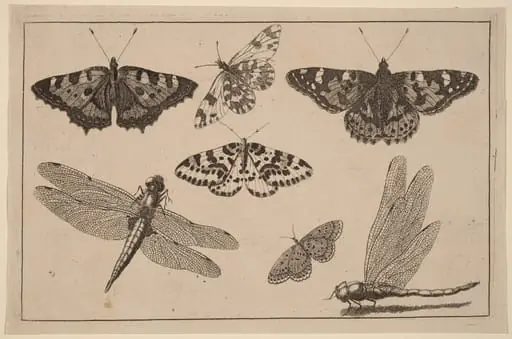
Untitled is a print by the Romanticist artist Charles-Joseph Panckoucke. It dates from 1784 and is held in the collection of the Victoria and Albert Museum.
About this work
Overview
The image was trimmed from its original context, leaving only the central composition surrounded by a narrow border.
This 1784 print by Charles-Joseph Panckoucke features four butterfly illustrations in black and white, originally part of a larger plate from the *Encyclopédie méthodique*. The image was trimmed from its original context, leaving only the central composition surrounded by a narrow border. Each specimen is labeled with a Latinized name, reflecting the scientific naming conventions of the period. The print belongs to a broader effort to systematically document natural history through engraved illustrations.
Subject & Meaning
The four butterflies—labeled Le P. Drusius, Le P. Amphitryon, Le P. Agénor, and Le P. Gambrisius—are depicted from a top-down perspective, emphasizing wing structure and patterning. Their names suggest classification within Linnaean taxonomy, though the designations are not modern scientific ones. The inclusion of fine vein lines and spot details indicates an intent to aid identification and comparison, aligning with Enlightenment-era goals of cataloging biodiversity with precision.
Technique & Style
Rendered in fine-line engraving, the butterflies are rendered with meticulous attention to anatomical detail. Delicate hatching mimics wing textures and venation, while subtle tonal variations suggest surface sheen without color. The composition is orderly and restrained, devoid of background elements, focusing attention solely on the specimens. This clinical presentation reflects the era’s preference for clarity and objectivity in scientific illustration.
History & Provenance
The print derives from Panckoucke’s *Encyclopédie méthodique*, a vast Parisian publishing project begun in 1782 to update and expand Diderot’s earlier encyclopedia. Issued in installments over decades, it included volumes on natural history, with entomology as a key section. This sheet was likely part of a folio intended for academic or institutional use, later separated and trimmed, as was common when plates were removed for binding or display.
Context
In the late 18th century, natural history was a dominant intellectual pursuit, with entomology gaining particular interest due to the diversity and beauty of insects. Scientific illustration served as a vital tool for communication among scholars across Europe. Panckoucke’s work contributed to this movement, providing accessible visual references that supported classification efforts and public engagement with emerging biological sciences.
Legacy
Though the specific names assigned to these butterflies are no longer in use, the print remains a representative artifact of Enlightenment-era scientific practice. Its precision and restraint reflect a broader cultural shift toward empirical observation. Surviving examples are held in institutional collections, where they continue to inform studies on the history of science and the evolution of biological documentation.
Artist & collection
Artist
A Paris-based printer in the 1780s, Charles-Joseph Panckoucke turned political and social scenes into crisp etchings.

 Moth, Butterflies, and Bees
 Five Butterflies and a Moth
 Swallow-tailed Butterfly and Twelve Other Insects
 Untitled
 Three Butterflies and Two Moths
 Muscarum Scarabeorum, vermiumque Variae Figure & Formae: A Moth, Three Butterflies and Two Beetles
 Five Butterflies, a Moth, a Beetle, and a Spider
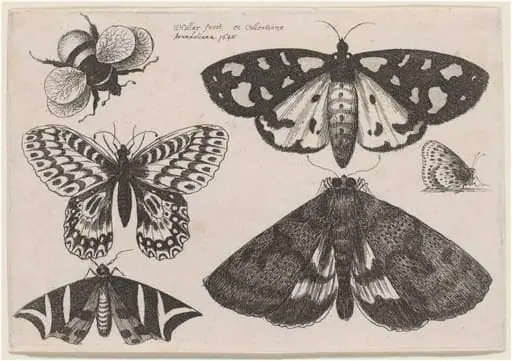 Three Moths, Two Butterflies, and a Bumble Bee
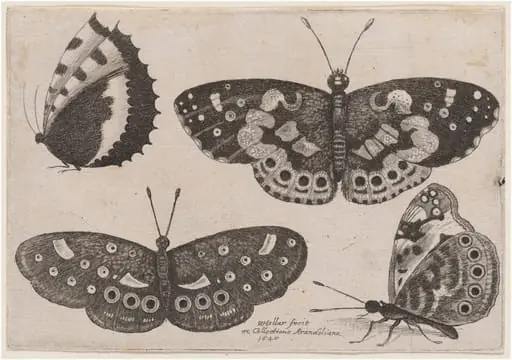 Four Butterflies
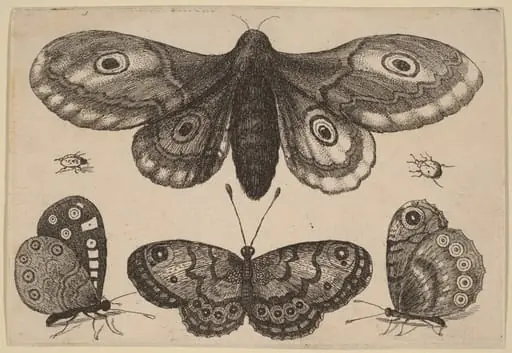 Moth, Three Butterflies, and Two Beetles
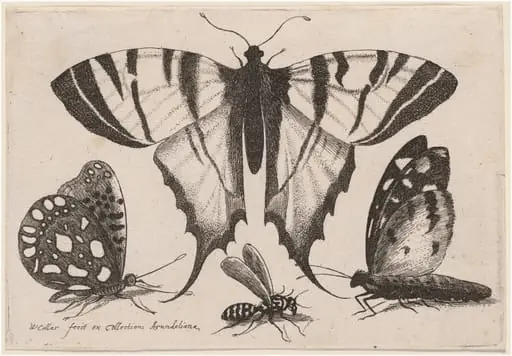 Two Butterflies, a Wasp, and a Moth
 Two Dragonflies and Five Butterflies