Artwork
Five Butterflies, a Moth, a Beetle, and a Spider
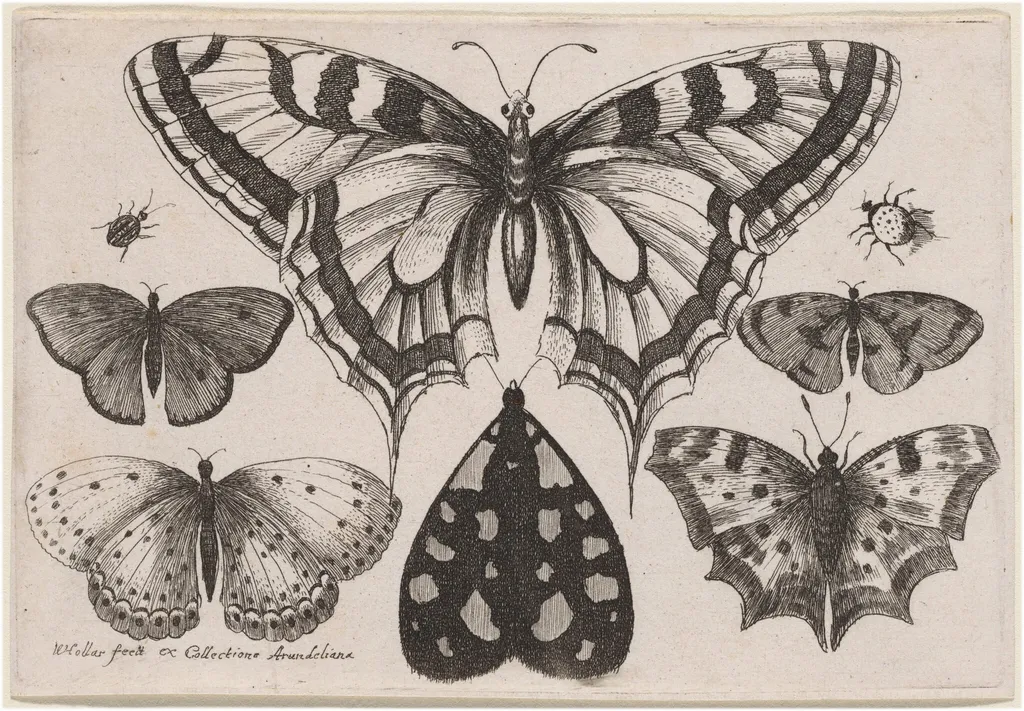
Five Butterflies, a Moth, a Beetle, and a Spider is an ink print by the Baroque artist Wenceslaus Hollar. It dates from 1646 and is held in the collection of the National Gallery of Art.
About this work
Overview
Created in 1646 by Wenceslaus Hollar, this etching presents a meticulous arrangement of six insects and a spider on slender branches.
Created in 1646 by Wenceslaus Hollar, this etching presents a meticulous arrangement of six insects and a spider on slender branches. Executed in black ink on laid paper, the work belongs to a series of natural studies Hollar produced during his time in England. Though best known for topographical prints, he devoted considerable attention to the precise rendering of small creatures, capturing their forms with scientific care and aesthetic restraint.
Subject & Meaning
The composition features five butterflies, each with distinct wing patterns—dotted, striped, or barred—alongside a moth with feathery antennae, a beetle, and a spider. Positioned on fragile twigs, the insects appear suspended in quiet observation. The arrangement suggests an interest in biodiversity and taxonomy, reflecting 17th-century curiosity about the natural world, though no overt symbolic meaning is evident beyond the celebration of minute biological detail.
Technique & Style
Hollar employed etching, a method involving acid-resistant grounds and incised metal plates, to achieve fine, controlled lines. The inked grooves produce crisp, delicate contours that define each insect’s wings, legs, and body segments with remarkable clarity. The absence of shading or tone emphasizes linear precision, aligning the work with the tradition of scientific illustration while maintaining an understated compositional elegance.
History & Provenance
Hollar, a Czech artist active in England from the 1630s, produced this print during a period of intense naturalist inquiry in Europe. Likely made for private collectors or scholarly circles, the etching was part of a broader trend of documenting flora and fauna. Its survival in multiple institutional collections indicates early recognition of its technical merit, though it was never widely disseminated as a commercial print.
Context
In mid-17th-century Europe, detailed natural studies gained traction among intellectuals and aristocrats fascinated by the microcosm. Hollar’s work aligns with contemporaries like Jan van Kessel and Maria Sibylla Merian, who combined artistic skill with observational rigor. This print reflects the era’s growing appetite for empirical representation, where art served as a tool for recording nature’s complexity without idealization.
Legacy
Though not among Hollar’s most famous works, this etching endures as an example of his versatility and precision. It contributes to the historical record of early scientific visualization, demonstrating how printmaking could bridge art and natural philosophy. Its quiet intensity continues to attract study among historians of science and print, valued for its restraint and fidelity to form.
Artist & collection
Artist
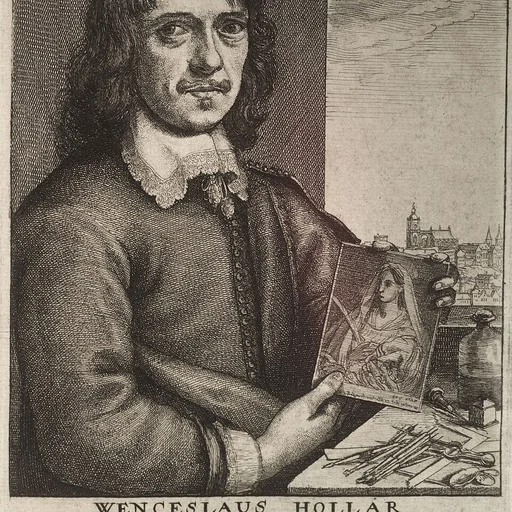
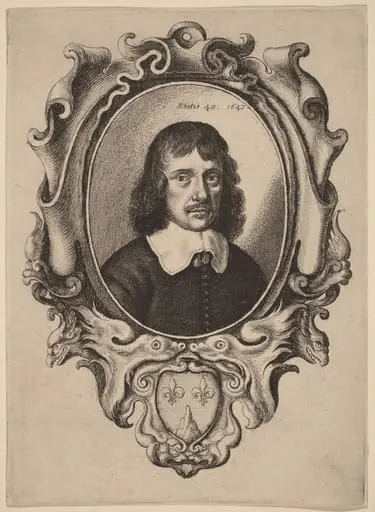
Wenceslaus Hollar (Czech: Václav Hollar (Czech pronunciation: ), German: Wenzel Hollar; 23 July 1607 – 25 March 1677) was a Czech engraver, etcher and painter.


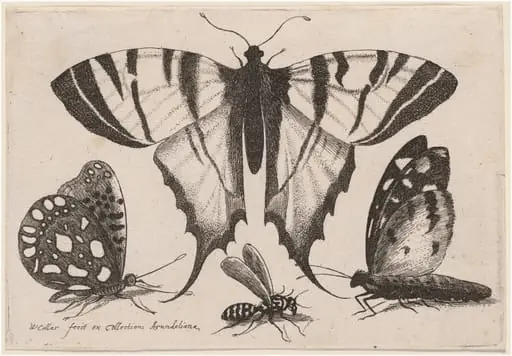 Two Butterflies, a Wasp, and a Moth
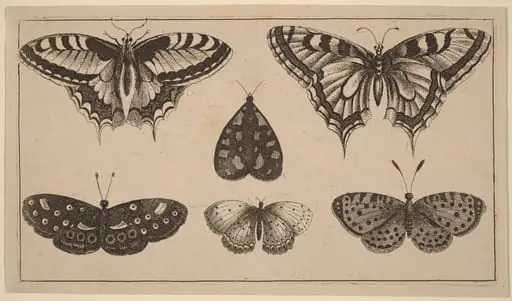 Five Butterflies and a Moth
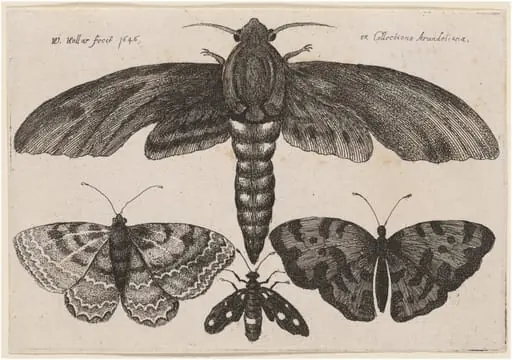 Moth and Three Butterflies
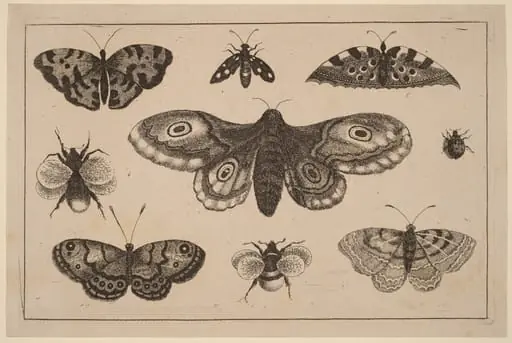 Moth, Butterflies, and Bees
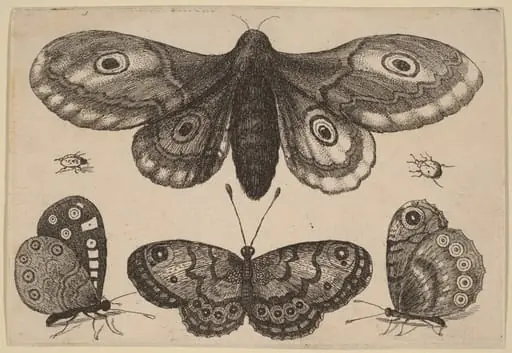 Moth, Three Butterflies, and Two Beetles
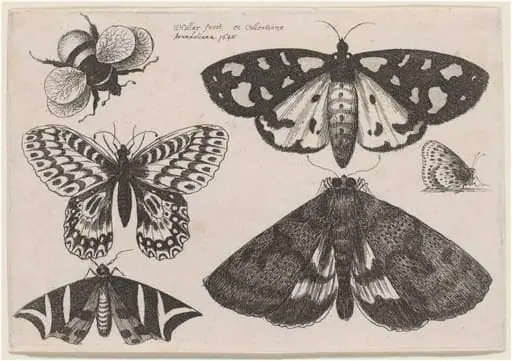 Three Moths, Two Butterflies, and a Bumble Bee
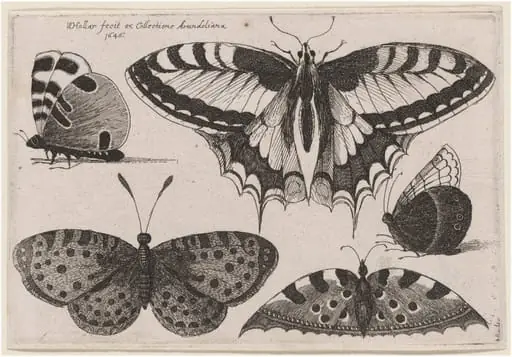 Three Butterflies and Two Moths
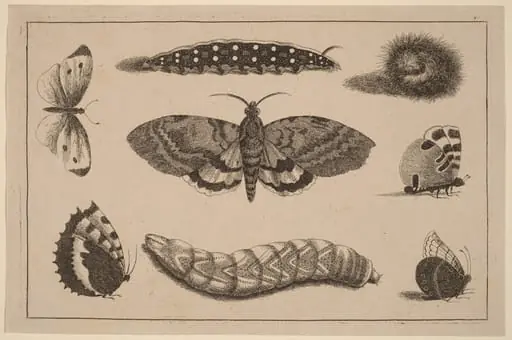 Three Caterpillars, a Moth, and Four Butterflies
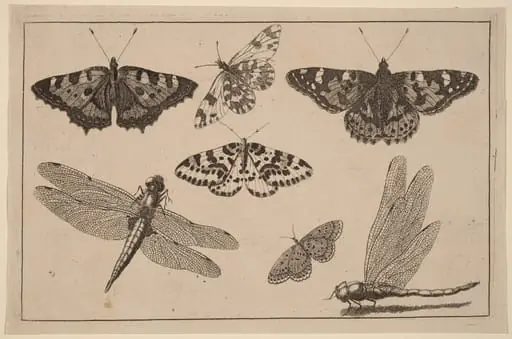 Two Dragonflies and Five Butterflies
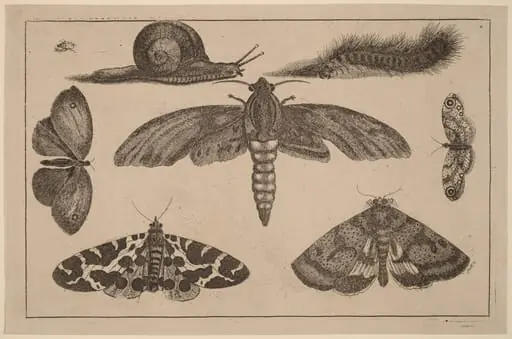 Six Insects, a Caterpillar, and a Snail
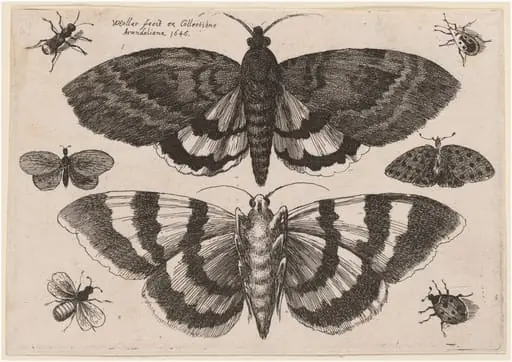 Two Moths and Six Insects