Artwork
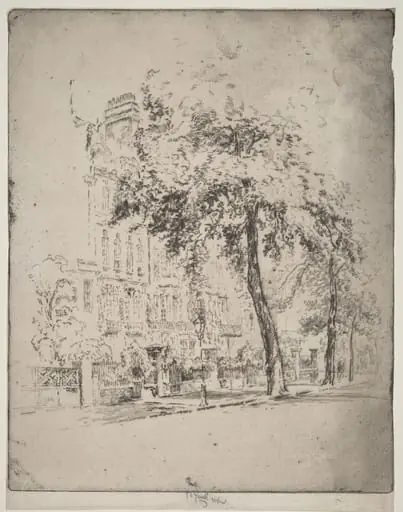
House Where Whistler Died
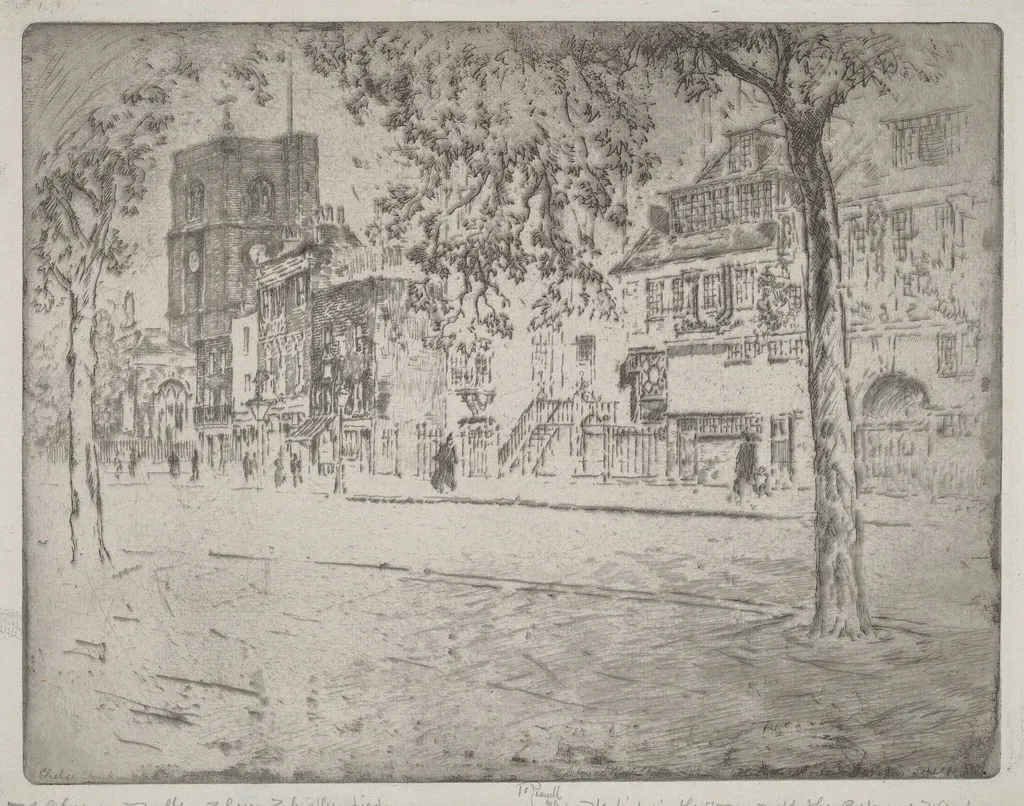
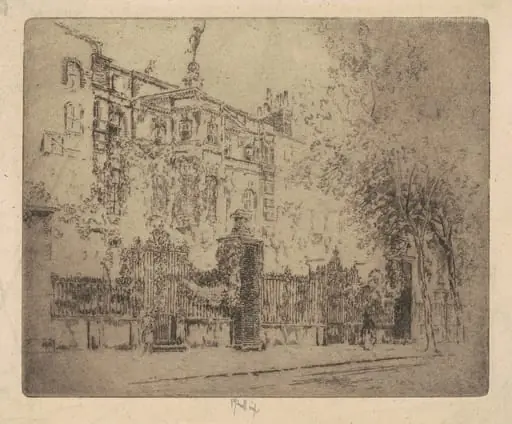
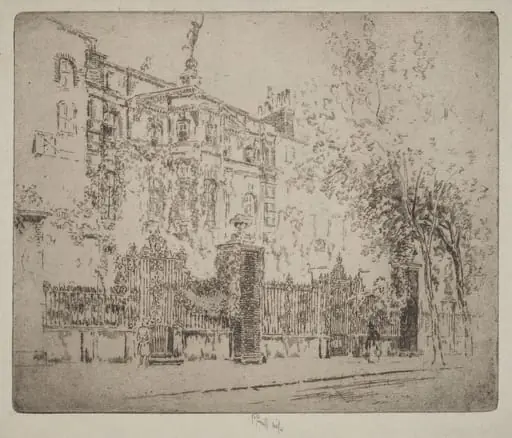
House Where Whistler Died is an ink print by Joseph Pennell. It dates from 1904 and is held in the collection of the National Gallery of Art.
About this work
This etching shows a plain brick house with a single light on in a second-floor window.
The artist, Pennell, made this after Whistler died there in 1903. He used a drypoint needle to scratch fine lines into the metal plate, then inked it by hand.
It’s a quiet piece. Look up the National Gallery of Art, Washington to see more of Pennell’s work.
Overview
Pennell, himself a printmaker deeply influenced by Whistler, chose to record the building’s unadorned facade with precision and restraint.
Joseph Pennell’s 1904 etching captures the modest London residence where James McNeill Whistler passed away in 1903. Executed shortly after Whistler’s death, the work is a quiet tribute, focusing not on grandeur but on the ordinary architecture of a home linked to a revered artist. Pennell, himself a printmaker deeply influenced by Whistler, chose to record the building’s unadorned facade with precision and restraint.
Subject & Meaning
The subject is a plain brick house in Chelsea, its only human trace a single illuminated window on the second floor. Pennell avoids dramatization, instead presenting the structure as a silent witness to Whistler’s final days. The image functions as a memorial, not through symbolism but through attentive observation—transforming an ordinary dwelling into a site of artistic memory.
Technique & Style
Pennell employed drypoint etching, using a needle to incise fine, textured lines directly into a metal plate. The resulting print retains the intimacy of hand-drawn marks, with subtle tonal variations achieved through controlled ink application. His style favors clarity and quiet detail over dramatic contrast, reflecting Whistler’s own emphasis on tonal harmony and understated composition.
History & Provenance
Pennell created the etching in 1904, shortly after Whistler’s death at 86 Cheyne Walk. The work was part of Pennell’s broader practice of documenting places connected to influential artists and cultural figures. It entered the collection of the National Gallery of Art, Washington, where it remains as part of a significant group of Pennell’s urban and architectural prints.
Context
In early 20th-century London, etching experienced a revival among artists seeking to capture the modern city with personal, intimate vision. Pennell, aligned with this movement, viewed architecture as a record of cultural life. His depiction of Whistler’s home fits within a tradition of memorializing artistic legacy through place, rather than portraiture or narrative.
Legacy
The etching endures as a quiet testament to the relationship between two American artists in exile. Pennell’s choice to record Whistler’s residence rather than his likeness underscores a belief in the significance of environment to artistic identity. The work continues to be studied for its restrained aesthetic and its role in the history of American printmaking.
Own this work as a print
Artist & collection
Artist
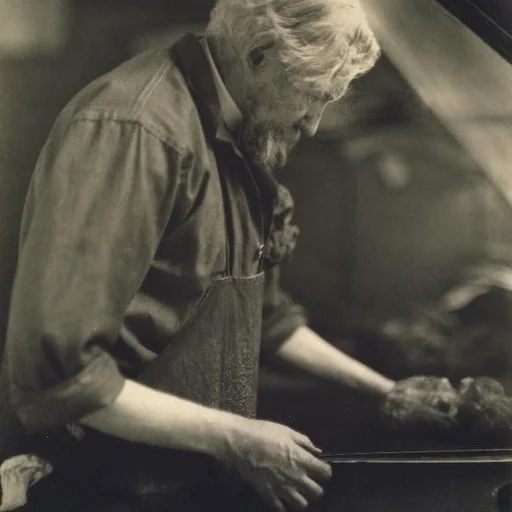
Joseph Pennell (July 4, 1857 – April 23, 1926) was an American draftsman, etcher, lithographer, and illustrator for books and magazines.