Artwork
LĂUTARUL

LĂUTARUL is a print by Alexandru Phoebus. It dates from 1933 and is held in the collection of the National Museum of Art of Romania.
About this work
Overview
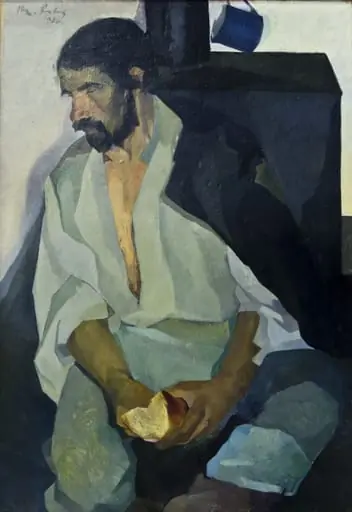
The composition focuses tightly on the subject’s upper body and face, eliminating extraneous detail to emphasize psychological presence.
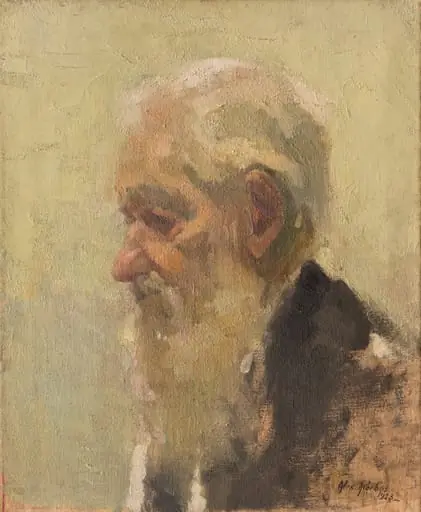
LĂUTARUL, painted in 1933 by Alexandru Phoebus, is a portrait of an elderly Romani musician. Rendered in oil on canvas, the work captures a solitary figure in a restrained, contemplative pose. The composition focuses tightly on the subject’s upper body and face, eliminating extraneous detail to emphasize psychological presence. The muted palette and soft modeling contribute to an atmosphere of quiet dignity.
Subject & Meaning
The figure is identified as a lăutar, a traditional Romanian Romani violinist, whose role carried cultural weight as both entertainer and keeper of folk memory. His aged features—deep wrinkles, lowered gaze, and stillness—suggest a life shaped by experience and solitude. The absence of instrument or context invites interpretation beyond performance, framing him as a symbol of inner resilience and quiet endurance.
Technique & Style
Phoebus employs a subdued, tonal approach with thin layers of oil paint to model form subtly. The background, a neutral earth tone, recedes to isolate the figure. Brushwork is deliberate but unobtrusive, emphasizing texture in the beard and fabric without ornamentation. Light falls gently across the face, enhancing the contours of age and the gravity of expression, aligning the work with interwar realist traditions in Eastern Europe.
History & Provenance
Created during a period of heightened interest in Romanian folk identity, LĂUTARUL emerged from Phoebus’s engagement with rural communities. The painting remained in private Romanian collections until the late 20th century, with no public exhibition record prior to the 1980s. Its current location is documented in institutional archives, though its early ownership history remains partially unverified.
Context
In 1930s Romania, artists increasingly turned to ethnographic subjects as part of a national cultural project. Romani figures were often depicted as emblematic of authenticity, though rarely with psychological depth. Phoebus’s portrayal diverges by avoiding romanticization; instead, it presents the lăutar with unadorned humanity, reflecting broader shifts toward introspective portraiture in interwar Eastern European art.
Legacy
LĂUTARUL is recognized as one of Phoebus’s most restrained and emotionally resonant works. While not widely reproduced, it has influenced later Romanian painters interested in marginalized subjects rendered with dignity. Its quiet intensity continues to be referenced in academic discussions on identity and representation in interwar Romanian art, particularly in relation to Romani visibility.
Artist & collection


 Peisaj 1
 Peisaj 2
 Peisaj cu deal
 PORTRET DE FEMEIE
 Bătrân cu chelie (Apostolul Petru)
 Cariera de piatră
 PORTRETUL AUROREI VORVOREANU
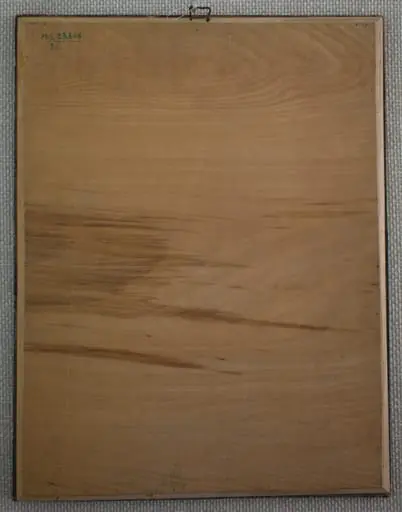 Icoana, întâlnită foarte rar, fiind și o reprezentare a temei "Facerea lumii". Primii oameni, Adam și Eva, în picioare lângă pomul Cunoștinței binelui și răului(care formează axa verticală a compoziției), după ce Adam a căzut la rândul lui în ispită și a mușcat din fructul oprit, devenind conștienți de goliciunea lor trupească. Au mijlocul înconjurat de cununi de frunze verzi. Adam ține o mână ridicată la piept cu cealaltă vrea să-și acopere goliciunea. Eva îi intinde mărul lui Adam, tiparul vrând să redea simultan succesiunea momentelor. Chipurile sunt expresive, redate din ușor semiprofil, privirea lui Adam îndreptată către mâna Evei. Părul lung, negru, lăsat pe umeri, Adam are mustață mică și barbă scurtă, trăsăturile anatomice schițate, chiar și ombilicul. Eva are sânii mari, una dintre pupilele ochilor lipsește. Pomul, cu tulpină conică, plasat ușor asimetric, coroana cu câteva ramuri subțiri cu frunze verzi și fructe roșii. Șarpele de culoare verde, este încolăcit pe tulpină, cu capul întors în dreptul coroanei. dispusă în arcadă, încadrează scena. Câmpul împărțit de o arcadă de flori roșii și verzi, în interior bleu, alb în exterior. Partea de jos- alb, între personaje încercându-se o alternanță cromatică. Rama profilată - patru stinghii îmbinate oblic, pictată cu negru. Dosul este realizat din placaj(a fost probabil înlocuit).
 Peisaj la Calica
 Compoziție 5
 Portrait of a man