Artwork
Busby's Church, Willen
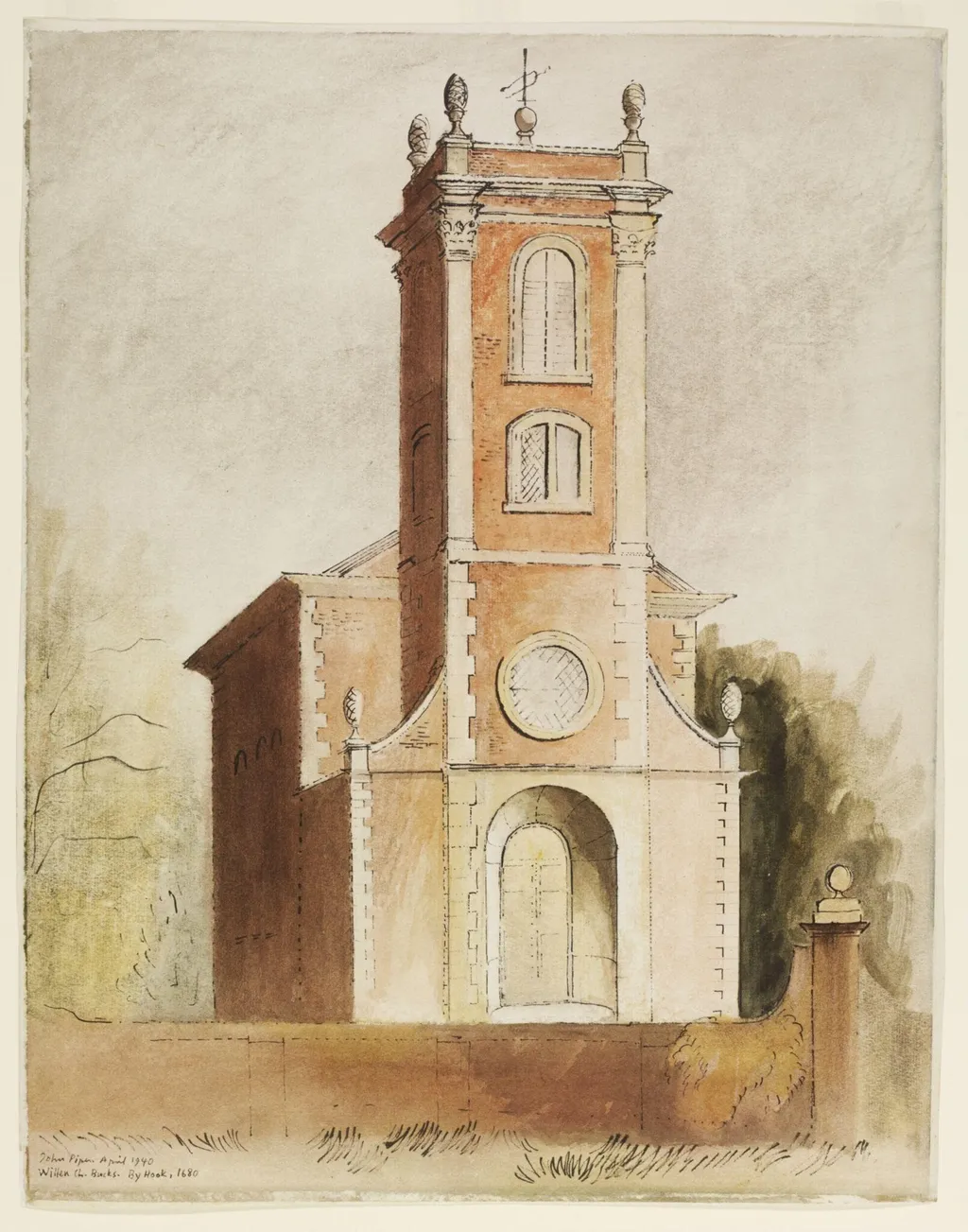
Busby's Church, Willen is a watercolor work on paper by Piper. It dates from 1940 and is held in the collection of the Victoria and Albert Museum.
About this work
Overview
Executed in delicate watercolour, the piece serves as a quiet record of a rural landmark at risk from conflict and modernization.
John Piper created this watercolour in 1940 as part of the *Recording Britain* project, a government-backed effort to visually archive the nation’s architectural heritage during wartime. The work captures St. Mary Magdalene Church in Willen, Buckinghamshire, with attention to its distinctive brick tower and pineapple-shaped finials. Executed in delicate watercolour, the piece serves as a quiet record of a rural landmark at risk from conflict and modernization.
Subject & Meaning
The church, dedicated to St. Mary Magdalene, is rendered with emphasis on its west tower—a structure marked by red brickwork and a weather vane. The pineapple finials, unusual for English ecclesiastical architecture, suggest regional craftsmanship and historical layering. Surrounded by trees and open ground, the building appears isolated yet enduring, embodying a sense of continuity amid the uncertainty of wartime Britain.
Technique & Style
Piper employed soft, fluid brushwork to convey the texture of brick and the dappled foliage around the church. The watercolour medium allows for subtle gradations of tone, lending the scene a hazy, atmospheric quality. Delicate washes suggest light filtering through leaves, while restrained detail keeps the focus on form and mood rather than precision, aligning with the project’s emotional rather than documentary aims.
History & Provenance
Commissioned by the Pilgrim Trust under Sir Kenneth Clark’s direction, the painting was produced during the early years of the Second World War. The *Recording Britain* initiative sought to preserve visual records of sites vulnerable to bombing or urban renewal. Piper’s work entered the project’s archive, later held by the Victoria and Albert Museum, ensuring its preservation as part of a national cultural inventory.
Context
Created during a period of national anxiety over cultural loss, the painting reflects a broader effort to safeguard Britain’s vernacular architecture. Rural churches like Willen’s were seen as symbols of continuity and local identity. Piper’s choice to highlight the tower’s unique finials underscores an interest in overlooked architectural details that might vanish without record.
Legacy
The painting remains part of the *Recording Britain* collection, a significant archive of wartime artistic documentation. Piper’s contribution helped define a generation of British artists engaged with heritage preservation. Today, the work continues to inform studies of wartime cultural policy and the role of art in national memory.
Artist & collection
Artist
A 1940s British artist known for delicate watercolours of country houses, churches, and riverside views, Piper captured quiet corners of England in soft washes and fine lines.

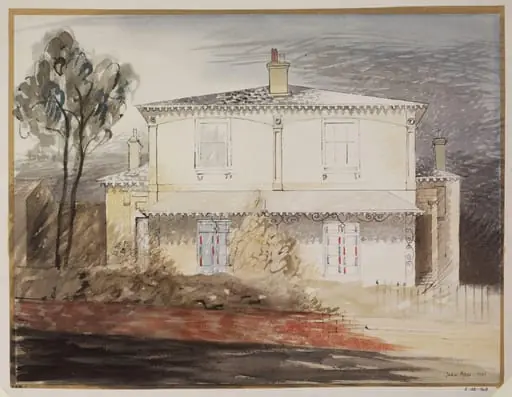 A House, Maidenhead
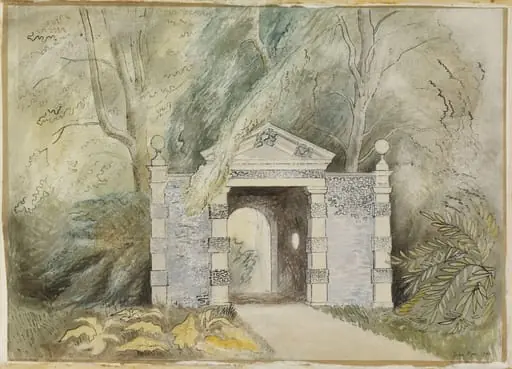 The river approach, Fawley Court
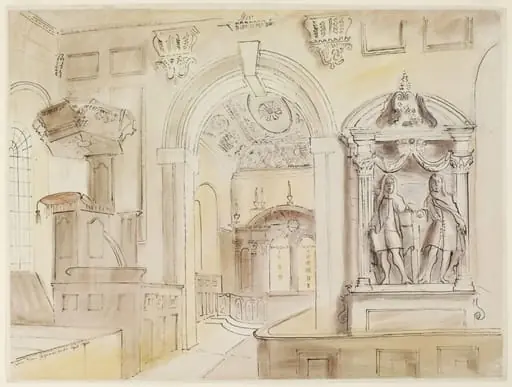 Interior of St. Peter's Church, Gayhurst
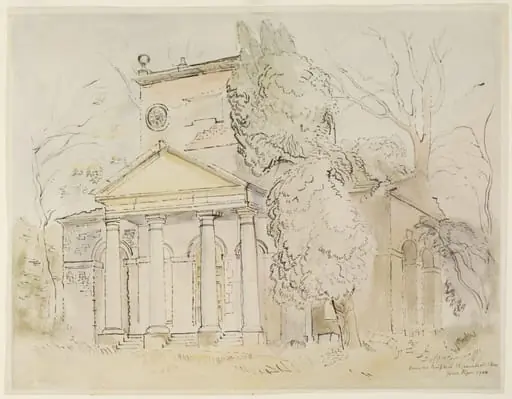 The Ruined Temple of Friendship in the Grounds at Stowe
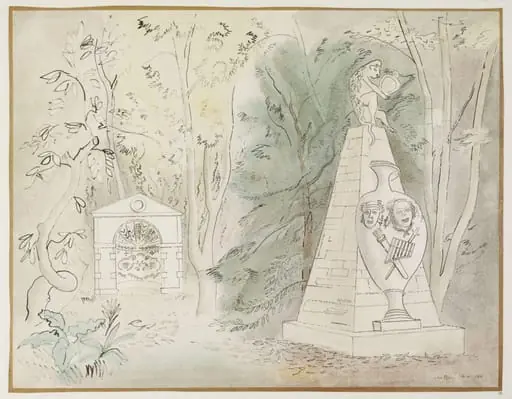 Congreve Monument (designed by Wm. Kent) and Shell Grotto, Stowe
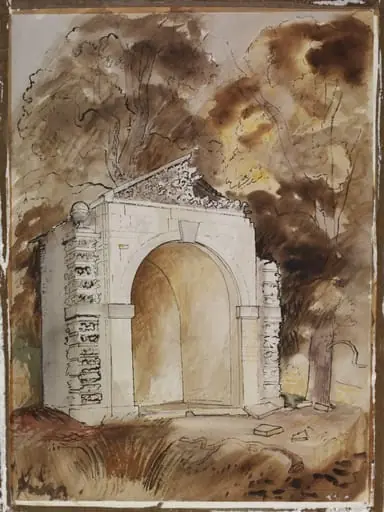 The Duck House in the Park of Buckland House near Faringdon
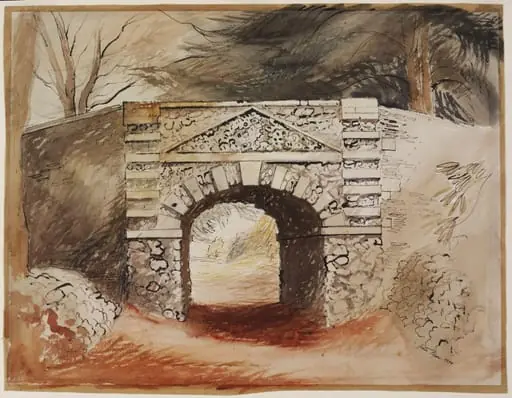 The Tunnel in the grounds of Buckland House, near Faringdon
 Dashwood Mausoleum, West Wycombe
 Chevet de St. Martin-sur-Renelle (The Apsis of the Church of St. Martin-sur-Renelle)
 Garden House
 Church of St Michel, Vaucelles, near Bayeux
 Untitled
![Tower of a Fortified House [recto], by Friedrich Salathé](https://artifactworldgallery.com/img/friedrich-salathe--tower-of-a-fortified-house-recto--123693842ba6a52f-w320.webp) Tower of a Fortified House [recto]
Tower of a Fortified House [recto] Gresham Church
 Church near Ladye Place
 Parti af St. Hans' kirke i Odense
 Ruined Church
 East Hanningfield Church, Essex
 Church by a Road